
Building a rota manually is a lost cause. You’re juggling staff availability, service user preferences, travel time, skill requirements, contracted hours, and last-minute sickness cover, all at once, often on a spreadsheet that was not designed for any of this.
Care rota software has matured significantly over the past few years, and the gap between what a good system can do and what spreadsheet-based rostering produces has grown wider. This article covers what to look for in care rota software in 2026, what features are now standard versus genuinely differentiating, and where providers most commonly make mistakes when choosing a platform.
What Baseline Features Every Care Rota System Must Have
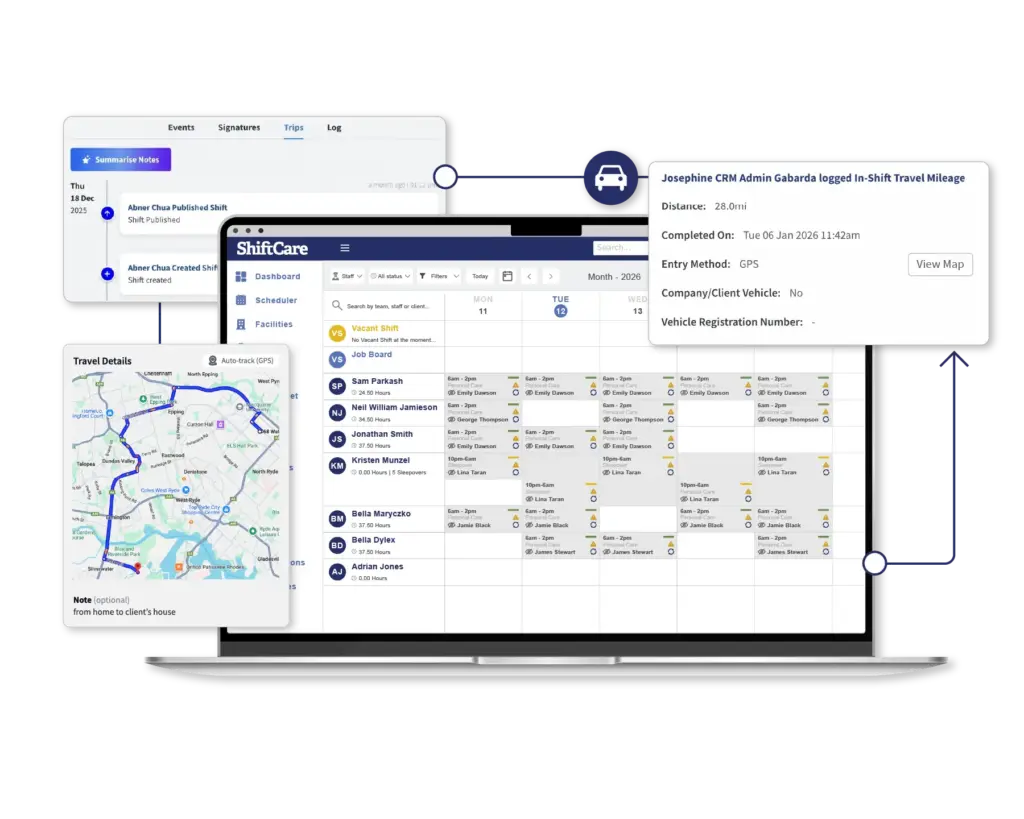
Additionally, some features are no longer differentiators. They are the baseline. Any care rota software you evaluate in 2026 should include the following without needing to be asked.
Furthermore, shift templates and recurring patterns are essential. The ability to build shift patterns that repeat automatically, with variations by day of week or service type, eliminates the rote work of recreating the same structure every scheduling period.
However, staff availability management needs to allow workers to input their availability through a mobile app and flag preferred and unavailable periods. Rotas built without visibility of actual availability produce the conflicts that generate most of the last-minute phone calls that waste management time.
Consequently, automated conflict detection should flag when a proposed shift creates an issue: a double-booking, a rest period violation, a skills mismatch, an expired qualification, or a situation where a worker is being rostered beyond their contracted hours. If the software does not flag these automatically, the manager has to catch them manually. Some will be missed.
As a result, mobile access for care workers is non-negotiable. Staff need to see their shifts, receive updates, confirm attendance, and flag concerns from their phones. Systems that require a desktop login for care workers are building in a communications gap that creates operational problems.
What Features Separate Good Rota Software from Adequate Software
In practice, beyond the baseline, several features now separate the better platforms from the adequate ones.
For example, travel time optimisation has become increasingly important for domiciliary care providers. Scheduling software that uses location data to minimise travel time between visits. That flags when a schedule will require a care worker to travel an unrealistic distance in a short window, reduces both the strain on care workers and the risk of late arrivals that affect service quality.
Importantly, real-time visibility for managers means seeing the current state of the rota as it is being worked, not as it was published. Software that shows which care workers have clocked in, which visits are currently in progress. Which have not started as expected gives managers the information they need to respond quickly to emerging problems rather than discovering them after the fact.
Notably, integration with payroll matters more than many providers initially appreciate. When confirmed shifts flow automatically to payroll calculation without manual re-entry, the risk of payroll errors decreases and the administrative time spent on reconciliation is reclaimed. For providers running weekly or fortnightly payroll across a large workforce, this is a significant operational benefit.
Ultimately, cQC-relevant reporting is increasingly a differentiator. Software that produces reports on staffing continuity, skill mix across visits, hours worked by service user. Agency use gives managers and quality leads the information they need for both internal governance and CQC evidence gathering.
Common Mistakes When Choosing Care Rota Software

The worst yet most common mistake is choosing based on price alone. Care rota software is not a commodity. The difference in operational impact between a system that genuinely fits your service model and one that does not is significant. The cost of that gap far exceeds any licensing savings.
Instead, the second common mistake is evaluating software based on demonstrations rather than trials. Demonstrations help show the software working smoothly with clean data. A trial with your own data, your own shift patterns, and your own staff reveals the friction points that demos conceal.
In particular, the third mistake is underestimating the change management requirement. Moving from spreadsheets or a previous system to new rota software requires training, process adjustment. A period of dual running. Providers who treat software implementation as a technical switch rather than an operational change project consistently encounter problems that could have been anticipated.
What Questions to Ask Vendors Before You Sign
Before signing a contract, ask the vendor how their system handles your most complex scheduling scenarios. If you run a mix of domiciliary care and supported living, ask how the system manages the different rostering requirements of each. If you have staff who work across multiple service types, ask how their qualifications and rate structures are managed.
Ask about the implementation support: what does onboarding look like, who is your point of contact during the transition. What training is included as standard versus charged additionally.
Ask about the customer success model after go-live: how do you report issues, what are the response time commitments. How are system updates communicated and managed.
Ask for references from UK care providers of a similar size and service type to yours. A provider running 200 visits a week in domiciliary care has different needs from a provider running three supported living services. References from comparable providers give you a more accurate picture of what your experience will look like.
Build Better Rotas With Care Management Support
The most common mistake is choosing based on price alone. Care rota software is not a commodity. The difference in operational impact between a system that genuinely fits your service model and one that does not is significant. The cost of that gap far exceeds any licensing savings. Run a trial with your own data, your own shift patterns, and your own staff. Demonstrations help show the software working smoothly with clean data. A trial reveals the friction points that demos conceal.
For UK care providers making a software decision in 2026, the baseline is higher than it was three years ago. Good rota software is no longer an operational luxury. It is the infrastructure that makes delivering consistent, compliant, quality care at scale actually possible. ShiftCare’s care rota software includes travel time optimization, real-time visibility, payroll integration, and CQC-relevant reporting built for UK domiciliary care and supported living providers.
Start your free trial today and see how ShiftCare helps UK providers build better rotas.