If you run a domiciliary care or supported living service in the UK, you’re juggling invoices for multiple funders simultaneously. Your local authority pays one way, your CCG or ICB another, NHS contracts demand their own templates, private pay clients expect something different, and personal budget holders need yet another format. Each month, staff spend hours cross-checking spreadsheets, chasing missing payment confirmations, and correcting invoices because a funder rejected them for a missing field or a formatting error.
This chaos doesn’t just waste time; it damages cash flow, strains relationships with commissioners, and leaves your finance team exhausted. Choosing the right care home invoicing software is the first step towards fixing this. With dedicated care home invoicing software, your system connects directly to shift records, making billing predictable, accurate, and dramatically faster. You’re no longer manually transcribing hours worked or guessing at funder-specific requirements. Instead, the software generates compliant invoices automatically, applies funder rules correctly, and flags potential payment issues before they become disputes.
Why UK Care Providers Struggle With Invoicing

The root problem is complexity. Unlike a shop or a consultancy, a domiciliary care provider’s revenue depends on a patchwork of funding sources. Local authorities fund most care, but they set their own fee rates and payment cycles. Some pay within 30 days; others take 60 or more. NHS contracts through integrated care boards (ICBs) have their own specifications and reconciliation requirements. Private pay clients and personal budget holders might pay on invoice or monthly in arrears. Each funder has different documentation standards, different definitions of billable activity, and different dispute processes.
When invoicing is manual or relies on generic accounting software, errors creep in. A care worker’s shift gets logged incorrectly in the rota system. The invoice generator picks up the wrong hours. The local authority rejects the invoice because the service code doesn’t match their contract. You issue a corrected invoice, but by then you’re 20 days into a payment cycle you’ve already missed. Cash flow tightens. Your team spends three days on the phone chasing the funder to re-process the corrected submission. This repeats monthly.
Skills for Care data and provider feedback consistently highlight that billing disputes and slow payment are major cash flow headaches for domiciliary care services, particularly those serving multiple commissioners.
The Solution: Automated, Funder-Aware Invoicing
Modern care management software solves this by automating invoice generation from your actual shift data. Here’s how it works in practice.
When a care worker completes a shift and records it in your rota system, all the relevant data is there: who was supported, when, for how long, and what services were provided. That data feeds automatically into your invoicing module. The software then applies funder-specific rules: it knows the local authority invoices monthly in arrears with a 35-day payment term, the NHS contract requires weekly submissions, and private pay clients need fortnightly statements. Each invoice is generated in the format that funder expects, with service codes mapped correctly, and all supporting documentation attached.
Because the data comes directly from your rota records, hours are accurate. Because the software knows each funder’s rules, invoices are compliant. And because invoices are generated automatically, they go out on time. The result is faster payment, fewer disputes, and better cash flow predictability.
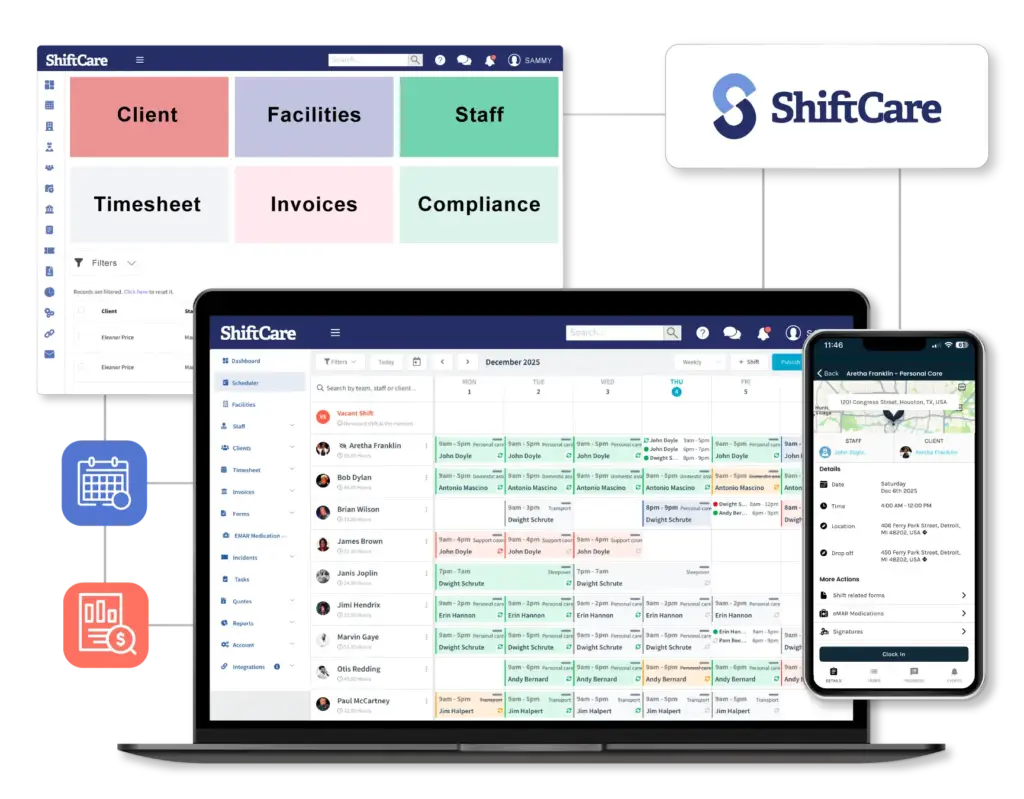
ShiftCare’s invoicing software allows you to set up custom billing rules for each funder, generate compliant invoices in bulk, and track payment status in real time. You can see which invoices are outstanding, which have been queried, and adjust future submissions based on funder feedback, all from a single dashboard.
Reducing Payment Disputes and Chasing Time
Payment disputes often stem from simple misalignment between what you invoiced and what the funder expected. A care worker’s hours don’t match what the local authority authorised. A service code is wrong. Documentation is missing. When these issues are caught before the invoice is submitted, they’re solved in minutes. When they’re caught after submission, they trigger a cycle of correction, resubmission, and delay.
The best care invoicing systems flag these mismatches at the point of invoice generation. Before an invoice goes out, the software checks it against funder rules and your own internal requirements. It alerts you if hours exceed what was authorised, if service codes don’t map to the contract, or if supporting documents are missing. You fix these issues instantly, and the invoice goes out clean.
This reduces the number of disputed invoices dramatically. In organisations using integrated care management software, the average time from invoice generation to payment receipt drops from 50+ days to 30 days or fewer.
Managing Multiple Payment Terms and Schedules
Different funders pay on different schedules. The local authority pays monthly. The NHS ICB pays weekly. Private clients pay on invoice. Without a clear system, you’re tracking multiple payment dates, multiple outstanding amounts, and multiple follow-up dates in your head or scattered across spreadsheets.
A centralised invoicing system gives you visibility across all funders. You can see at a glance how much outstanding revenue you have, when each funder is due to pay, and which invoices are at risk of being late. You can also forecast cash flow accurately: if your local authority pays 35 days in arrears and you invoice £50,000 monthly, you know you’ll have a cash dip mid-cycle and a surge when payment lands. This lets you plan staffing, purchasing, and payroll with confidence.
Get Paid Faster with Automated Invoicing
If you’re currently managing invoicing manually or with generic accounting software, the transition to funder-aware care invoicing software is straightforward. You’ll set up each funder’s billing rules once, map your service codes, and let the system do the work. Most providers see improvements within the first month: fewer disputes, faster invoices, and noticeably faster payment. The time your finance team gets back can be reinvested in analysing your billing data, spotting trends in funder behaviour, or planning growth.
That’s where real financial management begins. ShiftCare’s invoicing software allows you to set up custom billing rules for each funder, generate compliant invoices in bulk, and track payment status in real time. Start your free trial today. See how ShiftCare helps UK care providers get paid accurately and on time.