Section 42 of the Care Act 2014 places a statutory duty on Local Authorities to investigate suspected adult abuse or neglect. For domiciliary care and supported living providers, understanding how Section 42 enquiries work, what your role is, and what documentation standard is required is essential for both safeguarding effectiveness and CQC readiness.
Care providers are often the first to identify a safeguarding concern, and frequently the primary source of evidence when a Section 42 enquiry is active. Getting that process right from the initial concern through to post-enquiry learning separates providers with strong safeguarding cultures from those who create compliance exposure.
What Triggers a Section 42 Enquiry Under the Care Act 2014
A Section 42 enquiry is initiated by the Local Authority when it suspects an adult at risk is experiencing or at risk of abuse or neglect. The statutory definition of an “adult at risk” covers any adult aged 18 or over who has care and support needs and is experiencing or at risk of harm due to dependency or vulnerability. Care and support needs include physical disability, mental health conditions, learning disabilities, substance use, and age-related frailty.
Abuse under the Care Act 2014 spans physical, sexual, psychological, emotional, and financial harm. Neglect includes failures to provide food, hygiene, shelter, medical care, or emotional support. Self-neglect, where an individual neglects their own safety or wellbeing, is now widely recognised as a safeguarding concern warranting the same response.
Referrals to the Local Authority safeguarding team come from care providers, health professionals, family members, and members of the public. The threshold for referral is low by design. Reasonable cause to suspect harm is sufficient. Proof of abuse is not required before reporting.
How to Identify and Report Safeguarding Concerns in a Care Setting
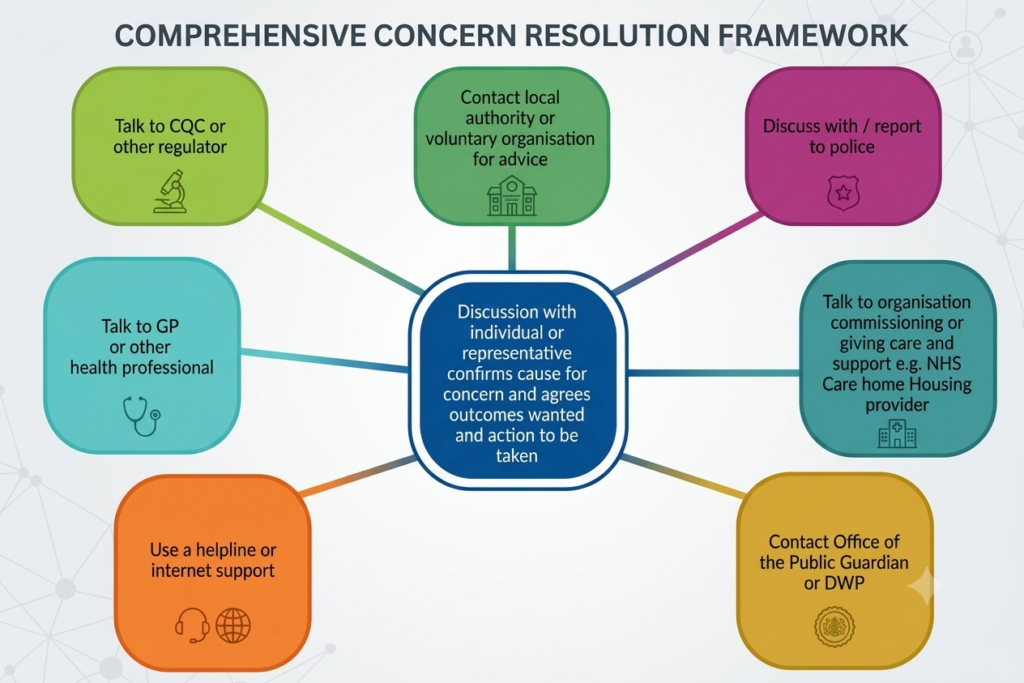
Safeguarding concerns surface in many forms: unexplained bruising, financial irregularities, a service user disclosing coercion, care worker behaviour that appears controlling, unexplained isolation, or withdrawal from usual activities. A strong safeguarding culture means any member of staff — care worker, receptionist, supervisor — can raise a concern without fear of blame or retaliation.
Once a concern is raised internally, your organisation must decide whether it meets the threshold for a Local Authority referral. Most providers rightly err toward reporting. The Local Authority’s safeguarding team makes the threshold determination. Your responsibility is to escalate promptly and transparently, not to investigate before referring.
Timing matters. Report suspected abuse or neglect to the Local Authority without delay, typically within 24 hours of becoming aware. If you’re uncertain whether a concern is reportable, contact the Local Authority’s duty safeguarding team for guidance before the end of the working day.
What Happens During a Section 42 Enquiry and What Providers Must Do
When a Section 42 enquiry is live, the Local Authority’s enquiry officer will contact your organisation formally to notify you and request cooperation. What follows involves several parallel processes:
- Documentary requests: Care plans, daily notes, records of prior concerns, and details of any staff connected to the allegation
- Staff interviews: The enquiry officer will request access to the care worker who raised the concern, their supervisor, and any manager with knowledge of the situation — on paid time, with support available
- Home visits: Often conducted with police if abuse is suspected, to speak with the service user and assess ongoing risk
- Perpetrator interviews: Where a staff member or family member is alleged to be responsible
Cooperate fully and transparently. Provide documents promptly. Make staff available without coaching their responses or limiting what they can say. Any attempt to suppress information will be treated seriously by the Local Authority and, if discovered, by CQC under Regulation 13.
Providers who worry that transparent cooperation will trigger CQC action are looking at this the wrong way. CQC responds well to providers who self-report, investigate, and remediate. Providers who suppress or minimise create exactly the regulatory exposure they were trying to avoid.

How Making Safeguarding Personal Shapes the Enquiry Process
The Local Authority’s enquiry must follow Making Safeguarding Personal (MSP) principles, which centre the response on what the individual wants to happen rather than imposing a standardised safeguarding outcome.
In practice, MSP asks: what would help this person feel safer? Do they want ongoing contact with the person who harmed them? What support do they need from their perspective? The answer may not be what the provider or Local Authority expected. A service user who discloses emotional abuse by a family member may not want contact removed. MSP respects that.
Apply the same principles internally. When a service user discloses a concern, listen without judgement, confirm you will support them, and ask what they need. Collaborative safety planning produces better outcomes than paternalistic responses.
What Safeguarding Documentation Must Include to Hold Up Under Scrutiny
Safeguarding enquiries depend on evidence, and care records are often the primary source. Notes must be contemporaneous, objective, and specific. Vague or interpretive language creates gaps that undermine both the enquiry and your organisation’s credibility.
Poor documentation: “Jim seemed unhappy.” “We think something may have happened.” Neither is usable in a formal enquiry.
Strong documentation records the date and time of any observation or disclosure, the exact words used by the service user in quotation marks rather than paraphrased, the actions taken immediately after including who was informed and when, and the context including the service user’s presentation at the time.
An example of adequate documentation: “On 23 April at 14:45, Jim disclosed that his son asked him for money and became angry when Jim refused. Jim said, ‘I felt scared.’ Office manager informed immediately. Written referral submitted to the Local Authority at 15:20.”
ShiftCare’s care management platform supports safeguarding documentation with timestamped record entries, role-based access controls, and audit trails that meet CQC evidence requirements. Notes recorded at point of care are harder to dispute than those completed retrospectively.
How to Use a Section 42 Enquiry to Strengthen Your Safeguarding Practice
When the enquiry concludes, the Local Authority shares findings unless the service user objects. You’ll learn whether abuse or neglect was substantiated, what factors contributed, and what the Local Authority recommends as a result.
An unsubstantiated allegation still warrants a structured review. What did the enquiry surface about your care planning, supervision, or staff training? Were warning signs missed? Was documentation insufficient? Use the findings to update safeguarding policies and schedule staff training before the next CQC assessment.
Team debriefs after enquiries build the institutional knowledge that prevents the same gaps from recurring. Confidentiality must be maintained throughout, but honest reflection is what separates organisations that learn from incidents from those that repeat them.
Build a Safeguarding Process That Holds Up Under CQC Scrutiny
Section 42 enquiries test whether your organisation’s safeguarding systems work in practice, not just on paper. Providers with clear referral chains, contemporaneous documentation, and staff who know how to raise concerns without fear consistently perform better under both Section 42 scrutiny and CQC assessment.
ShiftCare’s domiciliary care software centralises care notes, incident records, and staff training documentation so your safeguarding evidence exists before an enquiry is opened rather than being reconstructed after. Staff management tools track safeguarding training completion and certification expiry across your entire workforce, keeping your team compliant between CQC assessments.
Start your free trial today and see how ShiftCare helps UK care providers build the documentation foundation that safeguarding and CQC readiness both depend on.