Staff Scheduling Systems for Care Providers: The Complete Guide
Adult social care in England employs approximately 1.79 million people. According to Skills for Care, the sector vacancy rate runs at 9.9%, with annual staff turnover above 28%. Managing rota creation, cover requests, and workforce compliance in these conditions requires a system that surfaces problems before they affect service delivery.
Scheduling software for care providers operates differently from general workforce management tools. Domiciliary care, supported living, and residential care each have specific compliance requirements, service user continuity obligations, and commissioner reporting expectations. A system built for care manages these concurrently rather than treating them as separate administrative tasks.
What Core Functions Should a Care Staff Scheduling System Include?
A care staff scheduling system performs three core functions: rota management, compliance monitoring, and workforce communication. Rota management covers shift creation, publication, and last-minute cover requests. Compliance monitoring flags Working Time Regulations breaches, credential expiries, and unqualified staff assignments before a rota is confirmed.
Workforce communication includes mobile rota access for care workers and instant notification of shift changes. In addition, payroll integration ensures contracted hours, overtime thresholds, unsociable hours uplifts, and bank holiday premiums are calculated accurately against each worker’s terms of employment.
Core features to assess:
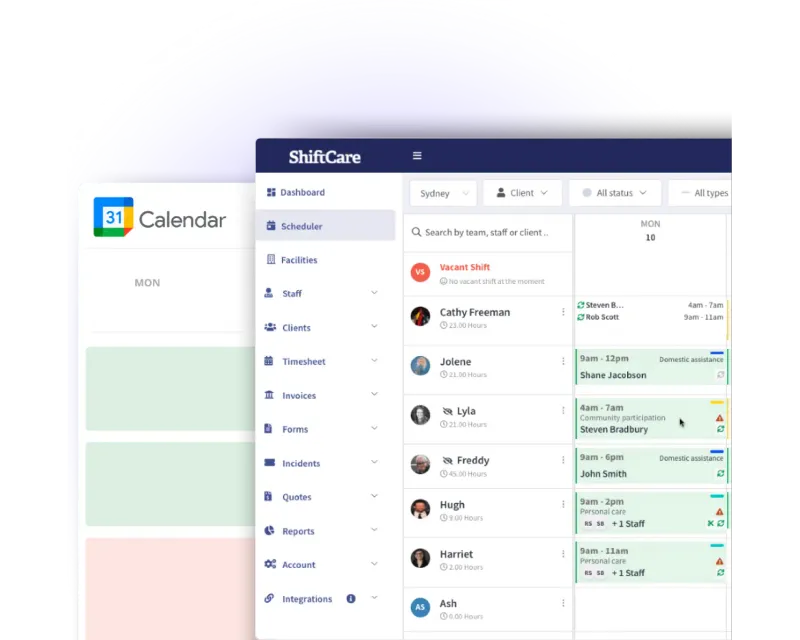
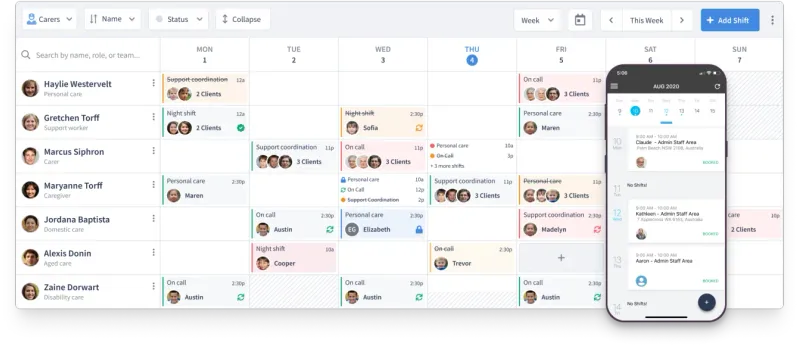
- Rota creation and publication: Template or drag-and-drop rota building with mobile access for care workers. Shift notifications are sent directly to the worker’s device, reducing coordinator call volume.
- Availability and leave management: Real-time visibility of care worker availability, approved leave, and absence records. Automatic cover suggestions when shifts become vacant.
- Credential-based matching: Restricts assignment of care workers based on qualifications, training completion, and DBS check status. Prevents the scheduling of an unqualified worker against a service requiring a specific competency.
- Electronic Call Monitoring (ECM): Captures GPS-verified call times at the point of care for domiciliary visits. Required by many local authority commissioners to confirm service delivery against commissioned hours.
- Working Time Regulations monitoring: Automated alerts when a proposed rota assignment would breach the 48-hour average working week, daily rest requirements, or weekly rest minimums.
- Bank staff and agency management: Tracks bank staff availability and hours separately from contracted staff, with rates applied correctly in payroll export.
- Payroll integration: Exports verified hours to payroll systems with contracted rates, overtime, and enhanced pay for unsociable hours applied automatically.
How Does Scheduling Software Support Working Time Regulations Compliance?
The Working Time Regulations 1998 set enforceable rest and hours limits for care workers in England, Scotland, and Wales. Key requirements include an average 48-hour working week, an 11-hour daily rest period, and a 24-hour weekly rest. Employers in care who breach these limits face enforcement action from the Health and Safety Executive.
Care workers may sign a written opt-out agreement to exceed the 48-hour average. However, opt-out status must be individually documented and can be withdrawn by the worker at any time with notice. Scheduling software should flag opted-out workers separately and apply appropriate monitoring to their hours.
Scheduling software that monitors WTR compliance identifies potential breaches before a rota is published. Consequently, care managers can adjust shift patterns proactively, rather than responding to a complaint or an HSE enquiry after a breach has occurred.
Record-keeping is also a legal obligation under the Regulations. Specifically, employers must maintain records demonstrating hours compliance for each worker covered, and those records must be accessible on request.
Scheduling Considerations Specific to Domiciliary Care
Domiciliary care scheduling operates on a visit-based model rather than fixed shift blocks. Each visit is linked to a service user’s care plan, a commissioned duration, and the required worker competency. Scheduling systems built for domiciliary care manage these constraints concurrently from a single rota view.
Electronic Call Monitoring is the standard visit verification method for publicly funded domiciliary care in England. ECM captures GPS-verified call times at the start and end of each visit, confirming service delivery to local authority commissioners. Furthermore, ECM records provide an audit trail for resolving disputes about missed or shortened visits.
Travel time between service users is an operational cost that affects both care worker pay and service capacity. Scheduling systems that cluster visits geographically reduce unproductive travel and improve contact hours per worker per day. In practice, route optimisation also reduces the risk of late arrivals and compressed visit durations.
Lone worker safety is a separate compliance requirement under the Health and Safety at Work Act 1974. Workers attending service users in private residences require a lone worker check-in and escalation process. Scheduling software that integrates lone worker monitoring removes the need for a separate check-in system.
The Care Act 2014 supports continuity of care as a principle for service user wellbeing. Scheduling software that records service user preferences and worker history enables coordinators to prioritise consistent assignment.
What to Evaluate When Comparing Care Scheduling Systems
Care providers comparing scheduling platforms should assess the following criteria before selecting a system.
Rota functionality covers mobile access for care workers, shift swap requests, and bank staff management. The system should flag potential WTR breaches automatically before a rota is confirmed. ECM capability determines whether GPS-verified call times are captured and exportable to commissioner reporting formats.
Payroll integration should apply contracted hours, overtime thresholds, and enhanced pay rates without manual recalculation. Lone worker check-in and escalation should be configurable by visit type and service user risk level. Additionally, CQC reporting capability should produce staffing level evidence and cover rate data retrievable during a site visit.
CQC’s Safe and Well-Led quality statements both assess staffing governance. Inspectors review whether providers monitor staffing levels, manage absences effectively, and maintain WTR compliance records. Scheduling software that produces these records in a retrievable format supports a stronger evidence base during inspection.
Data security considerations include GDPR compliance, UK data storage, and system access controls. Implementation support is relevant where a provider is transitioning from paper rotas or an existing scheduling platform, particularly in services where rota continuity is critical.
Frequently Asked Questions
What is the difference between a rota system and scheduling software?
A rota system manages shift assignments and publication for care workers. Scheduling software encompasses rota management and adds compliance monitoring, credential verification, payroll integration, and workforce communication tools. In care settings, scheduling software also handles ECM, lone worker safety, and service user continuity tracking that a basic rota tool does not address.
Does scheduling software help with CQC inspections?
CQC inspects staffing under the Safe and Well-Led quality statements. Inspectors assess whether the provider maintains appropriate staffing levels, manages absences effectively, and monitors WTR compliance. Scheduling software produces staffing level records, cover rate data, and compliance logs that support the evidence base during a site visit.
What is Electronic Call Monitoring in domiciliary care?
Electronic Call Monitoring captures GPS-verified call times at the start and end of each domiciliary visit. Local authority commissioners require ECM data to confirm service delivery against commissioned hours. ECM records also support resolution of disputes about missed or shortened visits and provide supporting documentation during CQC inspection.
How does scheduling software support Working Time Regulations compliance?
Scheduling software monitors cumulative hours per care worker and flags potential WTR breaches before a rota is confirmed. Specifically, the system identifies workers approaching the 48-hour average and those with insufficient daily or weekly rest. Opted-out workers can be flagged individually for separate hours tracking and monitoring.
Manage Rotas, ECM, and WTR Compliance From One System
Separate rota, ECM, and payroll systems create reconciliation work in every pay period. Workforce communication, compliance monitoring, and visit verification should operate from the same scheduling record.
ShiftCare’s scheduling software for UK care providers connects rota management, care documentation, and workforce compliance in one platform. Start your free trial today, no credit card required, and give your coordinators the tools to manage rotas, ECM, and WTR compliance from a single system.