Intellectual and developmental disability (IDD) support providers operate in one of the most complex, regulation-heavy sectors of care. Your staff manages client eligibility across state Medicaid waivers, tracks service authorizations that change quarterly, schedules intricate caregiver rosters, and documents every minute for compliance audits. Most of this work still happens across spreadsheets, email threads, and disconnected systems.
The result: missed billing opportunities, staff churn, and audit findings that cost time and money. Purpose-built IDD software solves this by consolidating everything into a single system—and that consolidation is the foundation for sustainable growth. When scheduling, billing, and compliance tools don’t talk to each other, friction accumulates fast. Claims get rejected, cash flow stalls, and state surveyors find inconsistencies during audits.
What Fragmented Systems Cost Disability Support Providers

When your scheduling, billing, and compliance tools do not talk to each other, friction accumulates fast. A caregiver logs hours in one system. A supervisor enters different data in another. Billing extracts from both, finds mismatches, and the claim gets rejected. Your billing staff spend two hours chasing down what should have taken minutes. Cash flow stalls and state surveyors find inconsistencies during audits.
Fragmentation also makes it nearly impossible to see the full picture of your operation. You cannot easily answer basic questions about your authorised hours, rejected service codes, and coverage gaps. Without that 0verview, you cannot forecast growth or solve problems before they cascade. This is where the right IDD software makes an immediate difference.
How Modern IDD Software Solves Common Issues
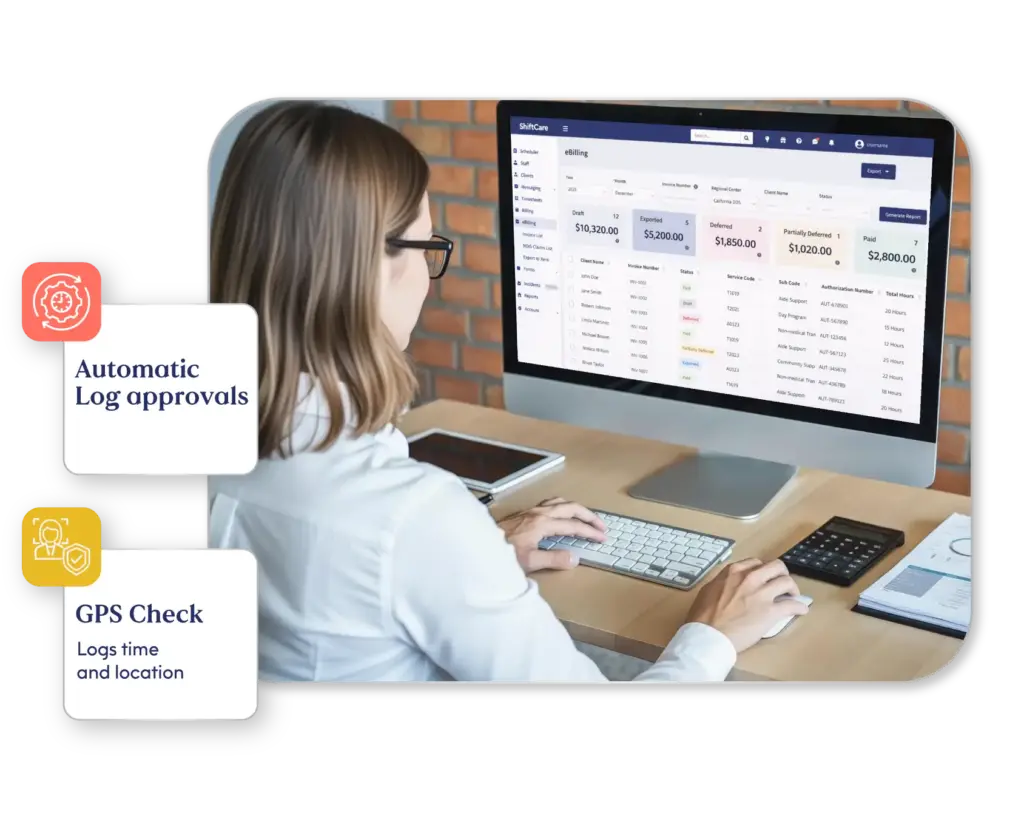
Purpose-built IDD software connects the dots. Scheduling is tied directly to service authorisation, so staff cannot accidentally schedule hours that are not approved. When a caregiver clocks in and out using electronic visit verification (EVV), that data flows straight into the billing module. The software validates each service code, checks caregiver certifications, and confirms Medicaid eligibility in real time. Claims are generated with near-zero errors.
Documentation becomes automatic too. Instead of relying on caregivers to fill out paper forms or remember to log notes later, the IDD software captures care details as they happen. Progress notes, incident reports, and service hours all feed into a central record immediately available for supervisors, families, and state auditors. For providers with multi-waiver clients — funded through an IDD waiver, a nursing waiver, and family-funded respite care simultaneously — the software routes claims across all funding streams in one view.
The Growth Multiplier Effect
When your team is no longer drowning in administrative work, they can focus on what actually drives business growth. Care coordinators spend time on meaningful family conversations and care planning instead of hunting down billing errors. Schedulers respond to new referrals and coverage requests in hours instead of days. Leadership sees real-time data and makes confident decisions.
Claim rejection rates drop significantly with integrated IDD software. Providers report rejection rates falling from 10 to 15 percent down to 2 to 3 percent when they move from manual billing to integrated e-billing solutions. For a provider doing $2 million annually, that difference in recovery rate is over $240,000 in additional cash flow. Growth also becomes predictable: you can see exactly how many authorised hours you are delivering versus how many are available, and you can price new programs with confidence.
What to Look for in IDD Software
Not all software serves IDD providers equally. You need a system built specifically for your funding model and state requirements. Look for software that:
- Handles multi-waiver clients across different funding streams
- Integrates with state Medicaid billing systems
- Supports EVV compliance requirements
- Generates audit-ready documentation with minimal manual work
- Connects scheduling, billing, and care management in one place
ShiftCare’s IDD software is designed to handle exactly these requirements, connecting scheduling, billing, EVV, and compliance in one system to reduce the friction that costs IDD providers time and money.
Stop Losing Revenue to Fragmented Systems
The transition away from spreadsheets and disconnected tools takes planning, but providers who make that move report faster billing, fewer audit findings, and happier staff. Your team gets back hours every week. Your cash flow stabilizes. Claim rejection rates drop from 10 to 15 percent down to 2 to 3 percent—for a provider doing $2 million annually, that’s over $240,000 in additional cash flow. ShiftCare’s IDD software connects scheduling, billing, EVV, and compliance in one system to reduce the friction that costs IDD providers time and money.
Start your free trial today! See how ShiftCare helps you recover lost revenue and reduce admin overhead.