Care coordination in HCBS settings is operationally more complex than in clinical settings. Participants receive services from multiple providers across Medicaid waiver, Medicare, and private pay funding streams simultaneously, and no single entity automatically sees the full picture. For HCBS providers, effective care coordination directly affects participant outcomes, billing accuracy, and compliance standing under CMS waiver requirements.
The CMS HCBS Settings Rule requires person-centered service plans to drive every coordination decision. Services must be planned around what the individual wants from their life, not around what the provider finds administratively convenient. Integrating input from the participant, their family, multiple service providers, and the state Medicaid agency into a plan that is both person-directed and administratively executable is where most coordination breakdowns begin.
Why Care Coordination Breaks Down in HCBS Settings
A participant receiving personal care from one agency, supported employment from another, behavioral support from a third, and home modifications through a separate contractor, all funded under the same 1915(c) waiver, is a standard HCBS scenario. No single provider sees everything being delivered or billed across that network. Three coordination failures surface consistently in CMS quality reviews and state audits as a result.
- Duplicated or conflicting services. Two providers billing for overlapping services under the same waiver budget is a recurring audit finding. Without a coordination mechanism giving each provider visibility into what others are delivering, duplication goes undetected until billing reconciliation surfaces it.
- Plan drift. A person-centered service plan developed at intake becomes outdated within months as participant needs evolve. When no provider owns the coordination function across the full team, plans go unreviewed and the gap between what was planned and what is being delivered widens quietly.
- Authorization overages. HCBS participants have approved funding limits per service category. Providers without visibility into a participant’s full service picture can deliver beyond what remains authorized. Medicaid does not pay for unauthorized delivery, and the delivering agency absorbs the cost.
The Four Care Coordination Models Used in HCBS Settings
State Plan Case Management
Most states designate a case management entity as the primary coordinator for HCBS waiver participants, typically a county department of human services, a managed care organization, or a state-designated lead agency. This entity develops the person-centered service plan, authorizes services, and monitors whether the plan is being implemented across providers.
As an HCBS provider, you receive referrals through this system and deliver services within authorized parameters. Your coordination responsibility includes reporting on service delivery, flagging participant changes that affect the plan, and participating in plan reviews. Providers who engage the case management entity as an active partner rather than a paperwork source influence plan decisions that directly affect service delivery and billing.
Managed Care Organization Coordination
All but 11 states use managed care to provide at least some home care, with states paying managed care plans a set fee for each person enrolled and managed care plans responsible for providing all services to enrollees. For HCBS providers under MCO contracts, coordination runs through the MCO’s care coordinator rather than directly with the state Medicaid agency.
MCO coordination requires providers to work within prior authorization frameworks specific to each plan, submit service records in the format and timeframe the MCO requires, and participate in care conferences the MCO schedules. Multi-MCO providers manage different coordination protocols per payer while maintaining consistent service delivery standards across all participants.

Participant-Directed Care Coordination
Under participant-directed models including the CMS Cash and Counseling model and state equivalents, participants or their authorized representatives manage their own service budgets and select their own providers. The coordination function shifts partly to the participant rather than sitting entirely with a case management entity.
Provider obligations in participant-directed models include working directly with the participant or their representative on scheduling and service planning, documenting services in a format that supports the participant’s own budget tracking, and maintaining the same compliance standards as in agency-directed models. Fiscal intermediaries typically handle payroll and billing on the participant’s behalf.
Integrated Care Models for Dual-Eligible Participants
Participants enrolled in both Medicare and Medicaid require coordination across both systems. The 2026 Medicare Advantage and Part D Final Rule added additional care coordination requirements for D-SNPs, requiring specific types to conduct a single, integrated health risk assessment for Medicare and Medicaid rather than separate assessments for each program.
For HCBS providers serving dual-eligible participants, this creates a coordination obligation spanning Medicare-covered services (skilled nursing, therapy, durable medical equipment) and Medicaid-funded HCBS (personal care, supported employment, day programs). Communication with the participant’s Medicare primary care provider and any Medicaid managed care coordinator both form part of the coordination responsibility.
Tools That Support Care Coordination in HCBS Operations
Person-Centered Service Plans Connected to Scheduling
A service plan that lives in a PDF and gets reviewed annually does not support real-time coordination. Care management software that connects service plan goals to shift scheduling means every visit is linked to an authorized service and a documented participant outcome. Coordinators can see which goals are being addressed, which are stagnant, and which participants haven’t had their plan reviewed within the required timeframe, without pulling records from a separate system.
Authorized Hours Tracking Across Service Categories
Real-time visibility into how much of a participant’s authorized funding remains in each service category prevents over-delivery before it occurs. Budget balance alerts triggered as a participant’s funding approaches exhaustion in a given category give coordinators enough lead time to request a plan amendment or adjust scheduling before unauthorized delivery begins.
Electronic Visit Verification
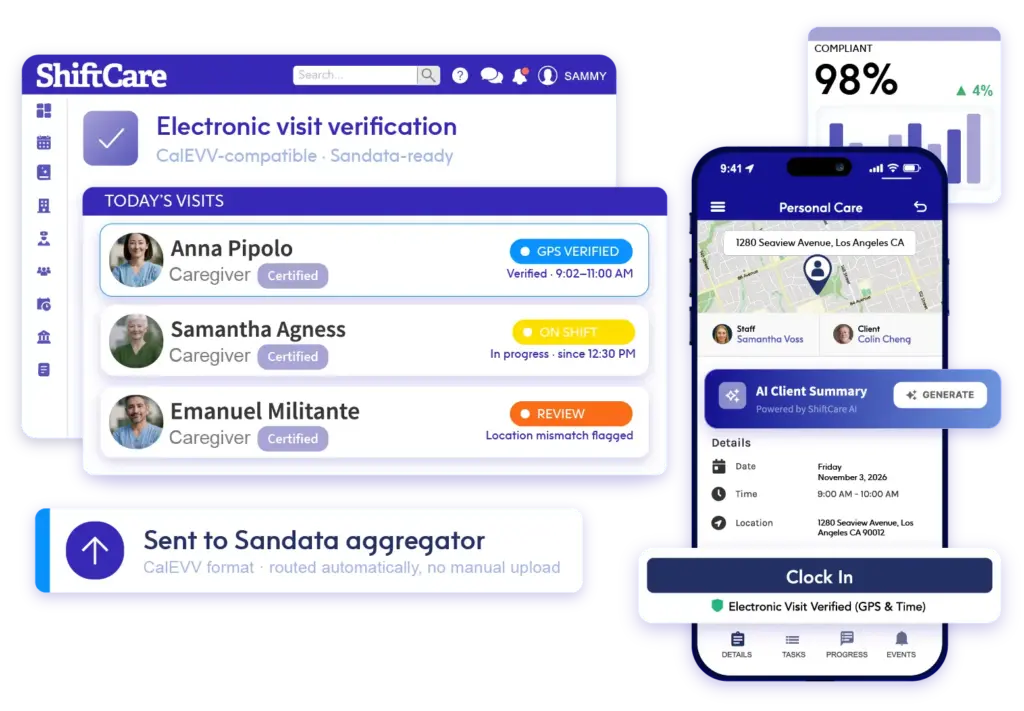
CMS mandated EVV for all Medicaid personal care and home health services effective January 1, 2023. EVV records verify that scheduled services were delivered at the right location, at the right time, by the right provider. That verification data feeds directly into billing reconciliation and provides the timestamped service record care coordinators and state auditors use to confirm delivery against the service plan.
Incident Management Connected to the Participant Record
Incidents affecting a participant’s safety, health, or service delivery need to reach the care coordinator and, where required, the state agency quickly. An incident management system connected to the participant’s care record surfaces reports to the right people automatically rather than requiring manual escalation. Most state HCBS waiver requirements set specific notification timelines, with serious incidents requiring state Medicaid agency notification within 24 hours.
Secure Family and Guardian Communication
Families and authorized representatives are active participants in HCBS care coordination. A secure portal giving authorized family members visibility into care plans, upcoming visits, and goal progress keeps them informed without requiring coordinators to manage communication through personal email or text threads that create documentation gaps and privacy exposure.
Best Practices for Care Coordination in HCBS Agencies
Assign a named coordinator per participant and document the assignment
Person-centered service plans require a named individual responsible for monitoring implementation. Agencies that assign coordination responsibilities informally and don’t document who holds them create accountability gaps when a participant’s circumstances change. Documenting coordinator assignments in the care management system produces a clear accountability trail that holds up during waiver reviews.
Build plan review triggers into scheduling workflows
Plan reviews should happen at defined intervals and whenever a participant’s needs change significantly. Scheduling systems that surface upcoming plan review dates automatically prevent the drift that occurs when plans go unreviewed for months. A review triggered by a hospitalization, a significant behavioral incident, or a change in living situation produces better outcomes than one triggered only by the calendar.
Reconcile billing against service delivery records before submission
Every Medicaid claim submitted should match a documented, EVV-verified service delivery record. Pre-submission reconciliation catches mismatches between what was scheduled, what was delivered, and what EVV recorded before they become billing denials. Agencies that reconcile before submission spend less time managing rejections and produce a cleaner audit trail for state waiver reviews.
Share relevant information across the provider team with documented consent
HCBS participants often don’t disclose their full provider network to any single agency. Communicating proactively with other providers, support coordinators, and case managers reduces duplicated effort and prevents conflicting support strategies. Providers who operate in isolation from the rest of a participant’s network create coordination gaps that surface in plan reviews and CMS audits.
Build Care Coordination Infrastructure That Holds Up Under Waiver Review
Care coordination in HCBS is an operational function. Providers that do it well connect service plans to scheduling, track authorized hours in real time, document every service delivery event, and communicate proactively with the case management entities that authorize their work.
ShiftCare’s care management platform connects person-centered service plans to scheduling and billing so every visit is linked to an authorized service and a documented participant outcome. Authorized hours tracking surfaces budget balance alerts before over-delivery occurs, and EVV integration generates timestamped visit records that feed directly into billing reconciliation. The family portal keeps authorized family members and guardians informed without adding communication overhead for coordinators.
Start your free trial today. See how ShiftCare gives HCBS providers the care coordination infrastructure that supports participant outcomes and waiver compliance simultaneously.