Running a home care agency means managing compliance across federal and state regulators simultaneously. A billing denial from Medicaid, a CMS survey deficiency, and an OCR HIPAA investigation can happen in the same quarter, and none of them are connected.
The agencies that stay out of trouble build systems that generate audit-ready documentation automatically, track certification deadlines before they lapse, and keep billing records aligned with what caregivers actually delivered.
CMS Conditions of Participation: What Medicare-Certified Agencies Must Meet
Medicare certification requires home health agencies to meet the Conditions of Participation (CoPs) set out in 42 CFR Part 484. CMS conducts compliance surveys, and deficiency citations are public record.
| CoP Area | What Surveyors Check |
| Patient rights | Written notice at start of care, informed consent, grievance procedures |
| Care planning | Physician-authorized plan, updated at least every 60 days |
| Clinical records | Complete, accurate documentation for every patient |
| Staff competency | Verified qualifications and documented competency assessments |
| Quality assessment | Active improvement programs with measurable outcomes |
| Emergency preparedness | Annual review, staff training, local coordination |
Surveyors cite deficiencies when documentation doesn’t match care delivery. Enough citations and CMS initiates enforcement action, up to termination of Medicare provider status. Treat every CoP as a documentation requirement, not just a care standard.
How State Licensing Requirements Vary for Home Care Providers
Skilled home health services require licensing in all 50 states. Non-medical personal care requirements range from comprehensive to nonexistent.
California requires a full Home Care Organization (HCO) license: background checks, documented training, registered agent, surety bond. Texas requires state registration. Some states require little beyond a local business license for companionship-only services.
Three areas drive the most operational variation:
- Training minimums. Each state sets its own minimum hours for home health aides and personal care aides. An agency expanding into a new state can’t assume its existing training program qualifies.
- Background checks. Most states require checks against the state abuse registry. Some require federal FBI fingerprint checks. Multi-state operators need separate protocols per state.
- Record retention. States require clinical records kept for 3 to 7 years. A policy built around one state’s minimum may not satisfy another state’s audit request.
What HIPAA Compliance Requires From Home Care Agencies
HIPAA applies to every agency that creates, stores, or transmits protected health information, effectively every agency that accepts Medicaid or insurance.
The HHS Office for Civil Rights enforces it. Fines run from $137 per violation for unknowing violations to $2.1 million per violation category for willful neglect. OCR’s current enforcement focus is risk analysis, agencies without a current, documented risk analysis are the primary audit target in 2025 and 2026.
The Four Requirements That Generate the Most Violations
- Risk analysis. Document every location where PHI exists and assess potential threats. An analysis that doesn’t cover mobile devices, caregiver apps, or cloud storage is incomplete.
- Business Associate Agreements. Every vendor that touches PHI requires a signed BAA, e.g., scheduling software, billing platforms, EVV systems, cloud storage. Missing BAAs are among the most common OCR findings.
- Access controls. Restrict PHI access to staff whose role requires it. Role-based permissions and audit logs are baseline requirements.
- Breach notification. Breaches affecting 500 or more individuals require OCR notification within 60 days. Smaller breaches go into the annual log submitted to OCR each March.
How EVV Compliance Affects Medicaid Billing and Claim Approvals
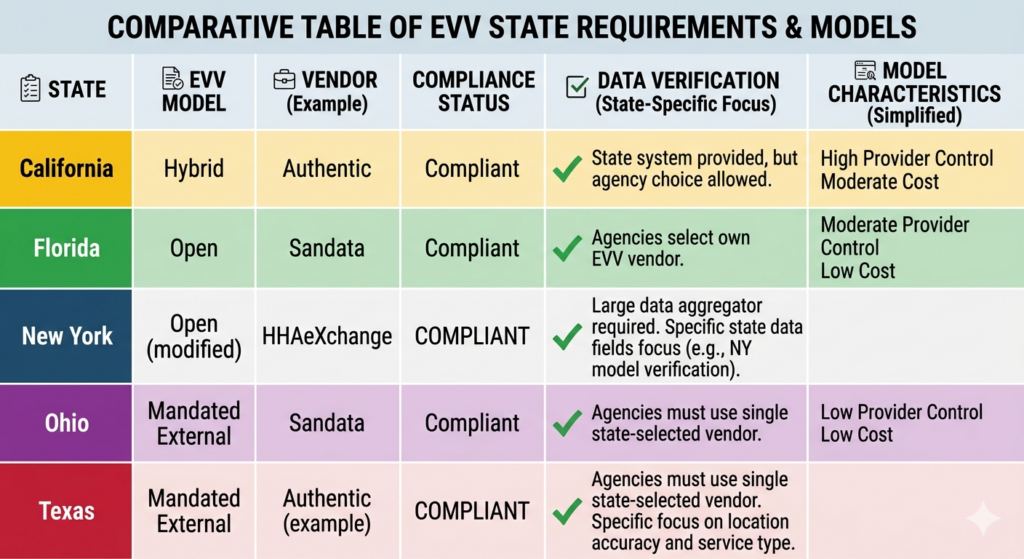
CMS mandated EVV for all Medicaid HCBS personal care and home health services from January 1, 2023. State enforcement has been active since January 2024. Non-compliant visits get denied.
Every qualifying visit must capture six data points: service type, individual receiving care, caregiver identity, date, time in and out, and location. Missing one makes the visit non-compliant.
State requirements diverge from there. California specifies requirements beyond the federal baseline. Texas maintains separate standards for long-term care providers. Multi-state agencies track a different EVV standard per state. When visit data doesn’t match the claim submission, Medicaid flags it. Denials add weeks to payment cycles and, with repeat errors, trigger audits.

How to Keep Your Agency Audit-Ready Year-Round
Across all compliance domains, the common thread is documentation. Auditors check whether records prove the right services were delivered, by qualified caregivers, on the dates claimed, with proper authorization.
Three practices make the difference:
- Document in real time. Notes logged at the point of care carry timestamps that hold up under review. Retroactive documentation raises questions auditors are trained to ask.
- Track certifications with lead time. Automated alerts 60 to 90 days before expiry give staff enough runway to renew without disrupting schedules.
- Reconcile billing before submission. Match every claim against EVV records before it reaches Medicaid. Time discrepancies and service code mismatches are preventable at this stage, not after denial.
ShiftCare’s care management platform centralizes documentation, tracks certification expiry, and connects care plans to billing workflows. EVV integration automates visit verification, and e-billing automation reconciles visit data against claim submissions before they’re sent. Multi-state operators can segment compliance requirements by state within a single platform.
Stop Managing Compliance Across Five Frameworks Manually
Every compliance failure traces back to documentation that didn’t keep pace with care delivery. Missed certifications, billing mismatches, and HIPAA gaps all surface when manual processes fall behind.
ShiftCare automates the documentation layer that every compliance framework depends on, so your team isn’t scrambling before an audit.
Start your free trial today and see how ShiftCare keeps your agency audit-ready year-round.