Compliance failures cost home care agencies thousands. A single audit finding triggers investigation, documentation review, and remediation planning. Management could spend weeks addressing findings instead of running operations. When multiple findings emerge, enforcement action follows.
The real cost isn’t the audit itself, but rather, it’s poor documentation that accelerates findings and extends remediation timelines.
Established agencies managing 20+ staff across multiple clients understand this clearly. What separates agencies that pass audits without findings from those facing corrective action isn’t luck or resources. It’s having systematic compliance frameworks in place, maintaining complete documentation, and organizing records so auditors see intentional systems.
Compliance Program Frameworks for Home Care Agencies
Without a compliance framework, your organization operates reactively to issues. One worker reports incidents correctly while another doesn’t. Care plans exist but don’t change when client situations shift. Training records scatter across spreadsheets. Auditors flag this fragmentation as systemic risk.
The Five Core Components
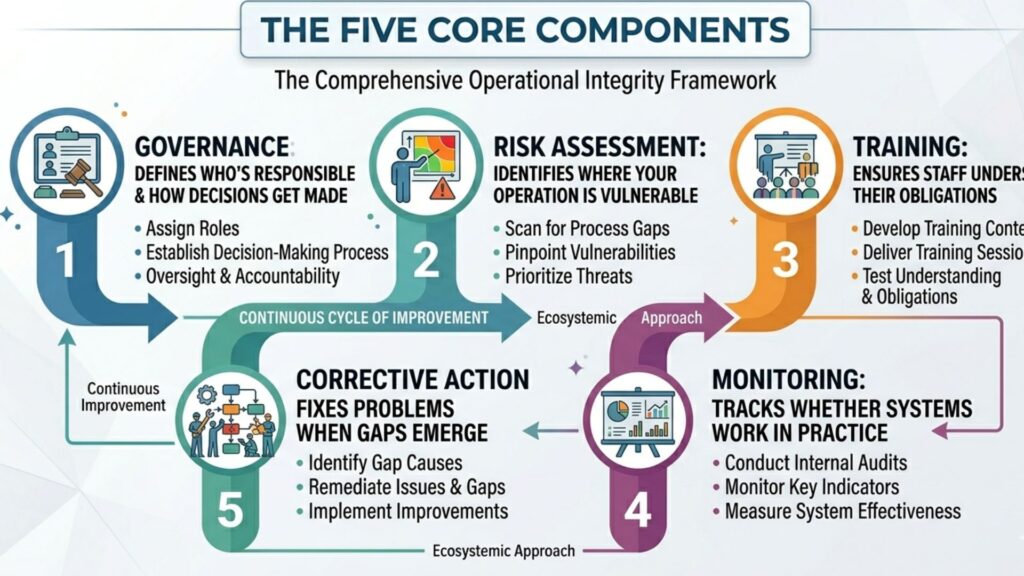
An effective compliance framework has five core components:
- Governance: Defines who’s responsible and how decisions get made
- Risk Assessment: Identifies where your operation is vulnerable
- Training: Ensures staff understand their obligations
- Monitoring: Tracks whether systems work in practice
- Corrective Action: Fixes problems when gaps emerge
Managing Multiple Regulatory Frameworks
Home care agencies operate under multiple regulatory frameworks. Medicare requires Conditions of Participation for home health. States impose their own licensing standards. Agencies serving specific populations follow program-specific requirements. Your organization probably serves multiple populations, which means managing multiple compliance systems at once.
Build a unified framework instead of separate systems for each program. Map your specific obligations first:
- What does Medicare require?
- What does your state require?
- What does your specific program require?
Create one set of policies that addresses all three. Train staff on the unified system. Store everything centrally.
What Auditors Look For
Auditors look for evidence of intentional framework. They want:
- Written policies clearly documented
- Staff training records maintained and current
- Procedures that staff actually follow
- Monitoring systems that catch gaps
- Corrective action when something breaks
Isolated good practices don’t demonstrate framework. Systematic documentation does.
Documentation Requirements You Can’t Skip

Auditors examine four categories of documentation. Findings cluster around the same patterns in all four.
Incident and Accident Reporting
Incident and accident reporting gets examined first because it reveals your organization’s actual priorities. Auditors want to know:
- What incidents were reported
- Whether they arrived on time
- How thoroughly they were investigated
- What corrective action followed
Serious injuries, allegations of abuse or neglect, and safety concerns are all reportable. Late or missing reports become audit findings because they signal your organization doesn’t take incident management seriously.
Client Care Documentation
Client care documentation includes progress notes, care plans, service agreements, and risk assessments. A current care plan is non-negotiable. It must be signed, dated, and aligned with client goals and funding.
Your documentation must include:
- Progress notes that document service delivered and capture relevant observations
- Service agreements that state terms clearly and are acknowledged by the client
- Risk assessments completed for any client with identified vulnerability
Auditors find the same pattern consistently. Care plans exist on file but don’t change when client situations evolve. A client’s behavioral pattern shifts over months but documentation stays unchanged. A client makes progress toward goals but the care plan doesn’t reflect it. When auditors compare plans to reality and find misalignment, that becomes a finding.
Staff Compliance Records
Staff compliance records cover training, credentials, competency, and disciplinary action. Every staff member needs:
- Current records for mandatory training, CPR/first aid, abuse and neglect reporting, manual handling
- Valid background checks
- Verified qualifications documented
- Competency assessments
- Performance reviews
- Full documentation of any disciplinary action
Payroll and Labor Law Compliance
Payroll and labor law compliance means wage classifications are accurate, timesheets are complete, rosters are documented, and tax withholding is correct. One worker misclassified at the wrong wage level creates liability. Multiple misclassifications compound quickly across every hour that worker spends on the job. Auditors examine payroll records specifically for:
- Wage classification accuracy
- Compliance with federal and state labor requirements
The Fragmentation Problem
The common pattern in established agencies is documentation scattered across tools. Incident logs live in one system, training records in spreadsheets, care plans in another tool, payroll in accounting software. Fragmentation creates blind spots. Staff can’t access policies. Managers can’t verify compliance. Auditors see disorganization and flag it as systemic weakness.
Audit Preparation Checklist

Conduct your own documentation audit before the official survey. Your checklist:
- Every client has a current care plan signed and dated within the required timeframe
- Every incident report is complete, timestamped, and investigated
- Training records are current for all staff
- Wage classifications are documented and match actual job duties
- Risk assessments are completed for flagged clients
- Policies cover required areas and staff understand them
What Auditors Examine
When auditors examine incident documentation, they look for completeness first:
- Date, time, location, people involved
- What happened
- Immediate action taken
- Investigation findings
- Corrective action
Then they assess timeliness. Was it reported within the required timeframe? Finally they evaluate investigation depth. Was root cause analyzed or just the surface issue? Was corrective action targeted at prevention?
Care Plan Alignment
Care plan alignment comes next. Auditors compare what the care plan says should happen with what progress notes show actually happened. When plan and reality don’t match, that becomes a finding. They also review:
- Whether behavioral observations are documented
- Whether concerns are flagged for follow-up
Staff Readiness
Staff readiness reveals whether compliance is understood or just performed. Auditors ask:
- Can staff explain their compliance obligations?
- Can supervisors describe incident escalation?
- Do caregivers know what the care plan requires?
Red Flags Auditors Find
Red flags appear consistently across audits:
- Incident reports incomplete because investigations were never finished
- Care plans unchanged for six months
- Training records with gaps or expired certifications
- Staff unaware of policies
- Wage classifications that don’t match actual job duties
- Timesheets missing required detail
Prevention vs. Remediation
Prevention is always simpler than remediation. Maintain complete documentation. Keep records current. Train staff on procedures. Monitor compliance systematically. When auditors see this, findings decrease.
How ShiftCare Automates Compliance Documentation
Established agencies managing compliance across multiple frameworks need systems that prevent gaps rather than spreadsheets that hide them.
Centralized Documentation
ShiftCare centralizes compliance documentation:
- Log incidents when reported and track investigations through completion
- Automated reminders flag deadlines
- Store care plans centrally so that authorized staff can access them
- Progress notes are documented in real time, capturing service delivery and observations
- Training records are maintained with expiry alerts before credentials lapse
Automated Validation
ShiftCare automates compliance validation:
- Validate wage classifications against labor law requirements automatically
- Shift documentation tracks compliance as shifts are created
- Payroll audits flag gaps before payroll runs
- Audit trails maintain themselves because every record is timestamped and complete
The Operational Result
The operational result is straightforward:
- No scattered documentation, no hidden gaps
- Everything auditors need is organized, current, and accessible
- Management time spent on compliance tracking drops because systems maintain records automatically
- Staff compliance status is visible at a glance
- Auditors see systematic compliance, not ad-hoc practices
Complete, organized documentation prevents the audit findings that cost time, money, and reputation. Automation is how established agencies maintain that standard at scale without consuming management bandwidth.
Automate Healthcare Compliance With ShiftCare
ShiftCare centralizes compliance documentation so incidents are logged and investigated on schedule, care plans stay current and aligned with reality, staff training records track expiries automatically, and wage classifications validate against labor requirements. Nothing scatters across spreadsheets. Nothing gets missed. Auditors see organized, systematic compliance.
Start your free trial today. See how ShiftCare turns compliance from scattered systems into organized, audit-ready records maintained automatically.