Home care scheduling in 2026 requires more than shift assignment. This guide covers what non-medical HCBS agencies need from scheduling software, how EVV integration affects billing, and how to evaluate platforms that handle Medicaid waiver, private pay, and Medicare Advantage services in one system.
Agency managers are still building weekly schedules in spreadsheets, calling staff at 7 a.m. to cover call-outs, and manually reconciling visit logs against billing records. The friction is expensive. Caregiver availability shifts daily, client needs change weekly, and compliance mandates tighten each year. Scheduling software built for these realities doesn’t just save administrative time. It protects billing accuracy and reduces audit exposure.
How Home Care Scheduling Software Has Changed in 2026
Scheduling software for home care has matured beyond basic shift assignment. The 2026 market includes solutions purpose-built for non-medical HCBS, integrated platforms bundling scheduling with payroll and billing, and hybrid models connecting to external EVV systems.
Most agencies operate across three program types simultaneously:
- Medicaid waiver services: different documentation standards, authorized hours limits, and EVV requirements per state
- Private pay clients: flexible service types but no reimbursement ceiling
- Medicare Advantage supplemental services: increasingly common, with their own rate structures and visit duration constraints
A single scheduling system must flex across all three without breaking billing or EVV workflows. Legacy software wasn’t built for this diversity, which explains why so many agencies are still on spreadsheets in 2026.
The labor market adds pressure. The Bureau of Labor Statistics projects continued growth in home care employment through 2033, but caregiver supply isn’t keeping pace with demand. Scheduling systems that give caregivers visibility into available shifts, allow self-scheduling, and offer predictable rosters are now retention tools as much as operational ones.
What Features Home Care Agencies Need From Scheduling Software
Industry feedback from non-medical HCBS agencies consistently identifies five operational requirements.
Real-Time Scheduling Visibility
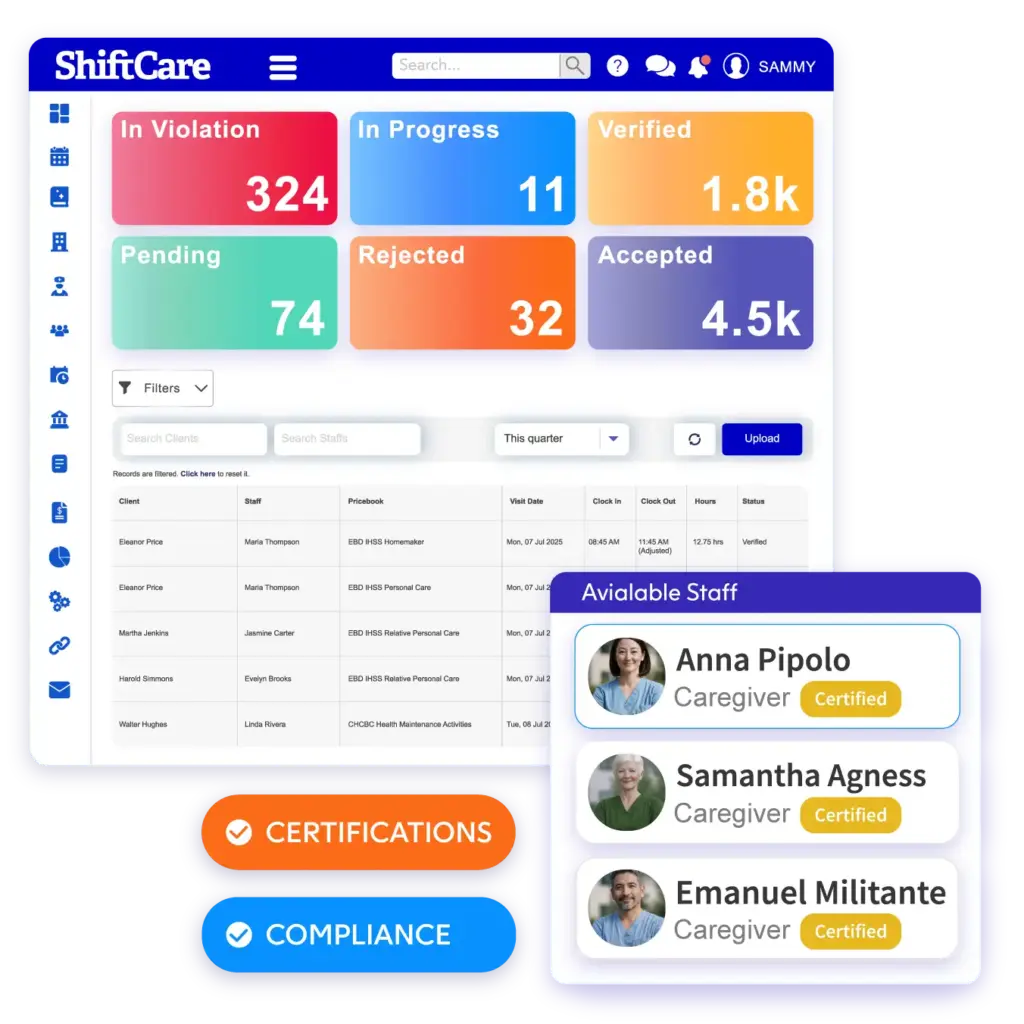
Managers need a single view showing who is available, who is assigned, who has called out, and how gaps affect client coverage. Spreadsheet management fails here because updates don’t propagate in real time. By the time a coordinator identifies a gap and starts calling staff to fill it, the client’s visit is two hours away.
Mobile Access for Caregivers
Caregivers need to view schedules, confirm shifts, request time off, and swap shifts via mobile app. Agencies report that caregivers with mobile self-management tools have better attendance and higher reliability than those managed through phone calls and email chains.
EVV Integration
Scheduling must connect to your EVV provider so scheduled visits automatically populate EVV devices. Manual sync between scheduling and EVV introduces errors that delay billing. In states with strict CMS EVV compliance requirements, disconnected systems create direct audit exposure.
Built-In Compliance Reporting
Whether documenting that a caregiver worked within waiver-authorized weekly hour limits or capturing required service codes and client attendance records, scheduling software should generate compliance reports without manual reconstruction after the fact.
Labor Cost Visibility Per Visit
Managers need the true cost per visit calculated against caregiver wage, mileage, and overtime, compared to reimbursement rates. Agencies that don’t track this often underprice services or discover unprofitable client relationships too late to course-correct.
Why EVV Integration Is Non-Negotiable for HCBS Providers
CMS mandated EVV for all Medicaid personal care and home health services effective January 2023. State enforcement has been active since January 2024. A scheduling system that isn’t EVV-integrated creates an operational silo: visits are scheduled in one system, caregivers clock in through EVV on separate devices, and coordinators manually reconcile discrepancies.
Real EVV integration works bidirectionally:
- Scheduled visits push automatically to EVV devices
- EVV clock-in and clock-out data flows back into the scheduling system
- Visit reconciliation reports surface automatically where scheduled times don’t match recorded times
Agencies without tight EVV integration face billing delays because staff spend time manually matching EVV records to claims before submission. In states with strict enforcement, this costs thousands in delayed reimbursement and increases audit risk. ShiftCare’s EVV integration automates visit verification and feeds documented visits directly into billing, removing the manual reconciliation step that creates most claim delays.

How to Evaluate Scheduling Software Pricing Against Actual ROI
Scheduling software pricing varies significantly across the market:
| Platform Tier | Monthly Cost | Best For |
|---|---|---|
| Entry-level | $200 to $500 | Very small teams, limited program types |
| Mid-market | $1,500 to $4,000 | 5 to 50 caregiver agencies, Medicaid waiver providers |
| Enterprise | $5,000+ | Multi-state, multi-program large agencies |
For agencies serving Medicaid waiver clients with 5 to 50 caregivers, a mid-market platform purpose-built for non-medical home care delivers the strongest return. The monthly cost is absorbed by measurable labor savings, compliance efficiency, and caregiver retention improvements.
How to Quantify the ROI
- Labor hours saved: Most agencies recover 5 to 10 hours per week of coordinator time after full implementation. At $25 per hour, that is $6,500 to $13,000 in annual labor efficiency.
- Billing accuracy: Track how many claims are submitted on time vs. delayed due to EVV reconciliation errors. Agencies with integrated scheduling and EVV consistently see fewer delayed submissions.
- Caregiver turnover reduction: Replacing a caregiver costs 1.5 to 2 times their annual wage when recruiting, onboarding, and training costs are included. A 10% turnover reduction in year one covers most mid-market software costs.
What to Expect When Implementing Scheduling Software
Buying software and deploying it successfully are different things. Many agencies implement new scheduling systems but default to old habits rather than trusting the new workflow. The result is unused licenses and unresolved problems.
What Successful Implementation Requires
- A change champion on staff responsible for training caregivers on the mobile app, supporting managers adapting to new workflows, and resolving early resistance
- 4 to 6 weeks budgeted for full implementation and staff training, not just go-live
- Clean data before migration — accurate staff profiles, client information, and historical scheduling records imported accurately produce reliable outputs from day one
What to Confirm With Vendors Before Signing
- Does the platform integrate with your state’s EVV aggregator or your current EVV system?
- Can it handle multiple program types (Medicaid waiver, private pay, Medicare Advantage) with different billing rules in one account?
- What does the implementation support include, and is it time-limited?
- How does the platform handle multi-state compliance requirements if your agency operates across state lines?
ShiftCare’s scheduling software connects shift management to care management workflows and e-billing automation, so visit data flows from scheduling through EVV verification into claim submission without manual intervention between steps.
How to Build Your 2026 Scheduling Strategy as an HCBS Provider
Effective scheduling software for home care in 2026 solves three operational problems: EVV compliance, labor cost visibility, and caregiver retention through mobile access. A generic workforce management tool retrofitted for healthcare solves none of them reliably.
Choose a platform purpose-built for non-medical HCBS agencies. Budget for implementation and change management alongside software costs. Measure outcomes in labor hours recovered, compliance findings prevented, and turnover reduced. Evaluated on those terms, the right platform is a revenue protection tool, not an overhead line item.
ShiftCare gives US home care agencies scheduling, EVV integration, and billing in one platform built specifically for HCBS providers managing Medicaid waiver, private pay, and Medicare Advantage services simultaneously.
Start your free trial today and see how ShiftCare replaces the spreadsheet workflows that slow your agency down.