Community integration services in Canada are funded and regulated at the provincial level, with each province setting its own documentation standards, billing requirements, and audit processes. This guide covers what funded providers must document, how billing works, and where claims most commonly get rejected.
Providers delivering community integration services contract directly with provincial funders. What CLBC requires in BC differs from what MCCSS expects in Ontario and what PDD regional offices audit in Alberta. Documentation obligations are similar in principle, but different enough in specifics that a system built around one province’s requirements will create gaps in another.
Provincial funders tie payment directly to service delivery records. Logs that don’t match billing submissions trigger delayed payments, clawbacks, and contract risk.
What Community Integration Services Include for Funded Providers in Canada
Community integration services support adults with disabilities to participate in community life outside the home. Funded activities typically include:
- Supported employment: Job coaching, workplace orientation, and ongoing employment support
- Community access and day programs: Recreational participation, skill-building activities, volunteering, and social inclusion
- Community participation supports: Individualized activities aligned with the person’s goals and support plan
- Transition supports: Time-limited supports to help individuals build independence in new community settings
Funding flows through provincial programs. Providers hold service agreements with their provincial funder and bill against authorized service hours. Authorization must exist before service is delivered. Billing for hours that fall outside the authorized scope is the most common cause of claim rejection.

What Documentation Provincial Funders Require
Across BC, Ontario, and Alberta, funded community integration providers must maintain six documentation categories as a condition of their service contracts.
Person-Centred Service Plans
Every individual must have a current service plan documenting their goals, preferences, and how services are tailored to their needs. Plans must reflect the person’s own priorities, not just the provider’s service schedule. CLBC’s 2025 Service Standards require plans to be updated when circumstances change, when a goal is achieved, or when the support approach shifts. A plan filed after intake and never revisited is a compliance gap waiting to surface during a quality review.
Attendance and Activity Logs
Every session requires a record of date, start and end time, staff name, activity type, location, and participant attendance. These logs are the primary evidence that authorized services were actually delivered. Billing submitted without matching attendance records is the most common source of acquittal failures in BC and reconciliation disputes in Ontario and Alberta.
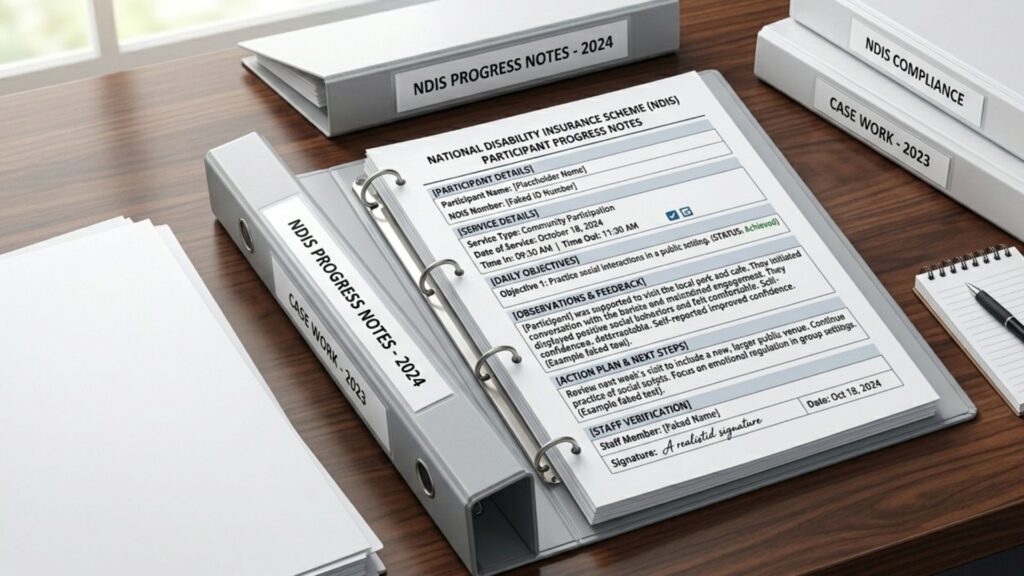
Progress Notes
Providers must track outcomes against the goals in the service plan. Note frequency is specified in the funder contract, but the expectation is consistent: notes must show movement toward the individual’s goals over time, not just that time was spent.
Incident Reports
Reportable incidents include serious injuries, medical emergencies, allegations of abuse or neglect, missing persons, and police involvement. CLBC requires immediate notification for serious incidents, with follow-up documentation completed within specified windows. Late or incomplete incident reports are among the most common deficiencies found during quality reviews.
Staff Records
Providers must maintain current records for every staff member: First Aid and CPR certification, background checks, and training completion. Expired certifications during a funded service period create contract compliance issues. Tracking expiry dates manually across a growing team is where gaps form.
Consent Documentation
Documented, time-limited consent must be on file for each individual. Consent must show the person understood what they were agreeing to. Missing or undated consent forms are a routine audit finding across all three provinces.
How Community Integration Billing Works and Where Claims Get Rejected
Billing for community integration services is unit-based. Providers submit claims for authorized service hours delivered in a given period, and the funder reconciles those claims against service delivery records before releasing payment.
| Common Billing Failure | What Triggers It |
|---|---|
| Hours billed exceed authorized units | Service delivered beyond what the funder approved for the period |
| No matching attendance log | Billing submitted for a session with no documented record |
| Staff not listed on service agreement | A caregiver delivered service but isn’t named in the contract |
| Activity type mismatch | Service code billed doesn’t match what the log describes |
| Late submission | Claims submitted outside the funder’s billing window |
Providers using separate systems for scheduling, service logs, and billing face the most reconciliation delays. When billing has to be manually matched against paper logs or spreadsheets, errors occur and submission timelines slip. ShiftCare’s e-billing tools connect service delivery records directly to billing submissions, cutting the manual reconciliation step that generates most claim rejections.
How Documentation Requirements Vary by Province
BC, Ontario, and Alberta all require person-centred plans, attendance records, progress notes, incident reports, staff records, and consent documentation. The differences are in the funder, the governing legislation, and the specific processes for submission and audit.
| Province | Funder | Governing Framework | Key Process Note |
|---|---|---|---|
| BC | Community Living BC (CLBC) | Community Living Authority Act | Acquittal reporting required; Service Standards updated 2025 |
| Ontario | MCCSS / Developmental Services Ontario | SIPDDA (2008) | Passport Program funds individualized community participation; person-directed planning required |
| Alberta | PDD Program | Continuing Care Act (April 2024) | Regional PDD offices manage contracts; community access and supported employment funded separately |
How to Keep Your Agency Audit-Ready for Provincial Funder Reviews
CLBC, MCCSS, and PDD regional offices can all request records and inspect documentation at any time as a condition of service contracts. Agencies that build audit readiness into daily operations consistently outperform those that prepare reactively.
Three practices make the difference:
- Document at the point of service. Notes and logs completed during or immediately after a session are more accurate and carry timestamps that hold up under review. Documentation completed hours or days later raises questions auditors are trained to ask.
- Automate certification tracking. Automated alerts 60 to 90 days before expiry give staff enough lead time to renew without disrupting service delivery schedules. A lapsed First Aid certification mid-contract is a compliance breach, not an administrative oversight.
- Reconcile billing before submission. Every claim should match a corresponding attendance log before it leaves your system. Catching mismatches pre-submission takes minutes. Resolving them after a funder flags the discrepancy takes weeks.
ShiftCare’s care management platform for Canadian providers centralizes participant documentation, tracks staff certifications, and connects service delivery records to billing workflows. Scheduling tools link authorized service hours to shift assignments, so what’s billed matches what was planned and delivered. Providers managing contracts across BC, Ontario, and Alberta can segment documentation workflows by province within a single platform.
Stop Rebuilding Your Audit Trail From Scratch Every Review Cycle
Documentation gaps surface during provincial quality reviews, acquittal reporting, and billing reconciliation. By then, reconstructing records from scattered logs and spreadsheets costs your team days of administrative work.
ShiftCare gives Canadian community integration providers a single system where documentation, scheduling, and billing connect by design. The audit trail exists because your team built it through normal service delivery, not because someone scrambled to create it before a funder visit.
Start your free trial today and see how ShiftCare keeps your agency contract-ready across every provincial funder you work with.