Electronic Visit Verification (EVV) has evolved from a distant regulatory requirement to an urgent operational mandate. Federal law under the 21st Century Cures Act requires all Medicaid-funded personal care and home health services to implement EVV systems capturing point-of-service data: caregiver arrival and departure times, services delivered, and verified care location. What began as straightforward compliance now directly impacts revenue integrity, billing accuracy, regulatory relationships, and operations.
Agencies without compliant EVV systems face Medicaid funding reductions, claims denials, audit findings, and reputational damage. Yet implemented strategically, EVV transcends compliance to become an operational asset by improving scheduling accuracy, preventing fraud, ensuring correct billing, and enabling data-driven management. Understanding EVV requirements, implementation pathways, and integration with care management systems is essential for any agency serving Medicaid clients.
What is Electronic Visit Verification (EVV)?
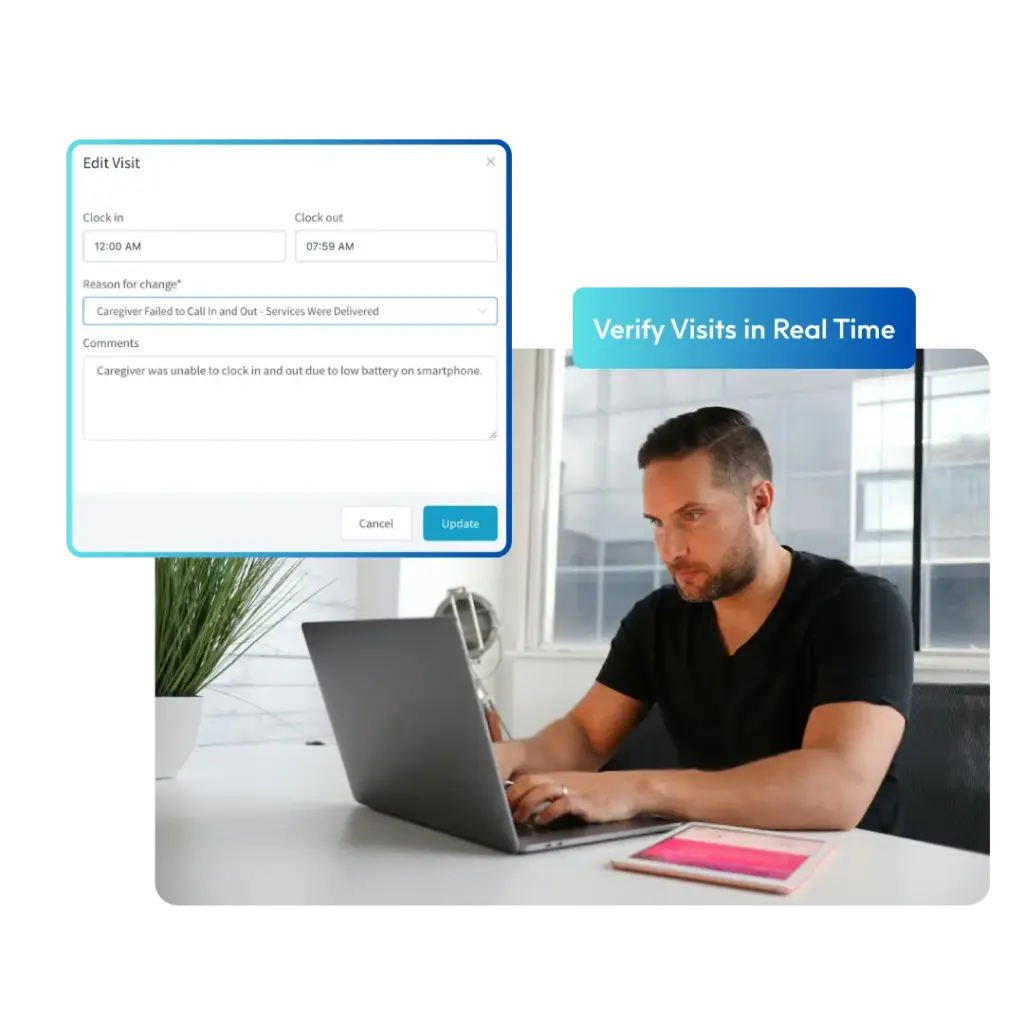
Electronic Visit Verification is a federally mandated system capturing point-of-service information proving that home care services were actually delivered as claimed. EVV records when caregivers arrived and departed from client locations, what services were provided, and who delivered them, creating an auditable trail that protects both agencies and state Medicaid programs from fraud while ensuring accurate billing and compliance.
The Federal EVV Mandate: Understanding the Requirements
Section 12006(a) of the 21st Century Cures Act established a federal requirement that all states implement Electronic Visit Verification for Medicaid personal care services (PCS) and home health services (HHCS) delivered in home and community settings. The deadline for PCS implementation was January 1, 2020; HHCS implementation deadline was January 1, 2023. States failing to comply face incremental FMAP (Federal Medical Assistance Percentage) reductions, up to 1%, unless they can demonstrate good faith implementation efforts and unavoidable delays.
What exactly is EVV? It’s a method of using technology to capture point-of-service information related to in-home service delivery. Rather than relying on paper timesheets that can be completed after the fact or with inaccurate information, EVV captures real-time or near-real-time data verifying that a caregiver actually arrived at the client’s location, provided the claimed services, and departed at the stated time. This creates an auditable record protecting both your agency and the state Medicaid program.
The federal law permits multiple approaches to EVV compliance. Agencies can implement mobile apps with GPS location verification, telephony-based systems where caregivers call designated numbers at visit start and end to verify location and identity, fixed devices (kiosks or tablets at client locations) where caregivers check in and out, or biometric recognition systems capturing visit verification through fingerprint or facial recognition. The specific approach varies by state; each state Medicaid program specifies which EVV methods are permissible within their jurisdiction.
State-Specific EVV Implementation and Timelines
While the federal law creates the overall requirement, states have significant discretion in implementation approach, timeline, validation processes, and penalties for non-compliance. This variation creates complexity for agencies serving multiple states. Colorado, California, Ohio, Indiana, and Pennsylvania, the key markets for home care providers, each have distinct EVV requirements and implementation schedules.
Colorado’s Department of Health Care Policy and Financing (HCPF) manages EVV for Medicaid recipients. Colorado requires EVV implementation for all personal care services by specified deadlines and has developed specific guidance on acceptable EVV technologies and submission formats. Home care agencies serving Colorado’s HCBS population must ensure their EVV systems meet HCPF specifications and submit data through approved channels.
California’s Department of Developmental Services manages EVV for IDD-waiver services through vendor relationships, creating different implementation pathways than traditional Medicaid PCS. Agencies serving California Regional Centers must work with approved EVV vendors and ensure visit data flows through DDS-specified systems.
Ohio, Indiana, and Pennsylvania each have distinct Medicaid EVV requirements with specific timelines, approved vendors, and submission processes. Agencies serving Ohio’s HCBS population face particular complexity in managing multiple state requirements. Many states have indicated plans to strengthen EVV validation in 2026, moving from initial acceptance of claims with EVV data to more rigorous validation processes that can result in denials for data quality issues or missing information.
Understanding your specific state requirements and implementation deadlines is critical. Contact your state Medicaid office, regional center, or managed Medicaid plan to confirm your obligations and approved compliance methods.
Why EVV Matters Beyond Compliance

While federal mandate drives EVV adoption, the business case extends well beyond regulatory checkbox compliance. First, EVV protects revenue integrity. Without EVV, services are billed based on claim submission with limited verification that services actually occurred. This creates vulnerability to fraud. Whether unintentional, such as billing for services not delivered, or intentional, such as caregivers submitting false timesheets, you could receive an audit warning. EVV creates an auditable trail making it extremely difficult to claim services that didn’t happen.
Second, EVV improves billing accuracy. When visit start and end times are verified electronically rather than relying on caregiver recollection or estimates, billing reflects actual service delivery. Caregivers often underestimate time slightly when completing timesheets, or conversely, might inflate time estimates. EVV-captured data reveals actual time spent, enabling accurate e-billing that reflects true service delivery.
Third, EVV enables operational insights that improve efficiency and decision-making. When you have actual data about when visits occur, how long they take, and the geographic spread of service locations, you can optimize scheduling, reduce travel time, and improve caregiver utilization. Agencies report using EVV data to identify scheduling inefficiencies, remove geographical service gaps, and plan capacity more accurately.
Fourth, EVV creates protective documentation if claims are questioned or audited. Should a state auditor or managed Medicaid plan question whether services were actually delivered as claimed, EVV data provides objective verification. This protective documentation is increasingly valuable as states and federal agencies strengthen program integrity efforts.
Implementation Approaches and Vendor Selection
Agencies choosing EVV implementation approaches must balance several considerations: compliance with state requirements, ease of use for caregivers, cost, integration with existing systems, and data security.
How to Implement EVV Compliance Strategies
Mobile app-based EVV with GPS verification is increasingly common. Caregivers check in and out using their smartphones, which captures precise location data and timestamps. This approach requires caregivers to have smartphones and adequate cellular service; agencies must consider whether all caregivers meet this threshold or whether backup methods are needed for those without smartphones. Integration with scheduling software allows automatic visit information to flow to the EVV system, reducing duplicate data entry.
Telephony-based EVV, where caregivers call designated phone numbers at visit start and end, requires less technology from caregivers but lacks location verification. Some states accept telephony as compliant; others require location-based verification. This approach works well for agencies with caregivers unable to use smartphone apps or for rural areas with limited cellular service.
Fixed device EVV using kiosks or tablets at client locations enables check-in/out without requiring caregivers to carry technology. This works well for clients living in facilities where a device can be permanently stationed but is impractical for traditional in-home care. Biometric EVV using fingerprint or facial recognition provides strong identity verification but requires devices at every care location and carries privacy considerations some clients may contest.
Comprehensive care management platforms increasingly integrate EVV functionality directly within their scheduling and documentation systems. Rather than using a separate EVV vendor, caregivers clock in/out through their regular care management app, which simultaneously captures EVV-required data (location, time, service code, caregiver identity, client identity) and submits to state systems. This integrated approach reduces caregiver burden, ensures data consistency, and simplifies administration.
When selecting an EVV approach or vendor, confirm state approval, assess ease of use for your caregiver population, understand integration capabilities with your billing and scheduling systems, and clarify support and maintenance arrangements.
Data Quality and Claims Validation
States increasingly validate EVV data before accepting claims. Initial implementation often involves soft edits, like flagging questionable data but accepting claims anyway. Many states have transitioned or are transitioning to hard edits in 2026. Claims with missing EVV data, suspect timestamps, or data quality issues are actually denied.
Common data quality issues that trigger claim denials include missing visit start or end times, caregiver check-in times inconsistent with claimed service, location data indicating services outside approved service areas, or data submitted after claim deadlines. Agencies submitting EVV data must ensure their systems capture and validate data correctly before submission.
Claims validation often includes checking whether start and end times align with visit duration claims, ensuring location falls within the approved service delivery area, confirming that the claimed caregiver is properly certified for the claimed services, and verifying that client eligibility was active on the service date. Some states conduct post-payment audits examining random sample of claims to verify EVV data authenticity and accuracy.
Your agency’s success depends on building EVV data quality into operational workflows rather than attempting to correct or fix data at submission. This means ensuring caregivers understand the importance of accurate check-in/out, providing training on EVV systems, monitoring for common data quality issues, and correcting problems before claims are submitted.
Integration with Care Management and Scheduling Systems
The most efficient EVV implementation integrates seamlessly with your broader care management platform. Rather than separating EVV into a standalone system, modern platforms capture EVV data as part of normal caregiver workflows. When a caregiver opens their mobile app to view the day’s schedule and visit information, they clock in at the client location using the same app. This clock-in automatically captures location (via GPS), time, caregiver identity, client identity, and service codes from the visit plan.
This integration eliminates duplicate data entry. Caregivers don’t log into separate EVV systems after documenting care through your main platform. It ensures data consistency as visit information exists in one place rather than across multiple systems. It also enables better analytics. You can correlate EVV time data with care documentation, billing information, and scheduling to identify patterns, opportunities, and issues.
Integration with billing systems is particularly valuable. Visit time captured through EVV automatically flows to billing, eliminating manual time entry and reducing billing errors. When visit time disputes aris between claimed time and actual time per EVV, the system can flag these automatically for review.
Integration with scheduling systems enables continuous feedback loops. If EVV data shows that visits consistently run longer than scheduled, the scheduler can adjust future scheduling. If geographic routing is inefficient, the system can suggest better optimization.
Compliance Monitoring and Audit Readiness
Build ongoing compliance monitoring into your operations rather than scrambling to achieve compliance only when audits occur. This means regularly running EVV data quality reports, identifying missing or questionable data, investigating and correcting issues, and maintaining documentation of correction efforts.
Designate someone responsible for EVV compliance. Your billing or compliance manager has the authority and support to investigate data quality issues and ensure systems are functioning correctly. This person should maintain regular contact with your state Medicaid agency or managed plan to understand any updates to requirements or acceptable methods.
Conduct internal audits of your EVV data sampling random claims and verifying that EVV documentation supports the service claim. Are start and end times reasonable for the claimed service? Is location consistent with client address? Are required data fields complete? These internal audits identify problems before external auditors do.
Maintain documentation of your EVV implementation, vendor contracts, caregiver training on EVV systems, and any data quality issues identified and corrected. When external audits occur, this documentation demonstrates your good-faith compliance efforts and systematic approach to maintaining data quality.
Preparation for 2026 and Future Changes
Most states are strengthening EVV validation in 2026, moving from softer acceptance of data to harder validation and claims denials. Take Missouri as an example. It announced soft-edit claims validation launching January 2026. Hard edits turning on in phases by provider type starting April 2026. Other states will likely follow similar trajectories.
This means 2026 is a critical year for agencies to ensure their EVV systems are fully functional, data quality is excellent, and staff are well-trained. Claims that might have been accepted with marginal EVV data in 2025 may be denied in 2026. Agencies not already compliant should prioritize implementation now rather than waiting for harder deadlines.
Additionally, anticipate that regulatory requirements will continue evolving. Federal agencies are discussing additional data elements beyond basic visit verification. For example, capturing specific services provided, documenting outcomes, or integrating quality measures. Choosing EVV systems and platforms designed for flexibility and future evolution helps you remain compliant as requirements change.
FAQs About Electronic Visit Verification (EVV) Compliance for HCBS Providers
What data does EVV actually capture and why does it matter?
EVV captures caregiver arrival time, departure time, service location, services delivered, and caregiver identity for each client visit. This creates an objective record for services. You’ll see which were delivered as claimed, preventing billing fraud, ensuring accurate billing matches actual service delivery, and protecting your agency during audits. States increasingly validate this data before accepting claims for payment.
Which EVV method is best for our agency?
The best EVV method depends on your caregiver population, state requirements, and service model. Mobile app-based EVV with GPS works well for tech-savvy caregivers and agencies with good cellular coverage. Telephony-based EVV works for caregivers without smartphones or rural areas. Fixed device EVV works for facility-based clients. Most agencies benefit from integration with their core scheduling software rather than separate EVV systems to reduce caregiver burden and ensure data consistency.
What penalties apply if we’re not EVV-compliant?
Non-compliance consequences vary by state but can include claim denials, Medicaid funding reductions, audit findings, demand for repayment of denied claims, reputational damage with payers, and potential loss of contracts with Medicaid managed care plans. Some states impose per-claim penalties. The most significant impact for most agencies is having claims denied outright, which directly impacts revenue and cash flow.
Turn EVV Compliance Into an Operational Advantage
EVV is no longer optional. Agencies should start implementing it strategically. Select appropriate methods, integrate with care management systems, and maintain rigorous data quality to gain competitive advantage alongside regulatory compliance. As states strengthen validation requirements in 2026 and beyond, agencies without mature EVV systems will increasingly face claim denials and audit findings. ShiftCare’s integrated care management platform includes robust EVV capabilities designed for HCBS providers. from mobile app-based check-in to automated data validation and state-specific claim submission.
Start your free trial today. See how ShiftCare’s EVV integration supports your compliance and operational efficiency.