Choosing disability care management software in Canada means finding a platform built for provincial funder requirements, not one adapted from a generic healthcare or US-built product. This guide covers what features matter, what compliance requirements to check, and what questions to ask before committing.
Spreadsheets and paper files break down at the same point for most Canadian disability providers: when caseloads grow faster than the admin team can keep up. Documentation falls behind, billing doesn’t match service records, and audit prep becomes a multi-day scramble. Software solves that only if it’s built for how Canadian provincial funders actually operate.
Why Generic Software Fails Canadian Disability Providers
CLBC in BC, MCCSS through DSO in Ontario, and PDD regional offices in Alberta each have specific documentation standards, billing workflows, and audit requirements. Software built for US home health agencies or generic healthcare settings doesn’t map to any of them. A platform that can’t segment compliance requirements by province, or that uses US billing terminology, adds administrative work rather than reducing it.
Disconnected modules create the same problem. Scheduling in one system, billing in another, and care notes in a third means staff spend time manually reconciling data that should flow automatically. Every manual transfer introduces errors and breaks the audit trail.
What Features to Look for in Disability Care Management Software
These are the features that directly reduce compliance risk and administrative overhead for Canadian providers. Everything else is secondary.
Person-Centred Care Plans
Care plans must reflect the individual’s goals, strengths, and support preferences. Provincial funders review plans during quality audits and expect them to be current. Software with structured, updateable care plans and version history gives you a defensible record when a funder requests documentation.
Scheduling Linked to Authorised Service Hours
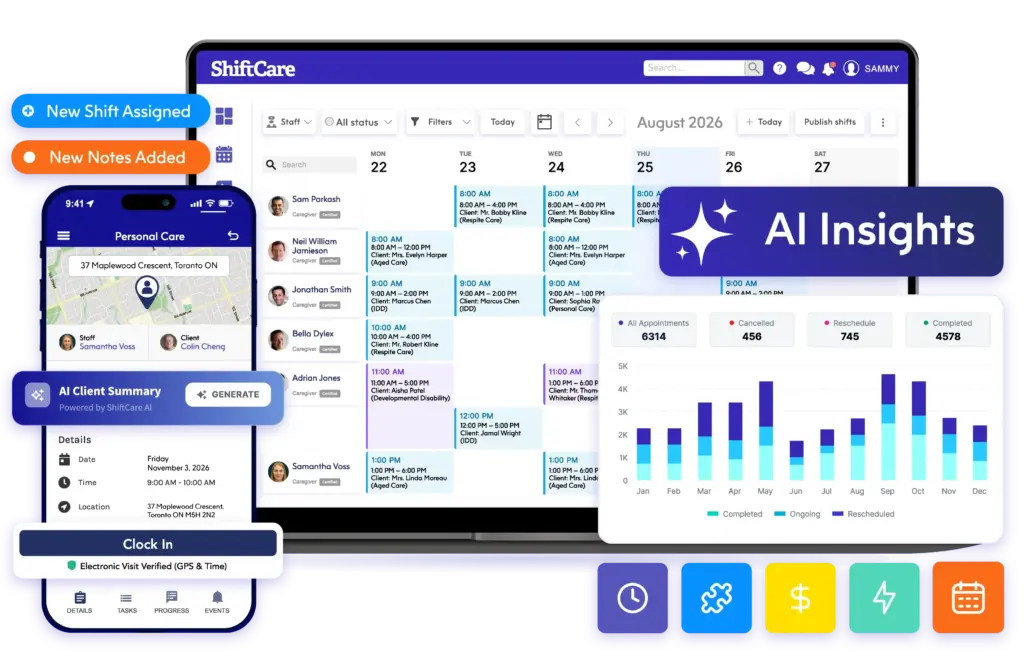
Authorised service hours from the funder agreement should feed directly into shift assignments, so only approved services get scheduled and billed. When a caregiver delivers a service outside the authorisation, the discrepancy needs to surface before billing reaches the funder, not after a claim comes back rejected.
Progress Notes and Activity Logs
Progress notes must connect to specific participants and specific goals. Funders expect notes to show movement toward documented objectives over time. Activity logs recording date, time, staff name, service type, and participant attendance are the primary evidence that services were delivered as billed.

Incident Reporting
CLBC requires immediate notification for serious incidents. DSO-contracted providers in Ontario follow MCCSS reporting requirements. Software with built-in escalation workflows and completion tracking reduces the risk of late or incomplete reports, which are among the most common deficiencies found during funder quality reviews.
Staff Certification Tracking
Every staff member delivering funded services must hold current certifications: First Aid, CPR, and background checks at minimum, with additional requirements varying by province and service type. Alerts triggered 60 to 90 days before expiry give enough lead time for renewals without disrupting shift schedules.
Audit Trails and Role-Based Access
Funders expect to see who accessed records, who made changes, and when. Role-based access restricts staff to participant information their role requires. Timestamped logs covering every edit, login, and document update are a baseline expectation in most provincial funder contracts.
Billing Integration
Service delivery records should feed directly into billing submissions without a manual export step. Pre-submission reconciliation that flags mismatches between visit documentation and billing data catches errors before they reach the funder and turn into rejection notices.
How to Evaluate Whether Software Meets Canadian Compliance Requirements
A demo showing clean UI and fast scheduling doesn’t tell you whether the platform holds up under a CLBC acquittal report or an MCCSS quality review. Ask vendors to demonstrate these specifically:
| Compliance Area | What to Look For |
| Provincial funder support | Can the platform segment documentation requirements by province? Does it support CLBC, DSO, and PDD workflows separately? |
| Care plan structure | Does the format align with person-centred planning requirements under SIPDDA (Ontario) or CLBC Service Standards (BC)? |
| Incident reporting | Are report templates configurable to provincial funder requirements, with escalation workflows and completion tracking? |
| Billing reconciliation | Does the platform flag mismatches between service records and billing submissions automatically before export? |
| Data residency | Is participant data stored on Canadian servers? BC’s PIPA and Ontario’s PHIPA have specific data residency implications for providers. |
Questions to Ask Before Choosing a Platform
- Is the software built for Canadian disability services, or adapted from another market? US-built platforms use Medicaid billing terminology and EVV workflows that don’t apply in Canada. Ask where existing Canadian clients are and which provincial funders they work with.
- Can it handle multi-province operations? Providers operating across provinces need to track different funder requirements, documentation standards, and billing windows within a single system. A platform that forces one unified compliance approach creates gaps wherever provincial requirements diverge.
- How does the platform handle data privacy? BC’s Personal Information Protection Act (PIPA) and Ontario’s Personal Health Information Protection Act (PHIPA) govern how participant data must be stored and handled. Confirm the vendor stores data on Canadian servers and can provide privacy compliance documentation for your province.
- What does implementation look like? Switching platforms mid-operation disrupts service delivery if not managed carefully. Ask for a realistic timeline, whether historical records can be migrated, and what training support is included before go-live.
- What does ongoing support cover? Provincial funder requirements change. Billing rules update. Staff turnover means new users need onboarding regularly. Support that covers regulatory updates and retraining keeps compliance intact over time.
Stop Evaluating Software That Wasn’t Built for Canadian Providers
A platform that digitises existing paperwork without connecting care plans, scheduling, and billing to each other just moves the reconciliation problem onto a screen. The audit trail still has to be rebuilt manually when a funder requests records.
ShiftCare is purpose-built for Canadian disability and home care providers, with support for CLBC, DSO, and PDD compliance workflows in a single platform. Scheduling tools link authorised service hours to shift assignments, and e-billing automation reconciles visit records against billing submissions before they leave your system.
Start your free trial today. See how ShiftCare supports compliant, efficient service delivery across every province you operate in.