Progress notes for behavioural support document what behaviour occurred, which strategies the support worker used, and how the person responded. Provincial funders in Canada, including CLBC, DSO, and PDD Alberta, treat these notes as primary compliance documents during contract reviews. Accurate documentation requires objective language, BSP references, and same-day recording.
Progress notes for behavioural support carry more documentation risk than standard shift notes. CLBC in BC, DSO in Ontario, and PDD in Alberta each review these records to verify that support workers followed approved strategies and recorded outcomes accurately.
The sections below cover what to include, how to write in objective language, how progress notes connect to Behaviour Support Plans, and what mistakes generate risk during funder reviews.
What Should Progress Notes for Behavioural Support Actually Include?
Behavioural support progress notes document more than what tasks a support worker completed during a shift. They record how the person responded, which strategies the worker applied, and whether those strategies came from the Behaviour Support Plan.
Core elements of a behavioural support progress note
- Date, shift time, and name of the support worker completing the note
- Specific behaviour observed, with time and context
- Strategies the worker used, referencing the relevant section of the BSP
- The person’s response to those strategies
- Any escalation or de-escalation the worker observed during the shift
- Communication with team members, supervisors, or family that shift
How Do You Document Challenging Behaviour Without Using Subjective Language?
Progress notes function as legal documents in provincial funder audits. Subjective or emotional language creates problems during reviews and provides little useful data for tracking behaviour over time.
- Document what is observable
- Support workers should record what they saw and heard. Neutral descriptors work: restless, raised voice, withdrawn, rapid movement, verbal refusal. Workers should avoid assigning intent or using emotional characterisations: aggressive, uncooperative, manipulative, difficult.
- When documenting a specific event, the note should answer four questions: what did the behaviour look like, when did it start, how long did it last, and what did the worker do in response.
What Is a Behaviour Support Plan and How Does It Connect to Progress Notes?
A Behaviour Support Plan (BSP) is the authorised document outlining agreed strategies for responding to specific behaviours. In Ontario, a registered psychologist, psychological associate, or other qualified clinician must prepare or approve the BSP under Ontario Regulation 299/10. CLBC in BC requires BSPs to include parameters for data collection, documentation, and reporting.
Progress notes are the shift-by-shift record of whether support workers followed those strategies and how the person responded. Without notes showing workers implementing the plan, funders cannot verify the BSP is operational.

What Do Provincial Funders Expect from Behavioural Support Documentation in Canada?
CLBC, DSO, and PDD in Alberta treat progress notes as core compliance documents and review them during contract audits to confirm that workers followed approved strategies and that agencies recorded outcomes for each shift.
Province-specific expectations
- Ontario (MCCSS/DSO): Behavioural documentation must reference the approved BSP. Reviewers check notes against Ontario Regulation 299/10 requirements during service reviews.
- British Columbia (CLBC): Temporary Safety Plans run for a maximum of 60 days. Agencies must send CLBC a copy immediately and maintain detailed progress notes throughout the temporary plan period.
- Alberta (PDD): The Alberta Council of Disability Services defines a qualified person for behavioural supports as someone with at least two years of relevant training and three years of practical experience. Documentation must reflect strategies that a person meeting that definition approved.
How Do You Document a Behavioural Incident in a Progress Note?
Most provincial systems require a separate incident report for significant behavioural incidents. The progress note for that shift should still document the event independently.
What the progress note should capture alongside the incident report
- Antecedent: what happened immediately before the behaviour started
- Behaviour: what the worker observed, described in objective terms
- Time: when the behaviour started and how long it lasted
- Response: which strategies the worker used and whether they came from the BSP
- Outcome: what happened after the worker responded, including any escalation or resolution
Workers who file an incident report but leave the progress note incomplete create a documentation gap that funders flag during audits.
What Documentation Mistakes Put Providers at Risk During Funder Reviews?
- Completing the note hours after the shift without noting it as a late entry
- Copying a previous shift’s note without updating what actually occurred
- Using emotional or interpretive language instead of observable descriptions
- Failing to reference the BSP strategies the worker used in response to a planned behaviour
- Recording that a behaviour occurred without documenting the response or outcome
Frequently Asked Questions
How soon after a shift should a support worker complete a progress note?
Support workers should complete progress notes before the end of their shift or as soon as possible after. Most provincial funders and agency policies require same-day documentation. Late entries should include a notation stating when the worker completed the note and why. Agencies that routinely allow workers to complete notes hours or days after a shift create documentation patterns that funders treat as a compliance concern.
What happens if progress notes are incomplete during a funder review?
CLBC, DSO, and PDD Alberta review progress notes as evidence that agencies delivered services and followed approved support plans. Incomplete notes can result in funding clawbacks for unverified service hours, findings of non-compliance with contractual documentation requirements, or requests for corrective action plans. Agencies with consistent documentation gaps risk contract review.
Should progress notes for behavioural support reference the Behaviour Support Plan?
Yes. Notes for shifts where a planned behaviour occurred should reference the specific strategies the BSP outlines and record whether the worker followed them. A note that records a behaviour without referencing the BSP strategy gives reviewers no way to confirm the agency implemented its own approved plan.
Can support workers express an opinion in a progress note?
Progress notes should record observations, not opinions. Workers can document what the person said, did, and how they responded to support strategies. Statements about what the person was thinking, feeling, or intending belong in a clinical assessment, not a shift note. Agencies should train workers to distinguish between observation and interpretation before they start documenting.
What is the difference between a progress note and an incident report in Canadian disability services?
A progress note is a routine shift record documenting what occurred during a visit, including any behaviours observed and the strategies the worker used. An incident report is a formal notification for significant events such as a serious behavioural incident, injury, or safeguarding concern. Most provincial systems require both documents when a significant incident occurs: the incident report initiates the formal notification process, and the progress note records the shift-level detail of what happened.
Give Your Team a Documentation System Built for Behavioural Support
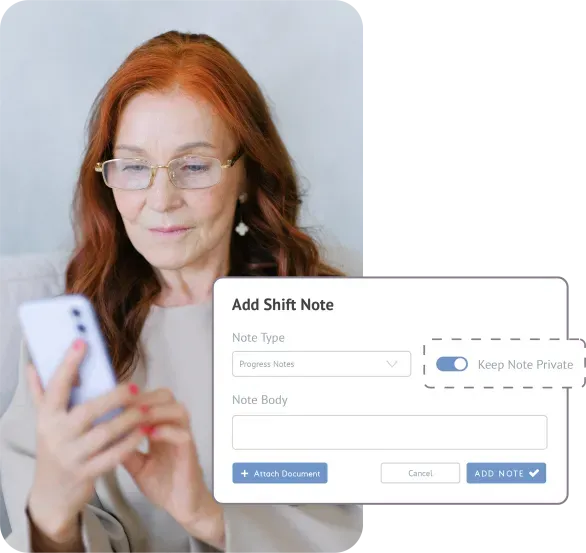
ShiftCare’s home care software for Canadian providers gives support workers a structured progress note template that captures behavioural observations, strategy references, and outcomes at the point of care. Care notes connect directly to each client’s support plan. Start your free trial today, no credit card required.
See it in ShiftCare.
7 days free on Premium. No credit card.