Automating EVV & Medicaid Billing Compliance for Home Care & IDD Providers

EVV is designed to protect clients and payors against fraudulent claims. But for home care and IDD providers, compliance often feels like an overwhelming barrier. A forgotten clock-out, an inaccurate GPS log, or a dropped signal can be the difference between a paid claim and a rejected one. Stack enough of those small errors, and you’re looking at an audit.
You didn’t get into this work to fight billing systems. You got into it to support people who need care. But when manual processes are eating into your team’s time and threatening your revenue, something has to change.
As discussed in our recent webinar with Paradigm, automation is how providers are closing compliance gaps without adding more admin work. ShiftCare and Paradigm work together to streamline EVV and Medicaid billing, so your team can focus on care delivery instead of chasing rejected claims.
Here’s what you need to know about how to upgrade your compliance and billing workflows.
What EVV Compliance Actually Requires (And Why It’s Not Just About Clock-Ins)
Under the 21st Century Cures Act, states must require Electronic Visit Verification for all Medicaid-funded personal care and home health services. But EVV compliance goes beyond simply clocking in and out. Federal requirements mandate six data capture points for every visit:
| Data Point | What It Captures | Why It Matters |
| Clock-in/Out Times | Exact start and end of visit | Medicaid won’t reimburse without verified timestamps |
| Geolocation | GPS coordinates of visit location | Proves the caregiver was at the client’s address |
| Service Type | HCPCS code for service delivered | Must match authorization and billing code |
| Caregiver Name | Who delivered the service | Required for compliance and audit trails |
| Care Recipient | Who received the service | Links visit to correct Medicaid ID |
| Date of Service | When service was delivered | Must fall within authorization period |
Source: CMS Electronic Visit Verification Requirements
Why EVV Compliance Requirements Vary by State
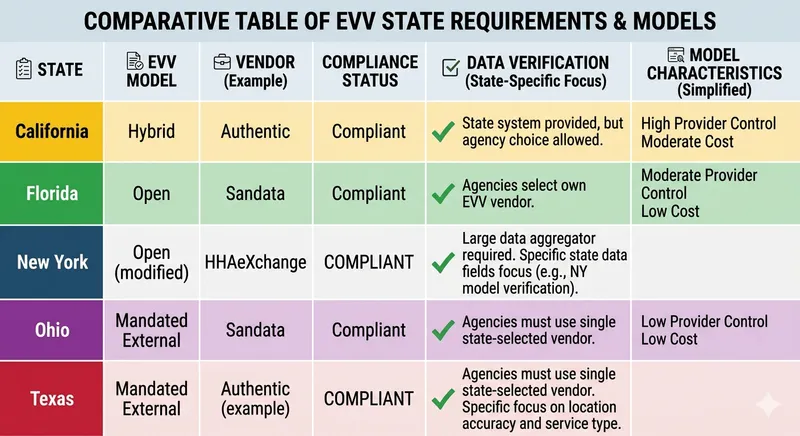
The 21st Century Cures Act sets the federal EVV mandate, but each state implements it differently. As we covered in our webinar with Paradigm, this is where multi-state providers face layered compliance complexity.
EVV Model Variations
- Alternate EVV states (e.g., Colorado): Providers choose their own EVV vendor rather than using a state-mandated aggregator.
- Aggregator states: States mandate specific EVV aggregators like Sandata or HHAeXchange. All providers must submit through the designated system.
- Hybrid models: Some states allow both open and aggregator options, depending on service type.
Manual Edit Thresholds
- Pennsylvania: Enforces a 15% cap on manual EVV edits. Exceed it twice and you’ll receive a formal non-compliance letter from the state.
- Other states: No published threshold, but patterns of manual edits trigger MCO reviews and can result in loss of preferred provider status.
- Regardless of state, high manual edit rates are a red flag for auditors.
Service Code and Modifier Differences
- Each state uses unique HCPCS codes and modifiers for HCBS services.
- Rate changes come with code updates — miss them, and your claim gets denied instantly.
- Regional Center vendors in California use different billing codes from Ohio HCBS providers.
- Medicaid waiver programs across Ohio, Indiana, Pennsylvania, and Colorado each define covered services differently.
For a step-by-step guide to getting EVV right from day one, read: How to Implement EVV in Your Home Care Business.
Common EVV Pitfalls That Cause Claim Rejections

EVV compliance is just one layer of the billing process. Even with clean visit verification, claims get rejected for reasons that have nothing to do with whether the caregiver clocked in correctly. Here are the most common pitfalls, and how automation prevents them.
Using Outdated Service Codes or Modifiers
Rate changes and policy updates come with new HCPCS codes and modifiers. Miss a code update, and your claim gets denied before anyone reviews it.
Claim scrubbing catches this before submission. It checks service codes against current rate schedules, flags outdated codes, and suggests correct replacements — preventing denials from coding errors that most providers don’t catch until it’s too late.
Neglecting Weekly Remittance Reconciliation
The amount showing in your payer portal doesn’t necessarily mean it’s in your account. Remittance Advices (RAs) contain payment details, adjustments, and denials. If you don’t reconcile weekly, missed payment discrepancies and shortfalls only surface during payroll — when it’s too late to fix them quickly.
Automated reconciliation posts payments, flags discrepancies, and gives you real-time cash flow visibility. No more surprise shortfalls weeks after services were delivered.
EVV Slippage Above 1%
EVV slippage is the percentage of visits with EVV errors: missed clock-ins, GPS mismatches, and manual edits. Managed Care Organizations (MCOs) track this metric closely. When slippage exceeds 1%, providers risk losing preferred provider status — which directly impacts your referral pipeline and revenue.
Even small error rates compound across hundreds of visits per week. Automated clock-in reminders and real-time exception reporting let coordinators fix issues during the week, not during the billing cycle.
Why Clean EVV Alone Doesn’t Guarantee Payment
Clean EVV verifies that a service happened. But it doesn’t address authorization overages, service code errors, or eligibility lapses. As we discussed in our webinar with Paradigm, billing compliance requires additional validation layers that EVV alone can’t provide.
Exceeding Authorizations
A caregiver delivers 42 hours. The participant was authorized for 40. EVV is clean, but billing gets rejected for exceeding authorization. You’ve already paid the caregiver, but Medicaid won’t reimburse you. That’s margin erosion on hours your team already worked.
Service Code Errors
A client is eligible for both Medicaid and Medicare. Your billing team bills the wrong payer or uses the wrong service code. The claim gets rejected even though EVV is perfect and the service was delivered correctly. These dual-eligible scenarios are one of the most common — and most preventable — causes of claim denials.
How ShiftCare and Paradigm Work Together to Automate EVV and Billing Compliance
[Suggested image: Caregiver with client, warm and professional]
The goal isn’t to pile more admin work onto your team. It’s to replace the spreadsheets, manual checks, and disconnected tools that are holding you back. As we walked through in our recent webinar with Paradigm, the ShiftCare and Paradigm integration covers the full compliance workflow — from the point of care through to payment.
ShiftCare handles automated EVV compliance at the point of care. Paradigm handles Medicaid and VA billing, claim scrubbing, and denial management. Together, they reduce manual edits, prevent claim rejections, and improve cash flow.
Learn more about the integration: ShiftCare + Paradigm: Automate Medicaid & VA Billing
ShiftCare: Automated EVV Compliance at the Point of Care
Automated Clock-In/Out Reminders: Push notifications remind caregivers to clock in when their shift starts, meaning no manual tracking required. This directly reduces EVV slippage from forgotten clock-ins, one of the most common causes of manual edits and audit flags.
GPS-Verified Visits, Even Offline: Most EVV systems fail when you lose your internet connection. ShiftCare captures GPS-verified clock-ins offline and syncs automatically when the connection is restored. Your staff can clock in and out accurately even in rural or low-connectivity areas.
Real-Time EVV Exception Reporting: ShiftCare flags EVV exceptions instantly: missed clock-ins, GPS mismatches, timestamp issues. Coordinators can resolve errors during the week instead of scrambling at the end of the billing cycle, which reduces the manual edits that increase audit risk.
Paradigm: EVV Reconciliation and Claim Scrubbing
Pre-Submission Validation: Paradigm scrubs claims before they’re submitted. It checks EVV alignment, service codes, authorization limits, and eligibility, catching the errors that would trigger rejections before the claim ever leaves your system.
Post-Submission Monitoring: After submission, Paradigm tracks claim status in real time. It handles denials, appeals, and payer follow-ups so issues are caught and resolved early, not months later during an audit. Providers get paid faster with fewer rejected claims.
Learn more about how Paradigm supports home care providers to get paid on time, stay compliant, and scale confidently with a fully integrated, AI-powered platform.
Automate EVV and Billing Compliance to Protect Your Revenue
Manually monitoring authorization overages, service code updates, and EVV exceptions pulls your team away from their core responsibilities. Every hour spent chasing a rejected claim is an hour not spent supporting clients.
Start your free trial today! ShiftCare and Paradigm give you a connected compliance workflow, from caregiver clock-in through to claim payment. No more spreadsheets, no more last-minute scrambles, and no more surprise denials.