EVV Software vs Full Care Management Systems: What’s the Difference?
EVV software captures the six CMS-required data elements for Medicaid visit verification: service type, caregiver identity, service receiver, date, start and end time, and service location. Full care management systems include EVV plus scheduling, Medicaid billing, care plan documentation, credential tracking, and reporting. Most home care agencies need both functions in one integrated platform.
Many agencies buy standalone EVV to meet the federal mandate. The visit gets verified. But the Medicaid claim still needs submitting. The care plan needs updating. The caregiver’s certification needs tracking. The sections below explain what each system covers, where each one stops, and what a disconnected setup costs a billing team.
What Is EVV Software and What Does It Actually Do?
The 21st Century Cures Act required EVV for all Medicaid personal care services from January 2020. Home health services followed in January 2023. Every Medicaid-funded visit must generate an EVV record with six specific data elements. That record transmits to the state aggregator before the associated claim processes.
EVV software does exactly that. It captures visit data at the point of care, timestamps the record, and transmits it to the state system.
What standalone EVV software does not include
- Caregiver scheduling or shift management
- Medicaid claim generation or submission
- Care plan creation or documentation templates
- Progress note capture
- Caregiver credential and certification tracking
- Billing performance or utilization reporting
What Does a Full Home Care Management System Include That EVV Software Doesn’t?
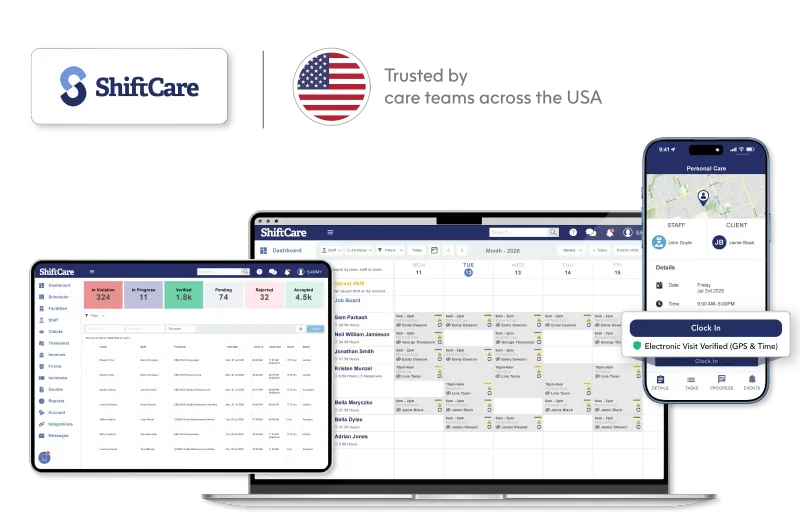
A full care management platform treats EVV as one module. Visit verification data flows directly into scheduling, billing, and documentation workflows. No manual re-entry. No reconciliation between disconnected systems.
Features beyond EVV in a care management platform
- Scheduling: shift assignment, caregiver-client matching, gap and conflict alerts
- Medicaid billing: claim generation from verified visit data, state-specific code mapping, submission and denial tracking
- Care plan documentation: state-specific templates linked to each participant’s authorized services
- Progress notes: captured at point of care, tied directly to the visit record
- Credential tracking: caregiver certification expiry alerts, background check status, training records
- Management reporting: authorization utilization, billing performance, EVV compliance rates
Can EVV Software Handle Medicaid Billing on Its Own?
No. EVV captures and transmits visit data. It does not generate or submit claims.
Billing requires converting verified visit records into billable service units using state-specific codes. Those units must match the participant’s authorized hours. Then the claim goes to the state Medicaid agency or managed care organization.
When EVV and billing run in separate systems, a coordinator manually reconciles visit records before each billing cycle. That step introduces the mismatches that generate denials. Under hard-edit enforcement, a discrepancy between EVV data and the claim submission triggers an automatic rejection.
Do Agencies in Open-System States Still Need a Care Management Platform?
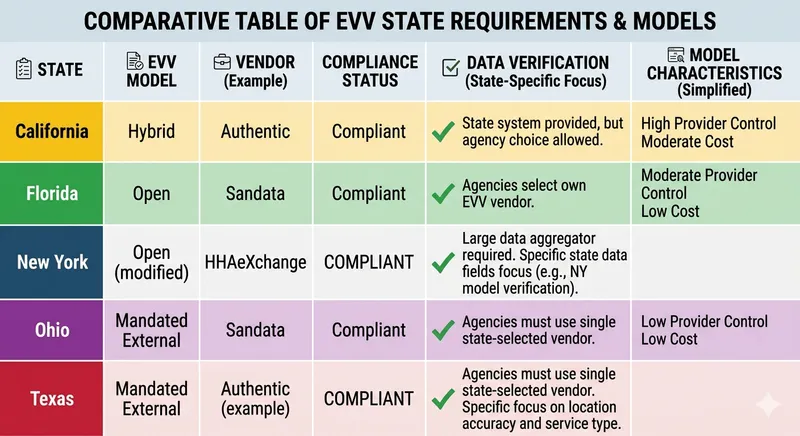
State type determines which setup applies.
Closed EVV states
The state mandates a specific EVV platform all Medicaid providers must use. The state’s system handles visit verification only. Agencies in closed states still need a separate platform for scheduling, billing, and care documentation.
Open EVV states
Agencies choose their own EVV software, as long as it transmits data to the state aggregator in the required format. In open states, a care management platform with built-in EVV handles verification and operations in one place. Agencies in open states gain the most from consolidation.
What Does Running Separate EVV and Billing Systems Actually Cost?
Disconnected systems introduce manual steps at the exact point where billing errors originate.
- Double data entry: Visit data captured in EVV must transfer manually into the billing platform each cycle.
- Timestamp mismatches: Manual transfers introduce discrepancies between what EVV recorded and what billing submits.
- Aggregator gaps: Visit data that doesn’t transmit to the state aggregator before claims go out triggers automatic denial under hard-edit enforcement.
- Reconciliation time: Coordinators spend hours per billing cycle matching EVV records to claims instead of managing operations.
None of these are edge cases, as they accumulate across every billing cycle for every active caregiver.
Frequently Asked Questions
Is EVV mandatory for all Medicaid home care services?
The 21st Century Cures Act requires EVV for all Medicaid-funded personal care and home health visits. The personal care mandate took effect January 2020. Home health followed in January 2023. Services delivered outside the home or without a physical in-home visit generally fall outside the requirement. State Medicaid agencies control implementation details, so covered services and enforcement timelines vary by state.
What are the six data elements CMS requires for EVV?
CMS requires agencies to capture six elements for every EVV visit record: the type of service delivered, the identity of the individual receiving care, the identity of the caregiver, the date of the visit, the start and end times, and the service location. Missing any element causes the EVV record to fail validation at the state aggregator. A failed record blocks the associated claim from processing.
What is the difference between an open and a closed EVV state?
In closed states, the state mandates a specific EVV platform all Medicaid providers must use. In open states, agencies choose their own EVV system as long as it transmits data to the state aggregator in the required format. Closed-state agencies handle visit verification through the state system and still need a separate platform for scheduling, billing, and care management. Open-state agencies can consolidate into one care management platform with built-in EVV.
How does EVV data reach the state Medicaid aggregator?
Most states route EVV data through a designated aggregator before it matches to a claim. Agencies using open EVV systems must transmit visit records to the aggregator in the state’s required format after each visit. Care management platforms with direct aggregator integration handle transmission automatically. Standalone EVV systems typically export data manually or through a batch process. Transmission failures before claims go out trigger automatic denials under hard-edit enforcement.
Can a home care agency use its own EVV software instead of the state’s system?
In open-system states, yes. Agencies choose any EVV software that transmits the six required data elements to the state aggregator. In closed-system states, no. The state mandates a specific platform all providers must use. Agencies operating across multiple states need to verify each state’s system type and confirm whether their care management platform integrates with the relevant aggregators.
Stop Managing EVV and Billing in Separate Systems
Disconnected tools require manual reconciliation at every billing cycle. Errors in that process generate denials that take weeks to recover.
ShiftCare’s EVV software captures all six CMS-required data elements at point of care and feeds verified visit data directly into the billing workflow. Start your free trial today and see how your team can start improving current workflows.