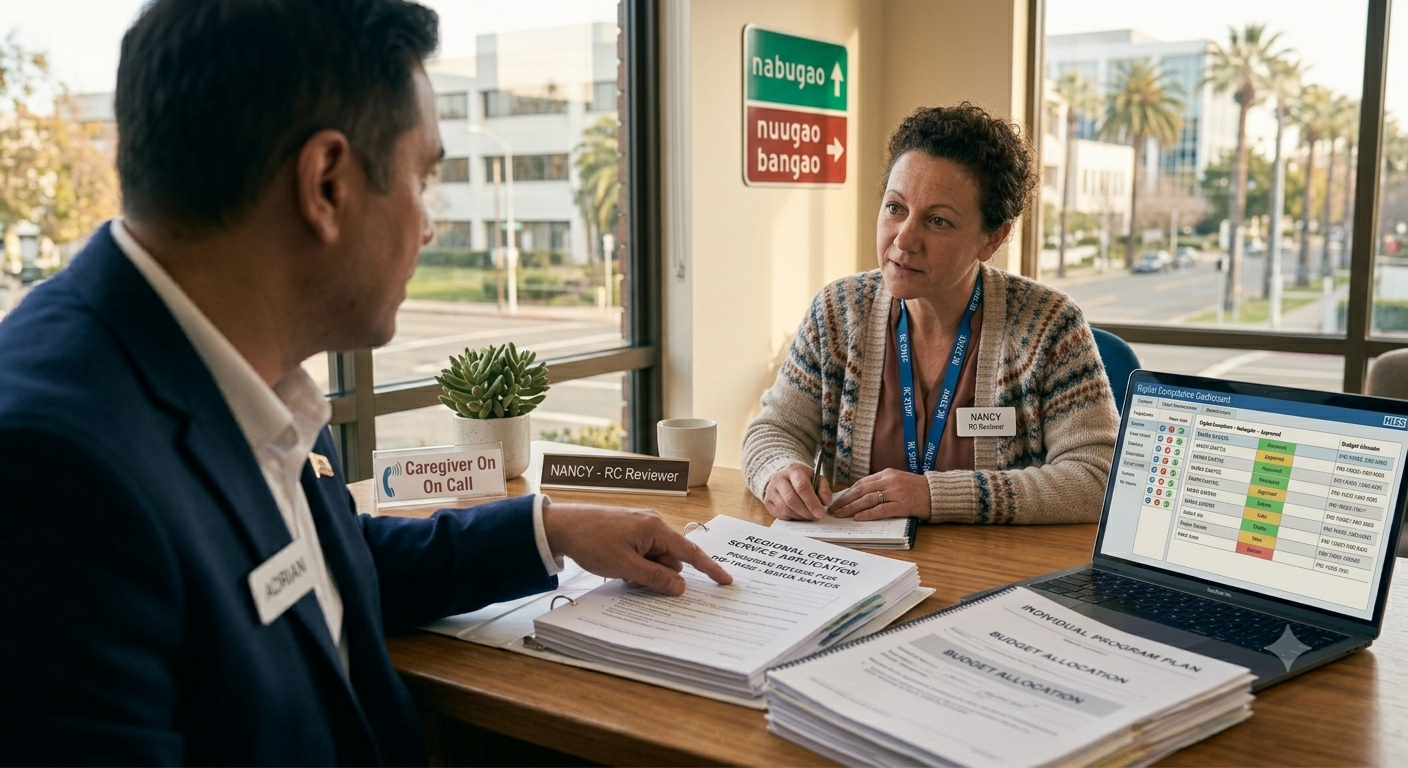
California Regional Center vendorization runs through Title 17 requirements, Live Scan clearances, and individual regional center review queues, each moving on a different timeline. Agencies that treat it as a one-step process lose weeks they don’t have to lose. Here’s what the process actually requires, and where most agencies slow themselves down.
Becoming a California Regional Center vendor takes most agencies far longer than they plan for, not because any single step is complicated, but because the process runs through several different reviewers who each work on their own timeline. The California Department of Developmental Services sets the framework under the Lanterman Act, but each of the state’s 21 regional centers manages its own vendorization intake, staffing, and pace.
Agencies that assume vendorization works like joining a new insurance panel typically underestimate how much documentation, background clearance, and program review stands between an application and a first referral.
The Real Timeline for Becoming a Regional Center Vendor in California
Most agencies budget a few weeks and end up spending several months. The gap usually comes from assuming the steps run in sequence, when most of them run in parallel. Background clearances, policy development, and the regional center’s review queue move at different speeds. A delay in one doesn’t pause the others; it creates a bottleneck where every piece has to align before the application moves forward.
Agencies that start background checks and policy documentation before they’ve chosen a regional center to apply with move through the process in a fraction of the time of those waiting for a green light at each stage.
Step 1: Confirm Your Service Category Matches an Actual Need
Title 17 of the California Code of Regulations defines dozens of distinct service codes, from Independent Living Services and Supported Living Services to In-Home Respite and Personal Assistance Services. Each carries its own staffing, documentation, and licensing requirements.
Agencies sometimes choose a service category based on what sounds closest to what they already do, rather than what a regional center’s consumers actually need in that catchment area. The result is an application that technically qualifies but never generates referrals. Talking to a regional center’s community services division before filing tells an agency whether there’s real unmet demand for the category it’s about to build a program around.
Step 2: Clear Live Scan and DOJ Background Requirements Early
Every staff member with consumer contact needs a Live Scan fingerprint background check through the California Department of Justice, cross-referenced against FBI records. Results can take several weeks depending on volume and whether a record requires manual review.
Agencies that wait until a vendorization application is otherwise complete before initiating Live Scan routinely lose a month or more on clearances that could have been running from day one. Starting this step the same week an agency decides to pursue vendorization, not near the end, is the single easiest way to compress the overall timeline.
Step 3: Meet Title 17 Program Requirements Before You Apply
Beyond background checks, Title 17 sets specific expectations for staffing ratios, written policies and procedures, staff training records, and insurance coverage, including general liability and vehicle insurance if the service involves transporting consumers.
Agencies that write these policies generically, borrowing a template not built around the specific service code they’re vendoring for, frequently get sent back for revisions that add weeks to the review. A program description that mirrors the exact language of the service code definition, backed by documentation showing the agency can actually deliver it, moves through review with far fewer rounds of back and forth.

Step 4: File the Vendorization Application With the Right Regional Center Vendor Unit
Each regional center manages its own application packet and intake process. An agency planning to serve consumers across more than one catchment area is effectively running several separate applications at once, not one application with multiple destinations.
The packet typically asks for a program description, staffing plan, budget, and references. Vendor units vary widely in how quickly they process a complete file versus one that arrives with gaps. Calling the vendor unit directly before submitting, to confirm the packet is current and complete, avoids the most common cause of an application sitting untouched for weeks.
Step 5: Prepare for the Program Review and Site Visit
Once a packet is accepted, the regional center’s vendoring staff typically conduct a program review that can include an interview, a site visit, and verification that what’s on paper matches what actually happens in practice. Agencies that borrowed their policies from a template rather than building them around actual operations tend to struggle here, because a reviewer asking follow-up questions about a specific procedure notices when the answer doesn’t match the document.
Agencies that treat this stage as a genuine walkthrough of their operations, not a formality, come out of it with fewer follow-up requests and a faster path to approval.
Step 6: Negotiate Your Rate Inside the State Schedule
Rates for most service codes follow a standardized schedule set by the Department of Developmental Services. Recent rate reform has moved many categories toward cost-based, standardized rates with limited room for individual negotiation. Some specialized services still allow a negotiated rate based on documented cost of care, particularly where a consumer’s needs exceed what a standard rate model assumes.
Agencies expecting to negotiate broadly are usually working from an outdated picture of how the system operates. Understanding which rate model applies to a specific service code before building a budget prevents a significant surprise after approval.

Step 7: Sign, Onboard, and Operate Like You’ve Done This Before
Approval comes with a vendorization number, but that number doesn’t generate referrals or authorize billing on its own. Each consumer served requires an individual Purchase of Service authorization from their service coordinator before an agency can bill for that consumer’s care.
Agencies that treat vendorization as the finish line are often surprised when referrals trickle in slowly. Building scheduling, documentation, and billing workflows before the first referral arrives, rather than scrambling once it does, is what separates agencies that scale smoothly from those that stumble on their first few consumers.
What Most Agencies Get Wrong About Becoming a Regional Center Vendor
Vendorization is the start of a relationship, not the end of a process. A vendor number doesn’t guarantee a referral pipeline. Service coordinators refer to agencies they know, and knowing an agency means understanding how it operates, responds, and documents care.
Agencies that don’t actively introduce themselves to service coordinators after vendorization often wonder why an approved vendor number never turned into consumers. The agencies that build their referral base fastest are typically the ones that arrived operationally ready: tracking authorized hours accurately, submitting clean billing to Regional Center formats, and documenting care in a way that holds up when a service coordinator checks in on a consumer’s progress.
Frequently Asked Questions
How long does California Regional Center vendorization take?
Most agencies complete the process in three to six months, though timelines vary significantly by regional center and service category. The biggest variables are Live Scan processing time, which can run four to eight weeks, and how quickly the regional center’s vendor unit processes a complete application. Agencies that start background clearances and policy documentation early, before the formal application is submitted, consistently move through faster than those who treat each step as sequential.
Can an agency be vendored with more than one regional center?
Yes, but each regional center runs its own separate application and intake process. An agency planning to serve consumers across multiple catchment areas needs to complete a distinct application with each regional center, including a program review with each vendor unit. There is no shared approval that transfers between regional centers, though the underlying Title 17 compliance documentation can often be reused with modifications specific to each application.
What happens to a vendorization application if Live Scan results are delayed?
The application typically cannot move forward until all staff who will have direct consumer contact have cleared background checks. Regional centers will not approve a vendor whose workforce hasn’t been cleared. Initiating Live Scan through the California Department of Justice as early as possible, ideally before the rest of the application is complete, prevents this from becoming the longest phase of the process.
What does a regional center expect from a newly vendored agency?
Approval comes with a vendorization number, but referrals follow operational credibility, not the number itself. Service coordinators look for agencies that respond reliably, document care accurately, submit clean billing, and communicate proactively about a consumer’s progress. Newly vendored agencies that introduce themselves to service coordinators, establish clear documentation practices from their first authorization, and build a track record on early consumers develop referral pipelines far faster than those waiting for inquiries to come to them.
Stop Treating Vendor Approval as the Finish Line
The vendorization packet gets an agency in the door. Operations keep it there. Agencies that scramble to build documentation, billing, and scheduling systems after their first referral lands make predictable errors on their first few consumers, and those errors reach service coordinators before the agency’s reputation does.
ShiftCare’s California Regional Center software tracks authorized hours in real time, manages consumer records and care documentation against each Purchase of Service, and automates billing directly to Regional Center formats. Start your free trial today, no credit card required, and have your operational systems ready before the first authorization lands.