
Indiana requires electronic visit verification for all Medicaid-funded personal care and home health services, administered through FSSA and IHCP. The state uses Sandata as its sponsored system, but agencies can use certified alternate vendors as long as all visit data routes through the Sandata Aggregator. Both compliance deadlines have passed, and IHCP is actively denying non-compliant claims.
Indiana providers are past the grace period. The Indiana Family and Social Services Administration (FSSA) required EVV for personal care services starting January 2021, and IHCP began rejecting non-compliant claims in January 2023. Home health services followed with a hard deadline in January 2024. If your agency is still managing visit documentation manually, claim denials are already happening.
Getting EVV right in Indiana goes beyond capturing visit data at the point of care. You need the right system, the right aggregator connection, and clean exception documentation before a claim hits the queue. Here is what every Indiana provider needs to know.
What Does Indiana’s EVV Mandate Require?
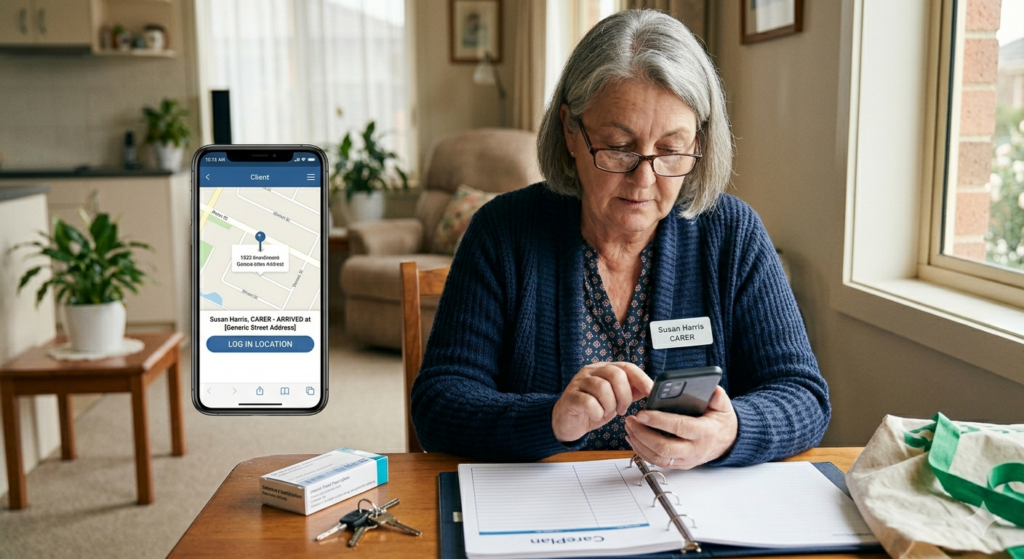
Indiana’s EVV requirement comes from Section 12006(a) of the 21st Century Cures Act, administered locally by FSSA and IHCP. Every qualifying visit must capture six data elements:
- Type of service performed
- Individual receiving the service
- Date of the service
- Location of service delivery
- Individual providing the service
- Start time and end time of the visit
Missing any single element creates a documentation gap. Auditors find those gaps.
Which Indiana Medicaid Services Require EVV?
The mandate covers a broad set of Medicaid-funded services:
- Personal Care Services (PCS)
- Home Health Care
- Private Duty Nursing
- Behavioral Health Services
- Home and Community-Based Services (HCBS)
- Respite and Homemaker Services
- Supported Living and Adult Day Services
- Transitional Services
Service-level applicability depends on the specific Medicaid program. Confirm requirements directly with FSSA before assuming a service falls outside the mandate.
What Are Indiana’s EVV Compliance Deadlines?
Personal Care Services (PCS)
IHCP required EVV for personal care services beginning January 1, 2021. As of January 1, 2023, IHCP began denying claims for personal care visits without a compliant EVV record. Agencies submitting PCS claims without EVV data are receiving rejections now.
Home Health Care Services (HHCS)
The home health mandate took effect January 1, 2024. Skilled nursing, occupational therapy, speech-language therapy, and physical therapy visits all require EVV documentation for dates of service on or after that date.
FSSA’s enforcement posture is not passive. The agency’s $200 million attendant care audit is actively expanding to additional providers. Retroactive audits pull records back months, and an undocumented visit is treated the same as a visit with no EVV record at all.
How Does Indiana’s EVV System Work?
Indiana operates an open EVV model. FSSA provides Sandata as the state-sponsored system at no cost, but agencies can choose a certified alternate vendor instead.
The requirement that doesn’t change: all alternate systems must export visit data to the Sandata Aggregator before it reaches CoreMMIS. Your agency can run a different EVV platform while the data still routes through Sandata on the back end.
To use an alternate vendor, contact FSSA at EVV@fssa.in.gov before going live. Agencies that skip certification and submit visit data outside the approved process risk claim rejections regardless of whether the six data elements were captured correctly.
If your agency uses Sandata directly, at least one employee per service location must complete training through Sandata Learn. That employee can then train the rest of the team.
When Can Indiana Providers Be Exempt from EVV?
Exceptions apply in limited situations. Providers may apply for an exemption if:
- Services are delivered in a rural area with limited internet or cellular access
- The caregiver providing services is under 18 years old
- Services are delivered through telemonitoring or telemedicine
Exemptions are not automatic. Agencies must submit a request through the IDM website and receive written approval before operating outside the standard EVV requirement. An approved exception still requires documentation.
What Does EVV Non-Compliance Cost Indiana Agencies?
Claim denials hit first. IHCP has been rejecting non-EVV-compliant PCS claims since January 2023. Beyond individual rejections, continued non-compliance can trigger reduced reimbursement rates or termination of your Medicaid provider status.
The longer-term risk is retroactive audits. Once FSSA identifies a documentation pattern, reviewers don’t stop at the flagged claim. One exception visit without supporting documentation can open a review covering months of records. Agencies absorbing FMAP reductions also face tighter claim scrutiny across all submissions, not just the flagged ones.

Frequently Asked Questions
What EVV system does Indiana use?
Indiana’s state-sponsored system is Sandata, provided by FSSA at no cost. Agencies can use a certified alternate vendor, but all visit data must export to the Sandata Aggregator before reaching CoreMMIS.
When did Indiana start denying EVV non-compliant claims?
IHCP began denying personal care service claims without EVV data on January 1, 2023. Home health services became mandatory January 1, 2024.
Can Indiana Medicaid providers use their own EVV software?
Yes, Indiana’s open model lets agencies use a certified alternate vendor. Contact FSSA at EVV@fssa.in.gov to begin vendor certification before going live.
What happens if an Indiana provider fails to comply with EVV?
IHCP denies the claim. Ongoing non-compliance can result in reduced reimbursement rates or termination of Medicaid provider status. FSSA’s active audit program also increases the risk of retroactive claim reviews.
Are there exemptions from Indiana’s EVV requirement?
Yes, for rural areas with limited connectivity, caregivers under 18, and telemedicine services. Providers must apply through the IDM website and receive written approval before operating outside the standard requirement.
Keep Indiana Medicaid Claims Off the Denial List
Manual visit documentation and exception tracking are the conditions audits are designed to expose. One missing data element on a high-volume account is enough to trigger a claim review that reaches back to the compliance deadline.
ShiftCare’s EVV integration captures all six required data elements at the point of care and flags exceptions before they reach billing. Connected to automated e-billing, visit records map directly to Medicaid claims without manual reconciliation. Start your free trial and see how ShiftCare’s home care software keeps your Indiana agency audit-ready.