Progress Notes in Disability and Aged Care: A Complete Guide
A progress note is the contemporaneous record of a support delivered. It typically includes details on what the support worker did, what they observed, and what they did about it. A defensible note names the participant and the worker, is dated and timed by the system, describes what happened in specific factual terms, evidences the supports the participant is funded for, and is written close to the shift rather than reconstructed later.
What are progress notes? Progress notes are the written record of what happened during a shift: who was supported, when, what supports were delivered, what was observed, what was done about it, and who wrote it. In NDIS and aged care they are the evidence an auditor works from and the handover the next support worker relies on. For the NDIS-specific rules, see our guide to NDIS progress notes. This guide is by ShiftCare, whose progress notes software is used by 8,000+ care providers.
Why Most Progress Notes Guidance Misses the Point
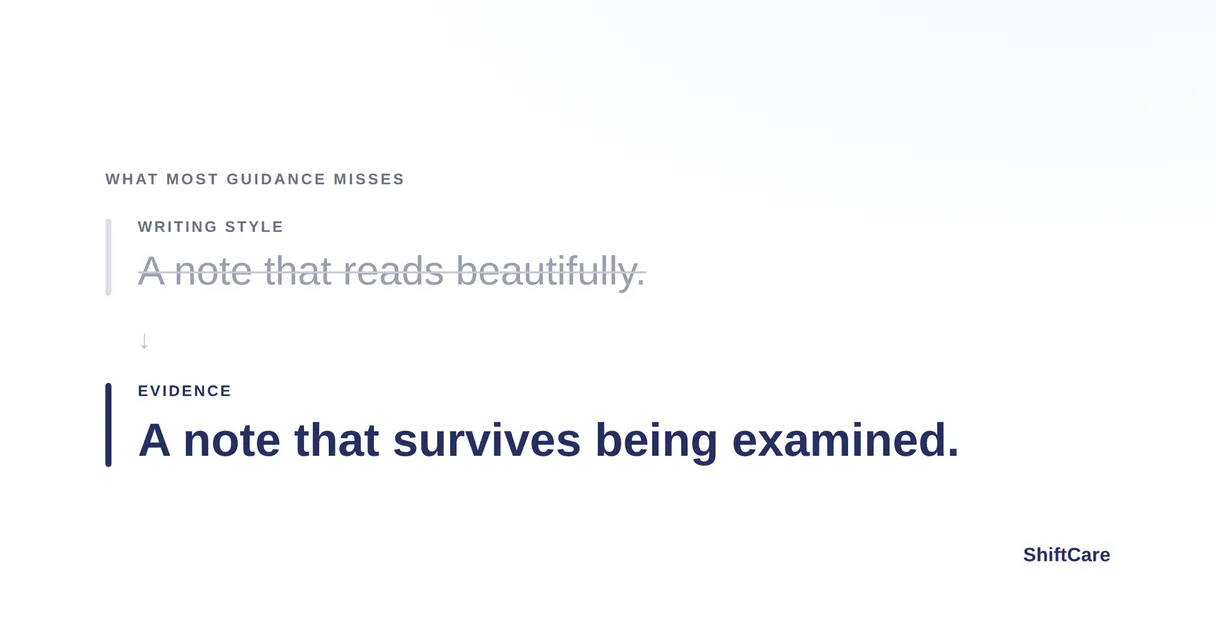
Almost every guide to ShiftCare’s progress notes feature is about writing style. Be objective. Be concise. Use a template. All true, and none of it answers the question a practice manager actually has, which is: what makes this note survive being examined?
Three different obligations land on the same paragraph, and they don’t ask for the same thing.
| Regime | What it wants from the note |
|---|---|
| NDIS Practice Standards | That the participant’s information is accurately recorded, current, and usable by the workers who need it |
| Payment and claiming | That the support you claimed for was actually delivered, to that person, on that date |
| Incident and complaint rules | That where something happened, it was recorded and acted on, with its own timeframes |
A note can read beautifully and satisfy none of them. A plain note that names the person, the date, what was delivered and what was observed satisfies all three.
If you’d rather start from a structure that already covers this, download our free progress notes template.
What the Practice Standards Actually Say
The Core Module sets the information management outcome in these words:
“Management of each participant’s information ensures that it is identifiable, accurately recorded, current and confidential. Each participant’s information is easily accessible to the participant and appropriately utilised by relevant workers.”
And the indicator beneath it:
“An information management system is maintained that is relevant and proportionate to the size and scale of the organisation and records each participant’s information in an accurate and timely manner.”
Four adjectives in the outcome: identifiable, accurately recorded, current, confidential. Each one is separately auditable. Then timely in the indicator, which is the word most documentation backlogs fail on.
There’s a second one worth knowing, because it decides what the worker should have been told before they arrived:
“Supports are planned with each participant to meet their specific needs and preferences. These needs and preferences are documented and provided to workers prior to commencing work with each participant to ensure the participant’s experience is consistent with their expressed preferences.”
A worker who was never given the plan can’t write a note that evidences it. Note quality is partly a rostering problem.
Are Progress Notes Mandatory?
No provision of the NDIS Act uses the words “progress note”. That surprises people, and it’s the reason so much guidance is vague.
What exists instead is a layered obligation. The Practice Standards require each participant’s information to be accurately recorded and kept current and timely. Providers must keep complete and accurate records of supports delivered in order to claim for them. Notes describing an incident become part of the incident record, which carries its own rules.
In practice, a contemporaneous note is how a provider meets all of that. There is no rule that says “write a progress note”, and there is no realistic way to comply without one.
The Three Clocks That Changed in 2026
This is the part almost nothing published on progress notes has caught up with.
| What changed | From | What it means for a note |
|---|---|---|
| Records relating to payment and receipt of NDIS funds must be retained for seven years, with a civil penalty for failing to | 27 August 2026 | The note behind a claim has to survive seven years in a form you can produce |
| The window to claim for a support drops from two years to 90 days | 1 December 2026 | An unwritten note is a countdown, not a to-do |
| Registration expands to personal care, daily living supports and supports in closed settings | 1 July 2027 | More providers held to the Core Module, more first audits |
The 90-day window is the one that changes behaviour. Two years absorbed a lot of untidy documentation. Ninety days does not. Under the old rules a shift delivered in March could still be claimed in early 2028. From December, a support delivered on the first of the month and never written up is revenue the organisation cannot recover.
Timeliness stopped being a compliance nicety and became a cash question.
What Has to Be In the Note
How do you write progress notes correctly? There are six elements. The last one is the one people forget is even a field.
| Element | What it means | Why it’s tested |
|---|---|---|
| Who | The participant, named or identified | “Identifiable” is the first word in the Practice Standards outcome |
| When | The date and times of the support | Ties the note to the shift and to the claim |
| What was delivered | The supports actually provided | This is what the claim asserts happened |
| What was observed | The participant’s presentation, response, anything that changed | This is what makes the note worth reading next week |
| What was done about it | Follow-up, escalation, or nothing and why | Turns an observation into a record of care |
| Who wrote it | The worker who delivered the support | A note filed by someone who wasn’t there is not evidence of anything |
Everything else, including headings, templates, formats, is your organisation’s choice, and should be driven by what your participants and your auditors actually need.
For a worked example of these six elements applied to a real NDIS shift, read how to write NDIS progress notes.
The Same Shift, Written Three Ways
This is where most guides stop being useful, because they show a good example and no bad ones. The failure modes are more instructive than the model answer.
The shift: a two-hour morning personal care visit. The participant was slower than usual, declined breakfast, and the worker noticed a change in how she was moving.
Version One: Too Thin
Morning visit. Showered and dressed. All good, no issues.
Why it fails. “All good, no issues” is contradicted by the shift itself. Something was different. It evidences no funded support beyond showering, records no observation, and if this participant’s plan funds support for mobility or nutrition, the note doesn’t show either was delivered. At a plan review there is nothing here to review. At an audit it demonstrates that the organisation’s documentation standard isn’t being met.
It is also the most common progress note in the sector, and the reason is not laziness. It’s the ninth hour of a shift and the ninth note of a week.
Version Two: Long, and Still Not Evidence
Arrived on time as always. Participant seemed a bit down and not herself this morning, I think she may be coming down with something or possibly feeling depressed about her sister not visiting last weekend. Encouraged her to eat but she wasn’t interested. Had a lovely chat about her garden. She’s such a positive person normally so this was unusual. Showered and dressed as per usual routine. Left the house tidy. Will keep an eye on her.
Why it fails. Length is not the problem, but rather, interpretation presented as a fact. “Possibly feeling depressed”, “coming down with something” and the sister theory are the worker’s speculation recorded as if observed. “Such a positive person” is a character assessment. “Will keep an eye on her” commits to a follow-up with no owner, no timeframe and no record of whether it happened.
If this participant is later unwell, this note reads as a provider that noticed a change, guessed at three causes and escalated to nobody.
Version Three: Defensible
8:00–10:00am personal care. Participant took noticeably longer to move from bed to bathroom than in previous visits and held the doorframe twice, which I have not seen before. Showered and dressed with the usual level of assistance. Declined breakfast, said she wasn’t hungry; second offer at 9:30 also declined. Fluids taken: one cup of tea.
Reported the mobility change and the two declined meals to the team leader by phone at 10:05am. Advised to log it and flag for the next shift.
Why it works. Every sentence is something the worker saw or did. The change is described rather than diagnosed, like “held the doorframe twice, which I have not seen before” is an observation a nurse or a GP can use; “seemed unsteady” is not. Both funded supports are evidenced. The escalation names a person, a time and an outcome, so the record shows the provider acted rather than noticed.
It is also shorter than version two. A defensible note is not a longer note. It is a note with the speculation taken out and the specifics put in.
Objective or Interpretation: The Test That Actually Works
“Be objective” is advice nobody knows how to apply at 9pm. Here is a test that takes two seconds: could a second person, standing in the same room, have disagreed with this sentence?
If yes, it’s interpretation, and it needs either removing or rewriting as the thing that was actually seen.
| Interpretation | What was actually observed |
|---|---|
| Was agitated all morning | Paced the hallway for around twenty minutes and twice asked what time I was leaving |
| Refused her medication | Was offered her 8am medication, said “not now”, and took it at 8:40 on the second offer |
| Had a good day | Chose her own clothes, ate a full lunch, and asked to go to the shops |
| Seemed depressed | Stayed in her room for most of the visit and declined the walk she usually asks for |
| Was aggressive towards me | Raised her voice and pushed the table away when I moved her cup |
The right-hand column is longer in every case, which is why the left-hand column gets written. It is also the only column that is any use to a behaviour support practitioner, a GP, a plan reviewer or an auditor.
Interpretation isn’t banned. It just has to be labelled as what it is: “my impression was that she was uncomfortable, though she didn’t say so” is honest and useful. “She was uncomfortable” is a claim nobody can check.
What Should Never Go In a Progress Note
Six things, and most of them get written with good intentions.
Another participant’s name. In a shared house or a group activity, the other person’s information belongs in their own record. Refer to “another resident” or “another participant”.
A diagnosis. Support workers observe and describe. “Appears to have a UTI” is a clinical judgement outside the role, and it is the sentence that gets quoted back if the actual cause was something else.
Character judgements. “Difficult”, “attention-seeking”, “manipulative”, “lazy” and their polite cousins. Participants and their families can request access to their records, and these are the words that end up in a complaint. They also tell a reader nothing about what happened.
Blame, about anyone. The family, the previous shift, another provider, the participant. Record what happened. If something went wrong, that’s an incident, not an aside in a note.
A backdated entry written as though it were contemporaneous. If a note is written three days later, that is fine and sometimes unavoidable, but the record should show when it was written as well as which shift it covers. Rewriting history is a much worse problem than writing it late.
Anything you wouldn’t want the participant to read, on the assumption they won’t. The Practice Standards say their information should be easily accessible to the participant. Write as though they will read it, because they are entitled to.
When a Note Isn’t Enough
A progress note describing an incident does not discharge your incident obligations. This catches out well-meaning providers who documented everything and reported nothing.
If something happened that requires a response, like an injury, an allegation, unauthorised restrictive practice, a serious behavioural event, then it is an incident. It has its own record, its own review, and in some cases a notification timeframe to the NDIS Quality and Safeguards Commission. The note records what the worker saw. The incident record is what the organisation does about it.
The practical rule for a support worker: write the note, and raise the incident. Deciding whether it’s reportable is not the worker’s job, and shouldn’t be.
How Soon Does a Note Have to Be Written?
There is no stated number of hours in the Practice Standards. The word used is timely, and it is assessed against what your organisation’s own policy says and whether you follow it.
Three things determine the honest answer:
Recall. Detail decays fast. The specifics that make version three defensible, like held the doorframe twice, declined at 9:30 as well, are gone by the next morning. What survives is “all good, no issues”.
Continuity. If the next worker is on tonight, a note written tomorrow served nobody.
The claim. From 1 December 2026, ninety days.
Most providers set the standard at end of shift, with a defined exception path for when that genuinely isn’t possible. The exception path matters as much as the standard. It’s a rule that cannot be followed on a bad day is a rule staff learn to work around.
Does Any of This Change in Aged Care?
Most of it doesn’t. The six elements are the same. The objectivity test is the same. The list of things that should never go in a note reads identically in a residential care home and a group home.
Three things do change, and the last one changes what the note is for.
The words change, and the words matter.
| NDIS | Aged care |
|---|---|
| Participant | Older person, or client |
| Support worker | Care worker, or personal care worker |
| NDIS plan | Care and services plan |
| NDIS Practice Standards | Strengthened Aged Care Quality Standards |
| NDIS Quality and Safeguards Commission | Aged Care Quality and Safety Commission |
Plenty of providers deliver both, and the note field is usually where the two vocabularies collide. Calling an aged care client a participant is not a breach of anything. It is a signal to an assessor that the team is working from the wrong mental model, which is a harder problem than a wrong word.
Which Standards you are audited against depends on your registration category.
The Aged Care Act 2024 and the strengthened Quality Standards commenced on 1 November 2025. The Act replaced approval and accreditation with a single registration system of six categories, and your category decides which of the seven Standards apply. There is no NDIS equivalent, and it is the part providers most often get wrong about their own obligations.
| Category | What you are audited against |
|---|---|
| 1 to 3 | Home and community services, assistive technology, advisory and support. Not audited against the Quality Standards, though provider obligations and the Code of Conduct still apply |
| 4 | Personal care and care support at home or in the community, including respite. Standards 1 to 4, plus Outcome 5.1 Clinical Governance if you deliver care management or restorative care management |
| 5 | Nursing and transition care. Standards 1 to 5 |
| 6 | Residential care, including respite. Standards 1 to 7 |
Conformance is assessed at the Outcome level, not the Standard level. Nobody is ever found to have met Standard 3. The finding lands on Outcome 3.1 or 3.2, and the evidence is your records.
The documentation obligation sits in Standard 3.
Outcome 3.1 covers assessment and planning. The Commission’s guidance for workers developing and maintaining care and services plans says to:
“keep information detailed, accurate and current so you can deliver care that meets each older person’s needs, goals and preferences”
Detailed, accurate, current. The same three demands the NDIS outcome makes in a different order, including the one that documentation backlogs fail on. The Commission also describes the care and services plan as the “source of truth” about an older person’s care needs, which cuts both ways: a note that contradicts the plan is a problem, and so is a note evidencing care the plan never described.
The difference that matters is deterioration.
The Commission tells workers to recognise and respond to deterioration, which it defines as physiological, psychological or cognitive changes that may indicate a significant worsening of the older person’s health, condition or wellbeing. Where a worker sees it, they are expected to escalate so the person can be reassessed and their plan reviewed.
Go back to the three versions above. Under the NDIS, version three is a good note because it evidences funded supports and records an escalation. In aged care that same note is doing something narrower and heavier. It is the first written record that something changed.
Slower from bed to bathroom. Held the doorframe twice, which the worker had not seen before. Two declined meals. One cup of tea.
If that person is in hospital a fortnight later, those four observations are the record of when the change was first seen and what the provider did about it. Version one says nobody noticed. Version two says somebody noticed, guessed at three causes and told no one. Neither is a defence.
This is also why home care carries more documentation risk than residential, not less. In a residential home the change gets seen by the next shift within hours. In home care the next set of eyes might be four days away, and the note is the only thing joining the two visits.
Progress Note, Case Note, Care Note, Support Log: Which Is It?
They are largely the same thing under different names, and the inconsistency is a real problem when you’re searching your own records or writing a policy.
| Term | Where you’ll see it |
|---|---|
| Progress note | The most common in Australian disability and aged care, and the term the NDIS sector uses |
| Case note | More common in support coordination, allied health and social work |
| Care note | Common in aged care and home care |
| Support log | The NDIA’s own term in the record-keeping requirements, where it means the record of individual supports delivered |
| Shift note | Informal, used by workers |
None is wrong. What causes trouble is using three of them inside one organisation, because staff then can’t tell whether the “case note” policy applies to the thing they call a shift note. Pick one term, define it in your policy, and use it in your software, your templates and your training.
What Software Can and Can’t Do About This
Honestly, because most of the problem isn’t software.
What it can do. Put the care plan in front of the worker before they arrive, so the note can evidence it. Let them dictate rather than type, which reliably produces more detail. Prompt for what a note left out. Require the note before the shift can be closed, if that’s the standard your organisation sets. Keep the note, the clock-in and the claim attached to the same shift, so the evidence doesn’t have to be reconstructed a year later.
What it can’t do. Know what happened. Judge whether a note is adequate for your audit, and that’s your organisation’s call. Make a note true. And it can’t fix a documentation standard nobody has written down: software enforces a policy, it doesn’t supply one.
The most common mistake providers make here is buying a system and expecting note quality to improve on its own. What improves note quality is a clear standard, the plan in the worker’s hand before the shift, and enough time at the end of it. Software makes those three things possible. It doesn’t decide them.
Make the Defensible Progress Note the Easy One to Write
A progress note that survives NDIS scrutiny doesn’t come from better writing. It comes from a worker who had the plan before the shift, a clear standard for what the note has to show, and a few minutes at the end to write it while the detail is still there.
ShiftCare is built to automate accurate, compliant progress notes. It puts the care plan in front of the worker before they arrive, lets them dictate instead of type, prompts for what the note left out, and holds the note, the clock-in and the claim against the same shift so nothing has to be rebuilt a year later. It will not decide your documentation standard for you. It will make that standard easy to keep. Start a free trial, run a week of real shifts through it, and read the notes it produces before you commit to anything.
Progress notes: quick answers
Are progress notes mandatory for NDIS providers?
No rule uses the words “progress note”. The NDIS Practice Standards require each participant’s information to be accurately recorded, current and timely, and providers must keep complete records of the supports they claim for. A contemporaneous note is how a provider meets those obligations, so in practice there is no way to comply without one.
What has to be in a progress note?
Six elements: who was supported (the participant, named or identified), when (date and times), what was delivered, what was observed (the participant’s presentation and response), what was done about it (follow-up, escalation, or nothing and why), and who wrote it. A note filed by someone who was not there is not evidence.
What should never go in a progress note?
Another participant’s name, a diagnosis (support workers observe and describe, they do not diagnose), character judgements such as “difficult” or “attention-seeking”, and blame. Participants and families can request their records, and these are the words that end up in complaints.
How soon after a shift does a progress note have to be written?
The Practice Standards do not give a number of hours. The word is “timely”, assessed against your organisation’s own policy and whether you follow it. Detail decays fast, so the defensible answer is before the worker leaves the shift or as soon as possible after it.
Sources: NDIS Quality and Safeguards Commission, NDIS Practice Standards. Aged care providers should read these alongside the Strengthened Aged Care Quality Standards.
Frequently Asked Questions
What is a progress note?
A progress note is the contemporaneous record of a support delivered, i.e., what the support worker did, what they observed, and what they did about it. It forms part of the participant’s file, evidences the support against their plan, and is what a provider produces when asked to show a support was delivered as claimed.
Are progress notes mandatory for NDIS providers?
No provision of the NDIS Act uses the words “progress note”. The obligation is layered: the Practice Standards require each participant’s information to be accurately recorded and kept current and timely, and providers must keep complete and accurate records of supports delivered to support payment claims. In practice a contemporaneous note is how providers meet both.
What should a progress note include?
Six things: who the participant is, when the support happened, what was delivered, what was observed, what was done about it, and who wrote it. Beyond that, headings and format are your organisation’s choice and should reflect what your participants and your auditors need to see.
How long do progress notes have to be kept?
From 27 August 2026, records relating to payment and receipt of NDIS funds must be retained for seven years, with a civil penalty for failing to. A note supporting a claim sits inside that. Notes describing an incident also form part of the incident record, which carries its own retention. Seven years from the date of the note is the practical floor.
Does the 90-day claiming change affect progress notes?
Yes. From 1 December 2026 the window to claim for a support under a participant’s plan reduces from two years to 90 days. A shift that hasn’t been documented is a shift that hasn’t been claimed, and there is no longer two years of room to catch up. Note timeliness became a revenue question, not only a compliance one.
How soon after a shift should a progress note be written?
The Practice Standards say information must be recorded in a timely manner, without stating a number of hours. It’s assessed against your own policy and whether you follow it. Most providers set the standard at end of shift, with a defined exception path. Detail decays fast, and the specifics that make a note useful are usually gone by the next morning.
What’s the difference between objective and subjective in a progress note?
An objective statement is something a second person in the room could not have disagreed with. “Held the doorframe twice” is objective. “Seemed unsteady” is an interpretation. Interpretation isn’t banned, but it should be labelled as impression rather than written as fact, because only the observation is useful to a clinician or a reviewer.
Can I write my opinion in a progress note?
You can record an impression as long as it’s clearly an impression. For example, “my impression was that she was uncomfortable, though she didn’t say so”. What causes problems is interpretation written as observation, and character judgements about the participant. Assume the participant may read the note, because they are entitled to access their information.
What should never go in a progress note?
Another participant’s name, a diagnosis, character judgements, blame directed at anyone, and a backdated entry presented as contemporaneous. Each of these either breaches someone’s privacy, exceeds the support worker’s role, or damages the record’s credibility. Write what you saw and what you did.
Can I write about another participant in someone’s progress note?
No. In a shared house or group setting, refer to “another resident” or “another participant” rather than naming them. Their information belongs in their own record. Naming them puts one participant’s information in another’s file, which fails the confidentiality element of the Practice Standards information management outcome.
Is a progress note the same as a case note?
Largely, yes. They’re the same record under different names. Progress note is the most common in Australian disability and aged care. Case note is more common in support coordination and allied health. Care note is common in aged care. Support log is the NDIA’s own term. Pick one term for your organisation and use it consistently in policy, software and training.
What’s the difference between a progress note and an incident report?
A progress note records what happened on a shift. An incident report records something requiring a response, and carries obligations a note does not, including notification timeframes under the Incident Management and Reportable Incidents Rules 2018. Describing an incident inside a progress note does not discharge those obligations. Write the note and raise the incident.
Can a progress note be edited after it’s saved?
That depends on your system, and it’s worth knowing the answer before an auditor asks. Good practice is to correct within the system rather than delete and re-enter, so the edit is recorded with the editor’s name and the time. A record that can be silently overwritten is worth less than one that shows a correction was made.
What if a note is written days after the shift?
Write it, and make sure the record shows both the shift it covers and when it was written. Writing late is a policy failure. Writing late and presenting the note as contemporaneous is a credibility failure, and it’s the one that damages every other note in the file when it’s discovered.
Do progress notes need to link to the care plan?
They should. The note is the main evidence that the supports a participant is funded for were actually delivered, and it’s what a plan review or a funding conversation is built on. A note that describes activity without connecting it to the plan makes the review harder and the claim thinner.
Can families see progress notes?
Only where your organisation shares them, and to the extent it decides. Separately, the Practice Standards say each participant’s information should be easily accessible to the participant themselves. It’s safest to write every note on the assumption the participant may read it.
Do progress notes support an NDIS payment claim?
They’re the evidence behind it. Providers must keep complete and accurate records of supports delivered to participants, and a claim is assessed against what was delivered. Where the note, the attendance record and the claim all attach to the same shift, the evidence chain doesn’t have to be reconstructed months later.
What does an NDIS auditor look for in progress notes?
Whether the record matches the Practice Standards outcome: identifiable, accurately recorded, current and confidential, and usable by the workers who need it. In practice that means notes that exist for the shifts delivered, name the person and the worker, describe what was actually done, and were written close to the time rather than in a batch.
Do support workers need training to write progress notes?
They need a written standard more than they need training. Most poor notes come from workers who were never told what good looks like for that organisation, or who were given the shift without the participant’s plan. A one-page standard with two worked examples does more than a session on writing style.
Should we use a progress note template?
Templates help, as long as they ask for what your services actually need. A template with too many fields produces faster, emptier answers. As a result, the staff learns to fill it rather than complete it. Fewer, better-chosen headings, different where the service type differs, beats one long form applied to everything.
Can support workers dictate progress notes instead of typing them?
Many systems allow it, and it usually produces a better record. A worker who would type three lines will typically speak considerably more, and the detail that gets lost when typing at the end of a long shift is the specific detail that makes a note defensible. The worker should still review what was captured before it saves.
How long should a progress note be?
There’s no target length, and length is a poor proxy for quality. A long note full of speculation is weaker than a short one full of specifics. Cover the six elements, describe what was observed rather than what you concluded, and stop. If a note is short because nothing unusual happened, say what was delivered and say that.