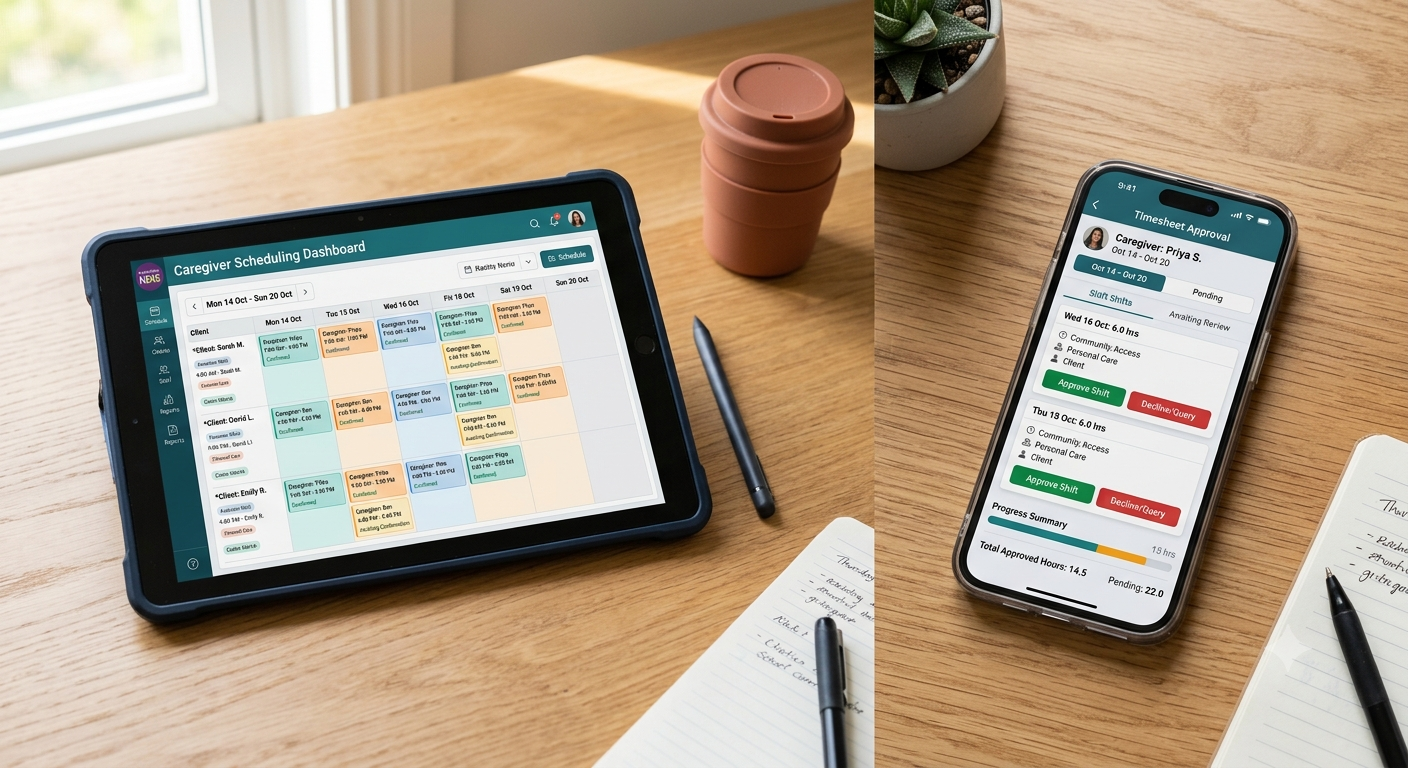
NDIS and aged care provider margins compressed from 35% to 10% over five years. The $285K leakage stack shows where a 100-participant provider loses money annually across six operational areas. At 10% margin, $285K in leaks equals $2.85 million in billable hours needed just to break even on operational losses. Providers operating under Support at Home and NDIS Reset cannot absorb this level of leakage and remain profitable.
Margin protection requires tracking five operational KPIs weekly and implementing a four-week reset to audit leaks, fix systems, and establish ongoing monitoring.
Where NDIS Providers Lose $285K Annually
A 100-participant provider with 50 to 60 support workers delivering 4,000 to 5,000 monthly billable hours leaks $285,000 annually across six operational areas:
- Structural overtime: $66,000: Rostering patterns that consistently push workers beyond 38 ordinary hours per week trigger SCHADS Award penalty rates at time-and-a-half.
- Shift overrun: $52,000: Workers staying 10 to 15 minutes beyond scheduled shift end times accumulate unscheduled labour costs daily.
- Casual dependency: $45,000: Over-reliance on casual workers at 25% loading instead of permanent staff at standard rates. The preventable portion represents regular shifts filled by casuals rather than permanent recruitment.
- Late clock-outs: $38,000: Workers clocking out late without real-time alerts to prevent unscheduled overtime.
- Cancellation drag: $55,000: Lost revenue from cancelled shifts plus emergency backfill costs at higher casual rates.
- NDIS claim rejections: $29,000: Payment delays, resubmission admin time, and cash flow gaps from incorrect Price Guide item numbers, missing service agreements, or wrong registration groups.
At 10% margin, $285K in operational losses requires $2.85M in billable revenue to offset. Providers cannot win enough new clients to cover this leakage and generate profit simultaneously.
Four-Week Implementation: Audit Leaks, Fix Systems, Track Results
Week-by-week implementation framework for margin protection.
| Week | Focus | Action Items |
| Week 1 | Audit leakage stack and implement KPI tracking |
|
| Week 2 | Compliance audit and documentation quality |
|
| Week 3 | Workforce model and skill matching |
|
| Week 4 | Daily claiming, billing accuracy, and cash flow management |
|
By week 4, providers have baseline KPI measurements, identified top leaks, and implemented systems to prevent ongoing leakage.
Real NDIS Provider Leaks: $75K SCHADS Breach and $10K/Month Overtime
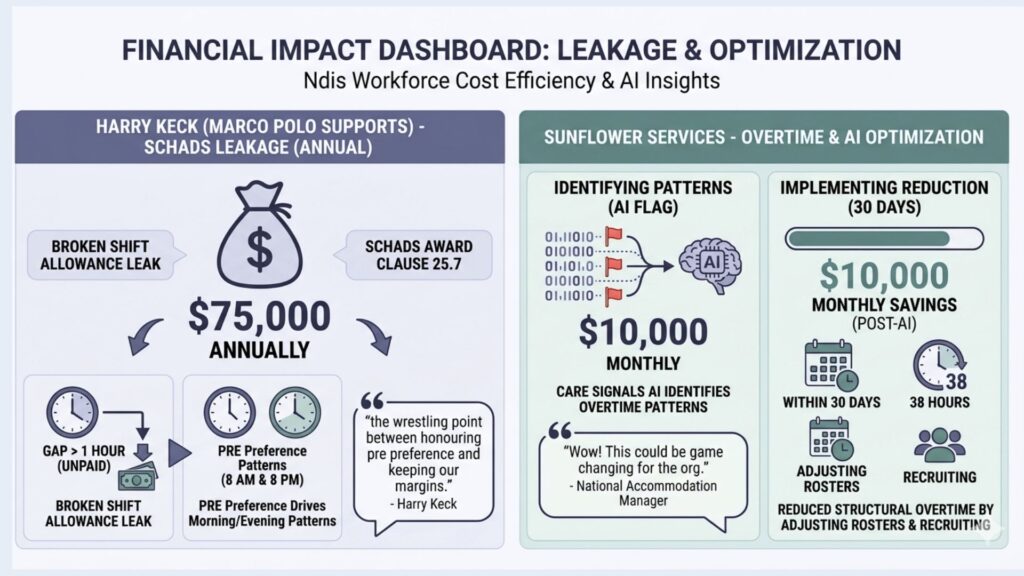
Harry Keck from Marco Polo Supports quantified his SCHADS leak: $75,000 annually in broken shift allowance. Broken shifts occur when a worker’s shift is separated by more than one hour unpaid break. Under SCHADS Award Clause 25.7, this triggers additional allowances.
Marco Polo absorbs $75K annually because participant preference drives morning and evening visit patterns (8 AM shower, 8 PM meal prep) with gaps between. Harry described this as “the wrestling point between honouring participant choice and keeping our margins.”
Sunflower Services used Care Signals AI to identify overtime patterns. The system flagged $10,000 monthly in preventable overtime from rostering patterns that consistently pushed workers into penalty rate thresholds. The National Accommodation Manager responded: “Wow! This could be game changing for the org.”
Within 30 days of identifying the pattern, Sunflower reduced structural overtime by adjusting rosters to cap workers at 38 hours and recruiting.
Stop Losing $285K Annually to Preventable Operational Leaks
ShiftCare tracks overtime percentage, casual mix, paid vs billed hours, cancellation recovery, and leave exposure in real time. The system validates NDIS Price Guide rates during shift creation, flags SCHADS Award breaches before rosters finalise, and prevents claim rejections through automated billing validation.
Start your free trial today. See how ShiftCare helps NDIS providers track the five operational KPIs and eliminate the $285K leakage stack without manual spreadsheets or weekly reporting meetings.