
Support at Home replaced Home Care Packages on 1 November 2025, introducing eight funding levels, quarterly budgets, and three service categories with different co-contribution rules. New ACQSC enforcement powers took effect May 2026. Personal care services move to fully government-funded clinical care on 1 October 2026. Here’s what each change means for agency operations.
Most home care providers adapted to Support at Home’s November 2025 launch, but the billing implications, service categorisation requirements, and quarterly budget rules are generating friction that manual systems weren’t built to handle. The programme replaced both the Home Care Packages scheme and Short-Term Restorative Care with a different funding logic: eight support levels, quarterly budget cycles, and three service categories that determine who pays for what and how much.
Two more changes land before the end of 2026. The Aged Care Quality and Safety Commission gained new enforcement powers in May, and personal care services reclassify into fully government-funded clinical care on 1 October. Providers that understand the full operating picture now can adapt ahead of each deadline rather than after it.
What Is the Support at Home Programme?
Support at Home launched on 1 November 2025 under the Aged Care Act 2024, replacing two separate schemes: the Home Care Packages programme and Short-Term Restorative Care. The consolidation expanded four HCP funding levels into eight support classifications, with annual budgets ranging from $11,795 at Level 1 to $78,106 at Level 8.
Services Australia holds client funding, not the provider. Clients hold the budget and engage providers to deliver services against it, so agencies claim against each client’s allocation after delivery rather than drawing from funds they hold. Providers that previously managed client funds internally now operate on a claim-and-receive cycle, which affects working capital in ways that annual HCP billing did not.
The No Worse Off principle applies to clients who held a Home Care Package on or before 12 September 2024. Any agency managing existing HCP clients through the transition needs to confirm each client’s protected status before adjusting their funding level.

How the Three Service Categories Change What Providers Bill
Support at Home divides all services into three categories, each with a different co-contribution structure. Billing a service under the wrong category creates co-contribution errors that fall on the client and require correcting.
Clinical Care is fully government-funded: nursing, occupational therapy, physiotherapy, speech pathology, podiatry, and dietetics all carry zero client co-contribution. From 1 October 2026, personal care services including showering, dressing, and continence join this category.
Independence Services attract a means-tested co-contribution and currently include personal care, home safety modifications, and assistive technology. Everyday Living, which covers domestic assistance, meal support, transport, and social activities, carries the highest co-contribution rate of the three.
Providers must document each service’s category in client care plans and service agreements. A client receiving both personal care and domestic assistance has services sitting in two different categories, each with its own co-contribution calculation.
How Quarterly Budgets and the 10% Care Management Fee Affect Operations
Support at Home runs on quarterly budget cycles, not annual lump sums. Each client’s allocation releases quarterly, with 10% of every quarter’s budget set aside for care management before services are funded.
The unspent funds rule introduces a hard rollover cap. Clients can carry over up to $1,000 or 10% of their quarterly budget, whichever is lower. Anything above that threshold returns to the government. Providers need to monitor each client’s quarterly spend closely and schedule additional services before the quarter closes, not after funds have already returned.
Tracking client budgets at the individual level is an operational requirement across every support level. An agency managing 80 clients across multiple classifications must catch each client approaching the rollover cap with enough time to act.
Services Australia pays providers through a claiming cycle, not on delivery. The gap between service delivery, claim submission, and payment creates a working capital lag that agencies need to plan around. Automated invoicing that generates claims directly from visit records reduces the manual reconciliation step between delivery and payment.
What the October 2026 Personal Care Changes Require Providers to Do
From 1 October 2026, showering, dressing, and continence services reclassify from Independence Services to Clinical Care. The government announced the change in April 2026 after months of pressure from consumer advocates and federal politicians. Clients using these services after that date pay no co-contribution.
Providers need to complete three things before 1 October. Service agreements for any client receiving personal care must be updated to remove co-contribution clauses for that service type. Billing and claiming configurations need to reflect personal care’s reclassification into Clinical Care. Affected clients need written notice explaining the change and when it takes effect.
The demand implication is worth planning for now. Removing the co-contribution for personal care removes the cost barrier for clients who have been limiting or deferring those services. Agencies that wait until October to build roster capacity will be responding to demand they could have anticipated in advance.
What the New ACQSC Enforcement Powers Mean for Provider Operations
Price caps were deferred in May 2026. The government originally planned to introduce formal pricing limits on 1 July 2026 but delayed the measure to allow an independent pricing study to run while the programme is in operation. No new start date has been announced.
The deferral does not mean pricing is unregulated. In place of caps, the Aged Care Quality and Safety Commission received new enforcement powers that are active now:
- Ordering refunds where providers are found to have overcharged clients for Support at Home services.
- Taking regulatory action against providers not issuing monthly statements to clients, regardless of whether pricing caps are in effect.
- Publicly reporting investigations and enforcement outcomes so consumers can see which providers have faced action.
- Publishing a quarterly National Summary of Support at Home Prices showing the median and price range by service type across the sector.
Providers not issuing monthly statements are now directly exposed to ACQSC enforcement action, not just best-practice guidance. The quarterly pricing summary makes the stakes concrete: providers charging above the sector median will appear in a government publication before any formal cap is in place.
The government is also encouraging providers to limit price increases to no more than two per year so clients can plan their quarterly spend with more certainty.
Frequently Asked Questions
What replaced Home Care Packages in Australia?
The Support at Home programme replaced Home Care Packages and Short-Term Restorative Care on 1 November 2025. The programme consolidated four HCP funding levels into eight support classifications. Clients who held a Home Care Package on or before 12 September 2024 are protected under the No Worse Off principle and maintain their previous funding level.
What are the three service categories under Support at Home?
Clinical Care covers nursing, allied health, and from 1 October 2026, personal care, all fully government-funded with no client co-contribution. Independence Services include personal care until October 2026, assistive technology, and home modifications, and attract a means-tested co-contribution. Everyday Living covers domestic assistance, meals, transport, and social activities and carries the highest co-contribution rate.
What does the quarterly budget cycle mean for providers?
Each client’s annual funding releases in quarterly instalments, with 10% of each quarter’s budget set aside for care management. Clients can carry over up to $1,000 or 10% of the quarter’s unspent budget, whichever is lower, and any amount above that returns to the government. Providers need to actively monitor client spend throughout each quarter, not just at the end.
What happened to Support at Home price caps?
Formal price caps were originally planned for 1 July 2026 but were deferred in May 2026. No new start date has been confirmed. In place of caps, the ACQSC gained powers to order refunds for overcharging, take regulatory action against providers not issuing monthly statements, and publicly report enforcement outcomes. A quarterly national pricing summary now publishes median and range by service type.
Stop Tracking Support at Home Changes Manually
Support at Home creates eight simultaneous tracking demands: funding levels, service categories, quarterly budget cycles, care management deductions, rollover caps, claiming timelines, personal care reclassification in October, and active ACQSC enforcement requirements. One missed monthly statement or miscategorised service creates a paper trail that compounds quickly. Agencies managing this manually are building compliance risk into every quarter.
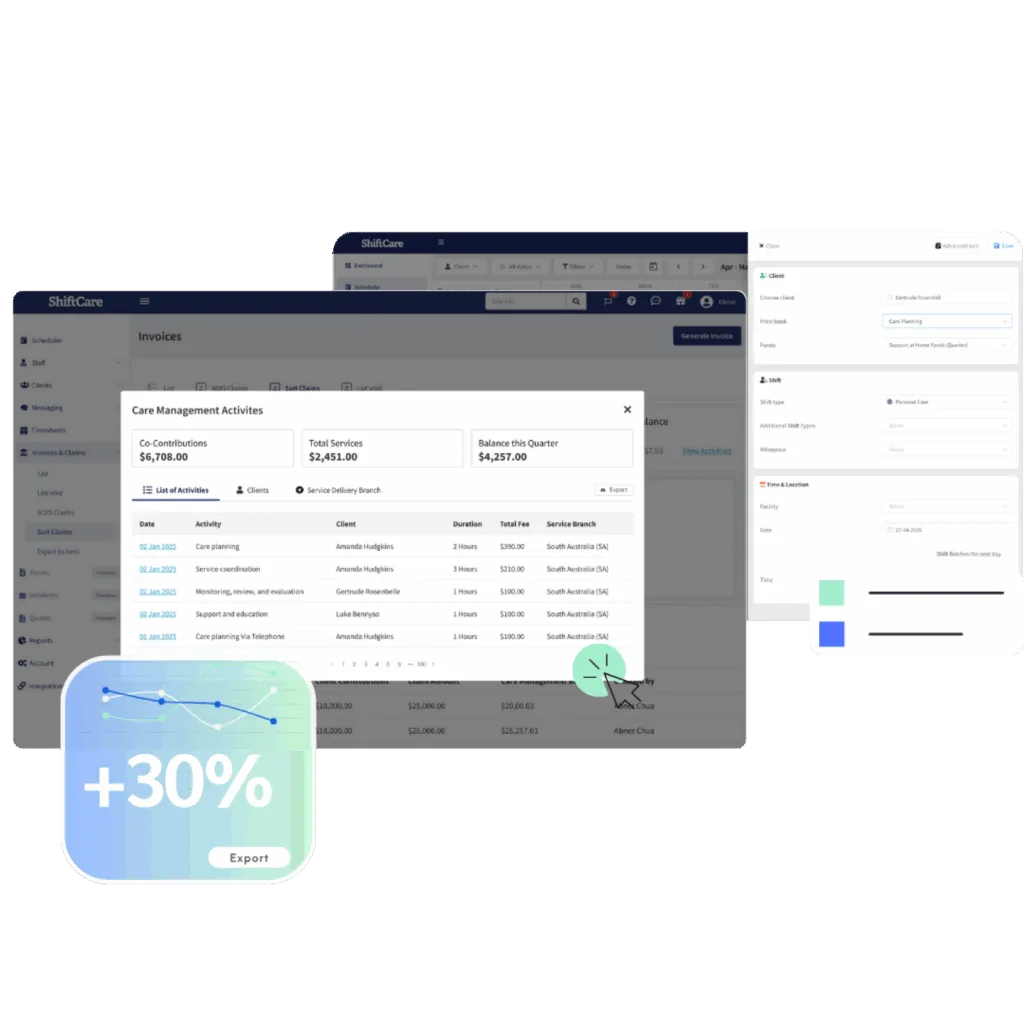
ShiftCare’s aged care software gives home care providers a single system for client care plans and service agreements, quarterly budget visibility per client, direct claiming through Services Australia, and the compliance documentation ACQSC audits and monthly statement requirements need. The dedicated Support at Home feature set is built for the programme’s structure, not retrofitted from a generic tool.
Start your free trial today, no credit card required, and have your operations running cleanly before October.