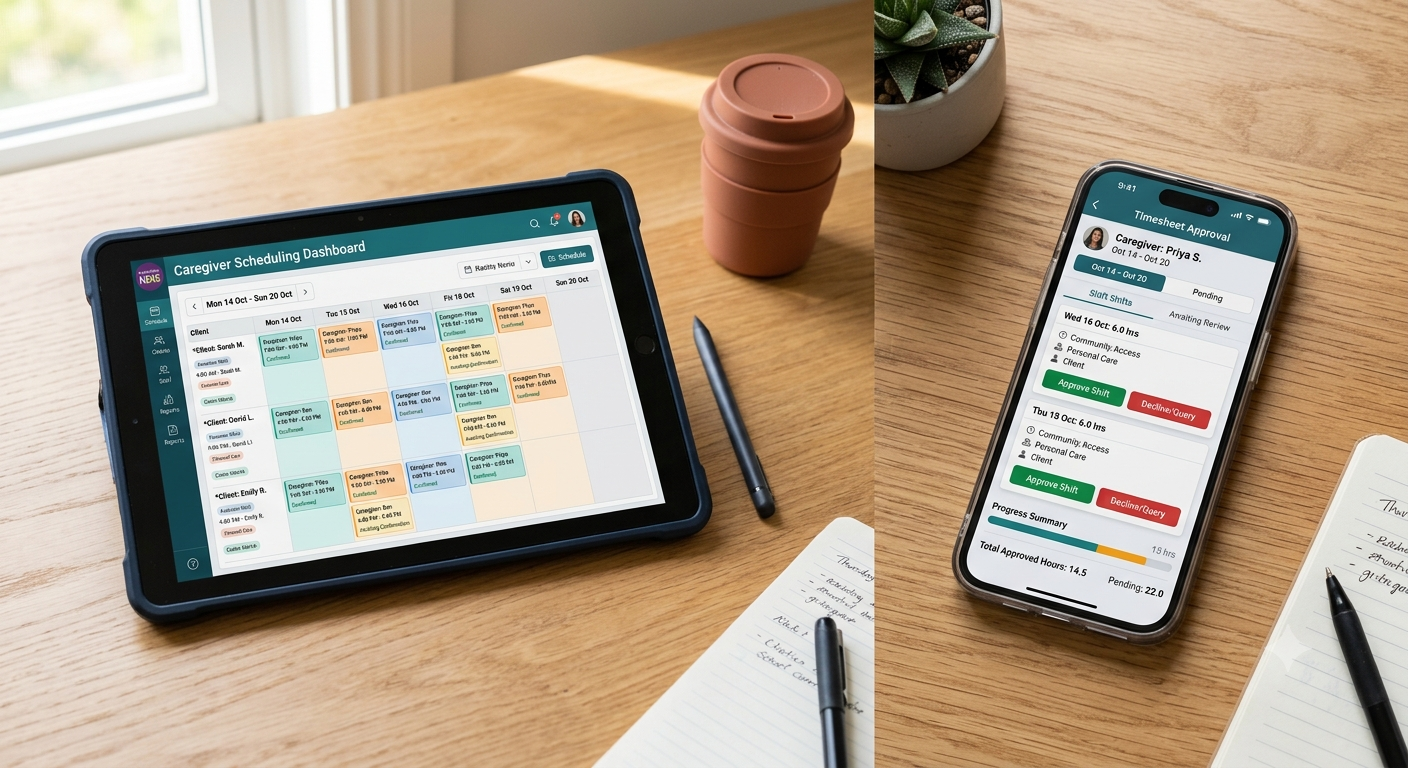
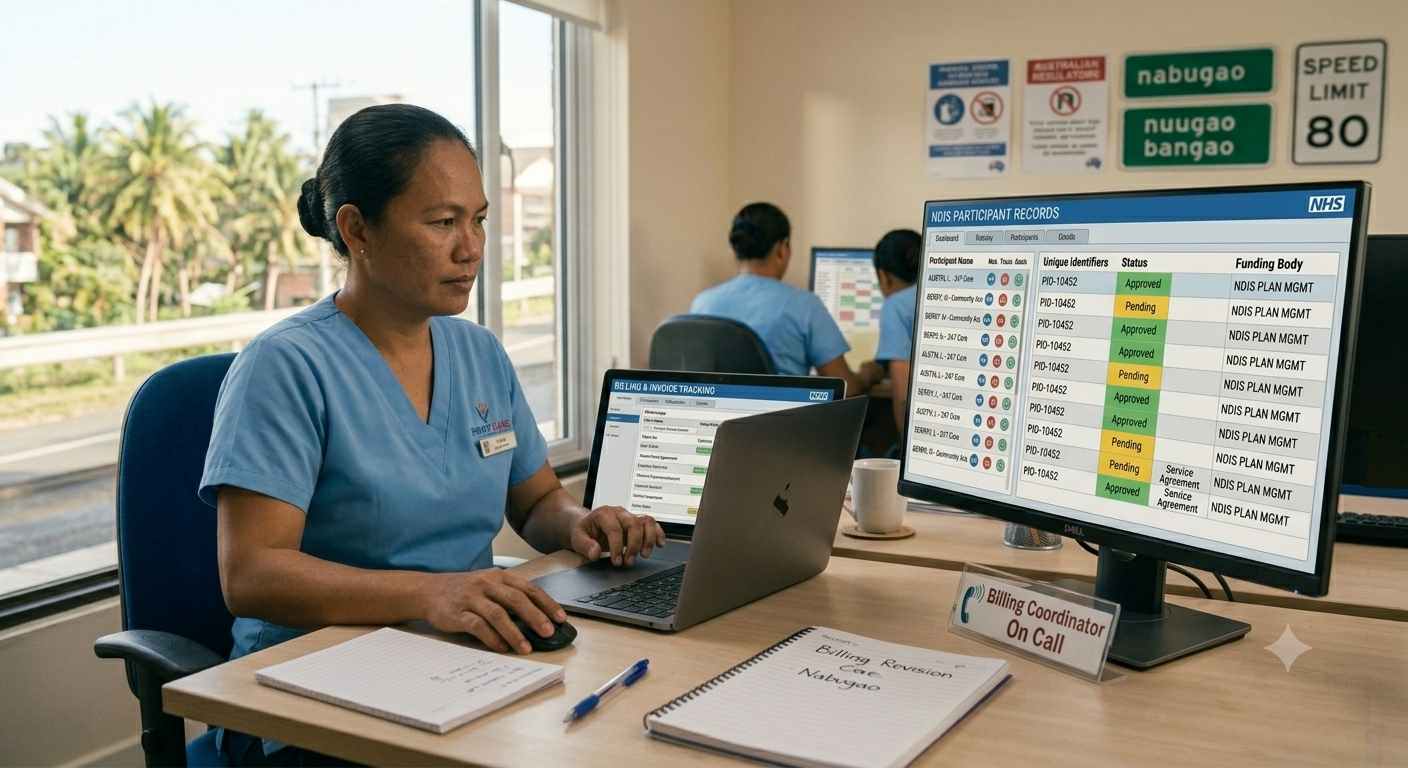
A 100-participant NDIS provider leaks $285,000 annually before winning a single new client. The leakage comes from six operational sources: structural overtime ($66K), shift overrun ($52K), casual dependency ($45K), late clock-outs ($38K), cancellation drag ($55K), and NDIS claim rejections ($29K). At 10% margin, these leaks equal $2.85M in billable hours providers must deliver just to break even on operational losses.
Providers need new revenue to cover operational leakage before generating profit. The six leaks are trackable, measurable, and preventable with the right systems.
Where the $285K Goes Before You Win a New Client

- Structural overtime: $66,000 annually from rostering patterns that push workers beyond 38 ordinary hours per week, triggering SCHADS Award penalty rates.
- Shift overrun: $52,000 annually from workers staying 10 to 15 minutes beyond scheduled shift end times without coordinator approval.
- Casual dependency: $45,000 annually from over-reliance on casual workers at 25% loading instead of permanent staff at standard rates.
- Late clock-outs: $38,000 annually from workers clocking out late without real-time alerts to prevent unscheduled overtime.
- Cancellation drag: $55,000 annually from lost revenue on cancelled shifts plus emergency backfill costs at higher casual rates.
- NDIS claim rejections: $29,000 annually from payment delays, resubmission admin time, and cash flow gaps caused by rejected claims.
These six leaks total $285,000 for a provider with 100 participants, 50 to 60 support workers, and 4,000 to 5,000 monthly billable hours. At 10% margin, $285,000 in operational losses requires $2.85 million in billable revenue to offset. Providers cannot absorb this level of leakage and remain profitable.
Structural Overtime: $66K Annual Leak

Structural overtime happens when rostering patterns consistently push workers beyond 38 ordinary hours per week, triggering SCHADS Award penalty rates. A worker rostered for 40 hours costs 38 ordinary hours plus 2 overtime hours at time-and-a-half. That’s 3 equivalent ordinary hours (38 + 1.5 + 1.5) instead of 40 ordinary hours.
The SCHADS Award sets overtime at time-and-a-half after 38 ordinary hours per week. A provider rostering 50 workers at 40 hours weekly pays for 150 equivalent ordinary hours (50 workers × 3 penalty hours) that could be avoided by capping rosters at 38 hours and hiring additional permanent staff.
At $30 per hour fully loaded, 150 penalty hours weekly costs $4,500. Over 52 weeks, that’s $234,000 annually in penalty hour costs. Of this, approximately $66,000 represents preventable structural overtime from poor rostering patterns rather than genuine demand spikes.
Structural overtime differs from emergency overtime. Emergency overtime (worker covers unexpected absence) is sometimes unavoidable. Structural overtime (worker consistently rostered above 38 hours) is a scheduling choice that costs penalty rates every single week.
Shift Overrun and Late Clock-Outs: $90K Combined Leak
Workers staying 10 minutes beyond scheduled shift end times accumulate quickly. Fifty workers averaging 10 minutes daily equals 500 minutes (8.3 hours) of unscheduled time per day. At $30 per hour, that’s $250 daily, $65,000 annually in shift overrun costs.
Late clock-outs add another $38,000 when workers forget to clock out or lack real-time alerts. Combined, shift overrun and late clock-outs represent $90,000+ in preventable labour costs that real-time alerts eliminate.
Casual Dependency: $45K Annual Leak
Casual workers cost 25% more than permanent staff under the SCHADS Award. A provider delivering 4,500 billable hours monthly with 30% casual mix pays casual loading on 1,350 hours monthly. At $7 per hour loading ($28 × 0.25), that’s $9,450 monthly, $113,400 annually in casual loading costs.
The $45K leak represents the preventable portion: regular shifts filled by casuals instead of recruiting sufficient permanent staff to cover base demand. Reducing casual mix from 30% to 20% saves $37,800 annually in loading costs.
Cancellation Drag: $55K Annual Leak

A 100-participant provider scheduling 150 shifts weekly loses 7 to 15 shifts to cancellations (5 to 10% cancellation rate). At 4 hours per shift and $65 per hour billing rate, that’s $94,640 to $202,800 in lost annual revenue.
Backfill costs compound this. Cancelled shifts requiring emergency casual coverage cost 25% more than permanent workers. The $55K leak combines lost revenue from uncovered cancellations plus backfill premium costs. Reducing cancellation rates from 10% to 5% through better participant communication cuts this leak significantly.
NDIS Claim Rejections: $29K Annual Leak
Claims get rejected for incorrect Price Guide item numbers, service delivered outside plan dates, missing service agreements, wrong provider registration group, or incorrect rate loadings. Rejected claims delay payment by 2-4 weeks while providers identify errors and resubmit.
A provider billing $200,000 monthly with a 5% rejection rate loses $10,000 in delayed revenue monthly. Administrative costs add $600 monthly (coordinator time to fix and resubmit rejected claims). The $29K leak represents cash flow timing costs, admin resubmission costs, and claims never recovered.
Providers using manual billing see 5 to 10% rejection rates. Automated Price Guide validation reduces rejections to under 2%, recovering most of this leak.
Real Provider Example: $75K Broken Shift Allowance Leak
Harry Keck from Marco Polo Supports quantified his operational leak: $75,000 annually in broken shift allowance under the SCHADS Award. Broken shifts occur when a worker’s shift is separated by more than one hour unpaid break. Under SCHADS Award Clause 25.7, workers receive an additional allowance for broken shifts.
Broken shifts happen because participants prefer morning and evening visits (8 AM shower, 8 PM meal prep) with a gap between. Marco Polo Supports absorbs $75,000 annually because participant preference drives the scheduling pattern. Harry described this as “the wrestling point between honouring participant choice and keeping our margins.”
This validates the $285K framework. Marco Polo’s $75K broken shift leak alone represents 26% of the total stack.
Track and Prevent Leaks Before They Affect Your Margins
The six leaks total $285,000 annually. At 10% margin, this requires $2.85 million in billable hours just to cover operational losses. ShiftCare flags structural overtime before rosters finalise, alerts coordinators to shift overruns in real time, tracks casual dependency rates, prevents late clock-outs with mobile alerts, reduces cancellation rates, and validates NDIS Price Guide rates during shift creation.
Start your free trial today. See how ShiftCare helps NDIS providers track and prevent the $285K leakage stack through real-time rostering alerts, billing validation, and operational analytics.