An aged care provider in Tasmania wants to grow. They’re already delivering Support at Home to several dozen older people. An NDIS participant approaches them because they offer home-based services and the participant wants continuity. The provider sees opportunity: dual registration opens access to both participant pools.
But within months, the financial team is confused about which staff member’s time is billable to NDIS versus Home Care. A supervisor is unsure whether a particular service should be funded under one scheme or the other. An auditor flags discrepancies in time tracking. The provider suddenly realizes that opportunity without process is a compliance liability.
Dual registration is common in Australia and can be a legitimate growth strategy. But managing home care NDIS funding overlap requires clear operational separation and careful billing discipline. Here’s how to manage both schemes without compliance liability.
What’s the Difference Between NDIS and Home Care Funding?

NDIS and Home Care are entirely separate funding schemes with different rules, participant populations, and compliance frameworks.
NDIS:
- Administered by the National Disability Insurance Agency (NDIA)
- Funds supports for people under 65 with permanent disability (or 65+ if they entered the scheme before age 65)
- Plan-based funding with approved annual or six-monthly budgets
- Provider paid according to NDIA rates for support categories (personal care, community support, specialist supports)
- Hourly or per-unit-of-service billing
- Compliance sits under NDIS Quality & Safeguards Commission
Home Care (Support at Home from 1 July 2025):
- Administered by Department of Health and Aged Care
- Funds supports for people 65 and older
- Participant-centred but outcome-focused (helping older people achieve goals and maintain independence)
- Billing can be hourly, per-visit, or based on agreed service models
- Compliance sits under Aged Care Quality Standards v2
You can’t use the same compliance processes, billing systems, or quality standards for both. The schemes operate differently at every level.
Can a Provider Register for Both?
Yes. A provider can register with both the NDIA and the Department of Health and Aged Care simultaneously. Many providers do this, particularly in regional areas where participant populations overlap geographically.
Registration requires meeting the quality and compliance standards of each scheme separately. You must demonstrate you can operate to NDIS quality standards AND aged care quality standards. You’re functionally operating two separate businesses under one entity.
You can share infrastructure (office, admin staff, scheduling tools), but delivery, billing, and accountability are distinct. A participant receiving NDIS support must be billed and tracked separately from a participant receiving aged care support, even if the same care worker delivers both services.
Shared scheduling systems work well because they centralise visibility. Billing systems must cleanly separate NDIS from aged care charges. No exceptions.
Compliance Risks of Home Care NDIS Funding Overlap

The primary risk is billing confusion. If a care worker provides support to an NDIS participant and an aged care participant on the same day, but the time recording system doesn’t clearly separate the two, both regulators will flag it. Auditors will question whether billing was accurate and whether you’re inadvertently claiming the same hour of work under both schemes.
This results in:
- Funding clawback
- Financial penalties
- Reputational damage
- Audit findings that trigger further investigation
The secondary risk is compliance inconsistency. NDIS requirements and aged care requirements differ:
NDIS expects:
- Documented evidence of worker qualifications for specialist support delivery
- Incident reporting to NDIA under specific thresholds
- Plan-based service delivery documentation
Aged Care expects:
- Evidence of first aid training and dementia support training
- Incident reporting to aged care regulator under different thresholds
- Person-centred care plans aligned with Aged Care Quality Standards
If your staff training program doesn’t address both, you risk compliance findings from one regulator or the other. If your incident reporting process doesn’t distinguish between schemes, you’ll miss reporting obligations.
How Do You Separate Billing & Staffing?
Successful dual-registered providers use clear operational separation.
Billing separation:
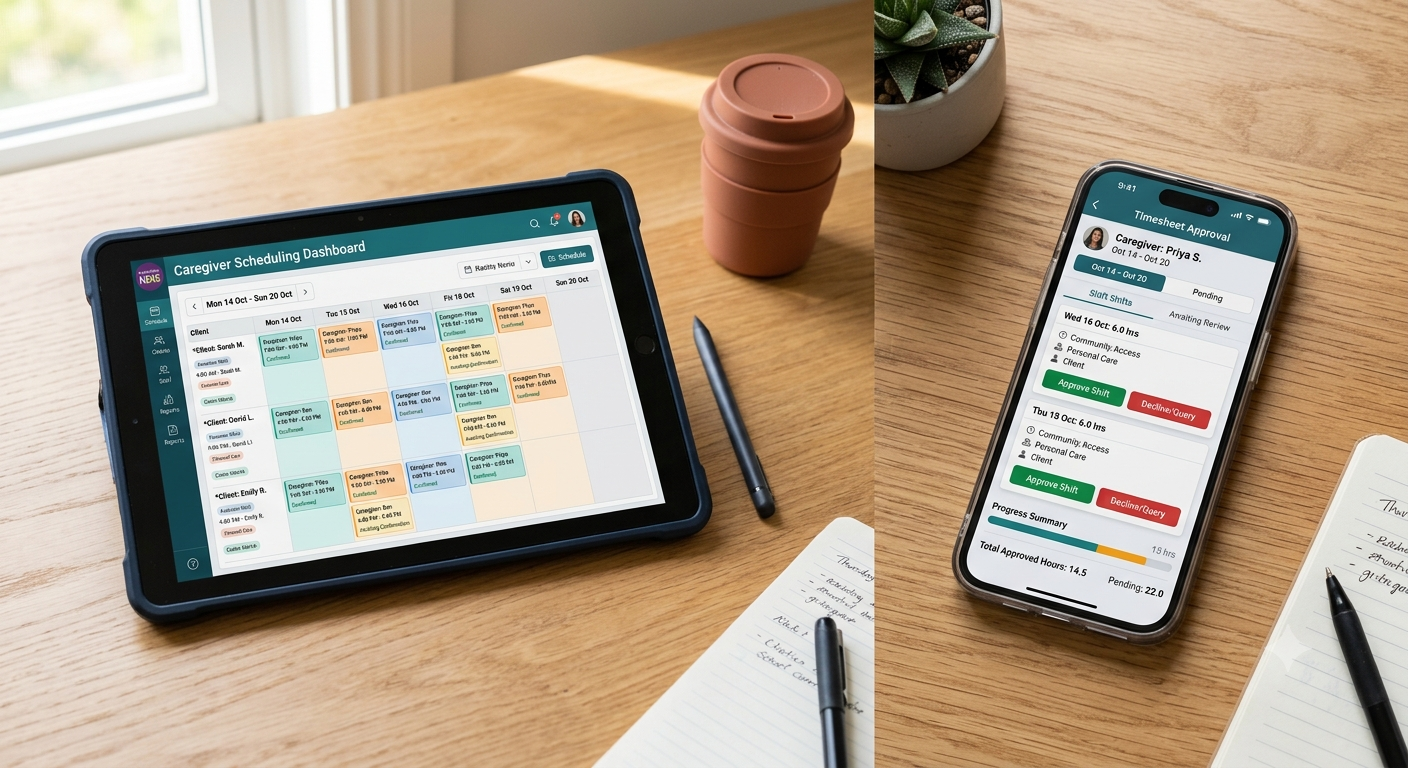
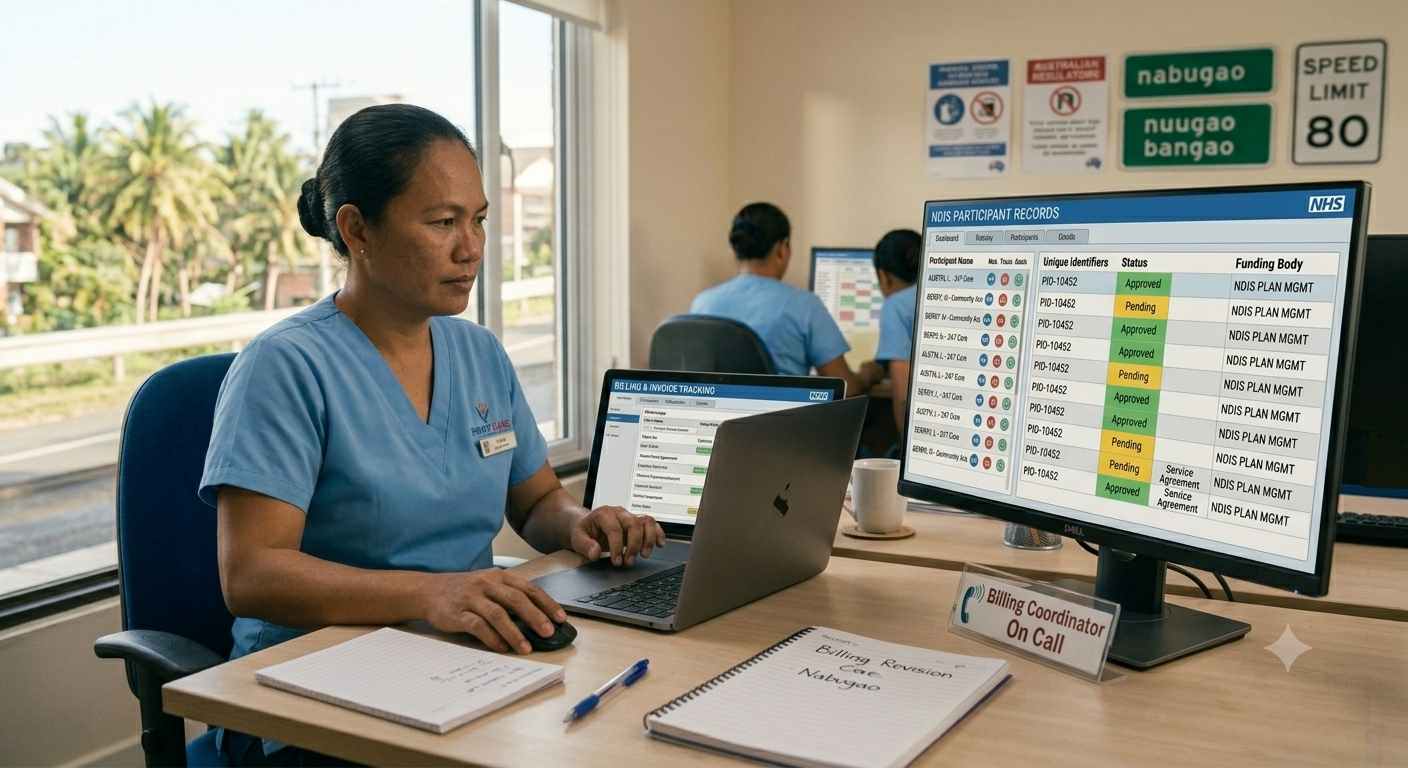
Every shift, every service delivery, every charge-out must be tagged to the correct scheme in your financial system. If your scheduling tool flags shifts as “NDIS” or “aged care,” and your time tracking system carries those tags through to billing, your finance team can reconcile charges cleanly.
Manual tracking fails quickly. Volume and complexity exceed human memory. Software systems that tag at the scheduling level prevent billing errors before they happen.
Staffing separation:
You don’t need separate staff teams for NDIS and aged care, but you need clarity on who is trained and credentialed for what.
- Worker trained for NDIS personal care but not aged care personal care → can only deliver NDIS shifts
- Worker has both qualifications → can work both schemes, but time allocation must be tracked accurately
Many providers assign staff to specific “pathways” within the rostering system:
- NDIS pathway
- Aged care pathway
- Mixed pathway (for workers credentialed for both)
This prevents under-qualified staff being assigned to the wrong scheme and makes it easy to see at a glance who can work which shifts.
Common Mistakes & How to Avoid Them
Mistake 1: Using a single participant file for both schemes
NDIS requires a plan document, participant goals, and documented service delivery against those goals. Aged care requires a care assessment, a person-centred plan, and documented progress on aged care quality standards.
These documents are not interchangeable. Maintain separate participant records or clearly labelled plan documents so auditors can trace who is being funded by which scheme.
Mistake 2: Mixing staff costs between schemes
If you have a coordinator managing both NDIS and aged care cases, their salary must be allocated proportionally between the two schemes. Charging their entire salary to one scheme means you’re under-charging one and over-charging the other.
Regulators will query this. Transparent cost allocation spreadsheets, updated monthly or quarterly, help avoid it.
Mistake 3: Assigning shared resource costs entirely to one scheme
Equipment, training, or software costs that benefit both schemes can’t be assigned wholly to one. Shared resource allocation requires defensible logic documented in your financial records.
If you’re unsure of the allocation, you’re already non-compliant.
Stop Mixing NDIS and Home Care Billing Before It Becomes a Compliance Issue
Dual registration works when your systems enforce operational separation. ShiftCare tags every shift at the scheduling level (NDIS or aged care), carries those tags through to billing, and prevents the same hours being charged to both schemes.
Start your free trial today. See how ShiftCare helps dual-registered providers track NDIS and aged care billing separately without manual reconciliation.