NDIS Worker Screening Check: Online Application Process and Requirements

The NDIS Worker Screening Check is a national background screening process for people working in certain roles with NDIS participants. Applications are completed through the relevant state or territory screening authority. Once approved, an NDIS clearance is generally valid for five years and recognised across Australia.
The NDIS Worker Screening Check is a national background screening process that verifies worker suitability before they can work with NDIS participants. Valid for five years and nationally portable across Australia, the check is required for workers in certain NDIS roles.
Understanding the NDIS worker screening check, including the online application process, documentation requirements and expected timeline, is essential for both disability support workers and providers.
For workers, obtaining an NDIS worker screening check is often one of the first steps towards employment in the disability sector. For employers and disability support providers, ensuring relevant team members have valid screening clearances is an important registration and safeguarding obligation.
Whether you are applying for your first check, renewing an existing clearance or managing screening compliance across a team, this guide covers the key requirements.
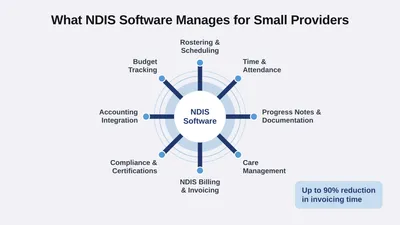
Providers can also use NDIS software to keep worker records, documents, schedules and compliance information organised in one system.
What Is an NDIS Worker Screening Check?

The NDIS Worker Screening Check is a national background screening process that assesses a worker’s suitability to work with people with disability in certain NDIS-funded roles.
The screening check goes beyond a standard police background check. It may include an assessment of criminal history and other relevant information that could indicate whether a worker presents an unacceptable risk to people with disability.
The check is conducted by state and territory screening units but is nationally recognised and portable. A worker who obtains an NDIS screening clearance in one state can generally use it when working for NDIS providers in another state or territory.
For providers, worker screening forms part of broader NDIS compliance management, alongside worker qualifications, training records, incident reporting and audit documentation.
Why Is NDIS Worker Screening Required?
Protecting NDIS Participants
The primary purpose of NDIS worker screening is to help protect people with disability from abuse, neglect, exploitation and other forms of harm.
Screening workers before they begin relevant roles creates an important safeguard by identifying people who may present an unacceptable risk to participants.
However, worker screening should not be treated as the only safeguarding measure. Providers should also maintain appropriate recruitment, supervision, training, incident management and complaint-handling processes.
Providers can review the NDIS incident reporting guide for more information about responding to and documenting reportable incidents.
Registration Requirements for Providers
Registered NDIS providers must have systems in place to identify workers who require screening and verify that they hold an appropriate clearance before they commence a risk-assessed role.
Worker screening records may be examined during an NDIS audit. Providers should be able to demonstrate that they:
- Identify risk-assessed roles
- Verify worker screening status
- Record clearance and expiry information
- Monitor renewals
- Respond appropriately to changes in a worker’s status
- Maintain accurate compliance documentation
See how to prepare for your first NDIS audit for additional guidance on organising evidence before an audit.
NDIS Worker Screening Eligibility Requirements

Not every person working somewhere in the NDIS sector automatically requires a screening check. The requirement usually depends on the provider’s registration status, the worker’s responsibilities and whether the position is considered a risk-assessed role.
Who Needs an NDIS Worker Screening Check?
A screening check may be required for:
- Paid employees
- Disability support workers
- Contractors
- Volunteers
- Sole traders
- Self-employed support workers
- Key personnel of registered providers
- Students completing placements in relevant roles
- Labour-hire workers performing NDIS support work
Providers should assess the actual duties and participant contact involved rather than relying only on a job title.
Registered NDIS Providers
Registered NDIS providers are generally required to ensure that workers in risk-assessed roles have a valid NDIS worker screening clearance.
This can include roles involving:
- Direct delivery of NDIS supports
- Regular physical contact with participants
- Regular communication with participants
- Work in participants’ homes
- Specialist disability accommodation
- Significant organisational decision-making
Registered providers should document which roles they classify as risk assessed and why.
Unregistered Providers
Unregistered providers do not always have the same national worker screening obligations as registered providers.
However, an NDIS worker screening check may still be:
- Requested by a participant
- Required under a service agreement
- Required under state or territory legislation
- Adopted voluntarily as a safeguarding measure
Unregistered providers should assess their responsibilities carefully rather than assuming screening is unnecessary.
Sole Traders and Self-Employed Workers
Registered sole traders working in relevant roles may need to apply for an NDIS worker screening clearance and verify their own application through the appropriate employer process.
Sole traders should confirm:
- Which state or territory portal to use
- Whether an Employer ID is required
- How their application will be verified
- Whether they can work while the application is pending
Volunteers
Volunteers working in risk-assessed roles may also require screening.
Some states and territories offer reduced fees or fee exemptions for eligible volunteers. Applicants should select the correct worker category and provide any required supporting evidence.
Contractors and Labour-Hire Workers
Contractors are not automatically exempt from worker screening requirements.
Providers should ensure that contractors and labour-hire workers performing relevant duties have the appropriate clearance and that their records are included in the provider’s compliance system.
This can be incorporated into the organisation’s support worker recruitment and onboarding process.
Criminal Records and Eligibility
A criminal record does not automatically result in exclusion.
The screening authority may consider:
- The nature of the offence
- How long ago it occurred
- The circumstances surrounding it
- The relevance to disability support work
- Evidence of rehabilitation
- Other available risk information
Applicants should provide complete and accurate information when requested.
National NDIS Worker Screening: Key Facts
Five-Year Validity and Interstate Portability
An NDIS worker screening clearance is generally valid for five years from the date of issue.
Workers should begin preparing for renewal before the clearance expires to reduce the risk of a gap in eligibility.
Once issued, the check is nationally recognised. If a worker moves interstate or changes employers, they generally do not need to obtain a completely new check solely because of the move.
Providers should still verify the worker’s current status and link the worker to their organisation where required.
NDIS Worker Screening Online Application Process
Although each state and territory manages its own application process, most worker screening applications follow a similar sequence.
Step 1: Confirm That You Need the Check
Ask the provider whether the role is considered risk assessed and whether an NDIS clearance is required.
Step 2: Obtain the Employer’s Details
Applicants may need:
- Employer name
- Employer ID
- NDIS provider details
- Participant details, where applicable
- Role or employment information
Using incorrect employer information may delay verification.
Step 3: Apply Through the Relevant State or Territory Portal
Use the official government screening portal for the state or territory where you are instructed to apply.
Step 4: Complete the Online Application Form
You may be asked to provide:
- Personal details
- Current and previous names
- Residential history
- Employment details
- Employer information
- Consent to background checks
Step 5: Verify Your Identity
Identity verification may be completed:
- Online
- Through uploaded documents
- At a government service centre
- Through a digital identity service
Step 6: Pay the Application Fee
Fees vary by jurisdiction. Eligible volunteers may qualify for a reduced fee or exemption.
Step 7: Submit the Application
Review all information carefully before submitting and save your application reference number.
Step 8: Complete Employer Verification
The employer may need to verify that they employ or intend to employ the applicant.
Applicants should notify the employer after submitting the application so verification can be completed promptly.
Step 9: Monitor the Application
Check email and the application portal regularly in case additional information is requested.
Step 10: Receive the Outcome
Once approved, the worker will receive confirmation of their clearance status and screening number.
State and Territory Application Differences
The NDIS worker screening application process varies because each jurisdiction administers screening through its own government authority.

| State or territory | Application starting point | Important consideration |
| New South Wales | Service NSW | Applicants may need to complete identity verification through a Service NSW Centre. |
| Victoria | Service Victoria | Applications can generally be started online. |
| Queensland | Queensland worker screening services | Check the current disability worker screening process and identity requirements. |
| South Australia | Department of Human Services Screening Unit | Confirm current application and volunteer requirements. |
| Western Australia | Relevant WA screening authority | Follow the current WA government application pathway. |
| Tasmania | State vulnerable-person screening system | The NDIS process may operate through the state registration system. |
| Australian Capital Territory | Access Canberra | Check current identity and application requirements. |
| Northern Territory | SAFE NT or the relevant NT authority | Follow the current territory screening process. |
Application fees, accepted documents and verification procedures may change. Applicants should always use the official government portal for their jurisdiction.
Processing Timeline and Verification
Processing times vary between jurisdictions and applications.
Straightforward applications may be completed relatively quickly, while others can take several weeks or longer.
Processing may be delayed by:
- Incomplete applications
- Missing identity documents
- Poor-quality document uploads
- Name or date-of-birth mismatches
- Outstanding employer verification
- Incorrect Employer ID
- Incomplete address history
- Additional background assessment
- High application volumes
- Requests for further information
Applicants should avoid making employment plans based on a guaranteed processing time.
Employers should also confirm whether the worker is legally permitted to work while an application is pending. Rules differ between states and territories.
Common Mistakes to Avoid
Avoid these common worker screening mistakes:
- Assuming a police check is the same as an NDIS clearance
- Entering the wrong Employer ID
- Failing to disclose previous names
- Uploading expired or unclear identity documents
- Selecting the wrong paid or volunteer category
- Starting work before confirming eligibility
- Forgetting employer verification
- Failing to monitor the application portal
- Waiting until the clearance has expired before renewing
- Keeping screening records in disconnected spreadsheets or inboxes
After Your NDIS Worker Screening Check Approval
Once the screening check is approved, the applicant will receive confirmation of their clearance status and screening number.
Record:
- Screening number
- Date of issue
- Expiry date
- Employer linkage
- Current clearance status
When applying for disability support roles, workers can provide their screening number to prospective employers.
The clearance can generally be used across multiple employers and states, provided it remains valid and the relevant organisations complete any required verification or linking process.
Renewing an NDIS Worker Screening Check
An NDIS worker screening clearance is generally valid for five years.
Workers should check the renewal or reapplication rules in the state or territory where they currently live.
Before expiry:
- Confirm the expiry date
- Check the permitted renewal period
- Gather updated identity documents
- Notify the employer
- Submit the renewal application
- Monitor its progress
- Confirm the renewed status
Providers should set reminders well in advance rather than relying on workers to remember their expiry dates.
NDIS Worker Screening Check vs Police Check
| NDIS Worker Screening Check | Police Check |
| Assesses suitability for relevant NDIS roles | Reports disclosable police history |
| May include ongoing monitoring | Usually reflects information available at the time of issue |
| Recorded within the NDIS worker screening system | Not an NDIS clearance |
| Generally valid for five years | No universal national expiry period |
| Nationally recognised for NDIS worker screening | Acceptance depends on the requesting organisation |
| Cannot normally be replaced by a police check | Does not replace an NDIS worker screening clearance |
A provider may request both checks because they serve different purposes.
NDIS Worker Screening Check vs Working With Children Check
| NDIS Worker Screening Check | Working With Children Check |
| Protects people with disability in relevant NDIS settings | Protects children in child-related work |
| Applies to relevant NDIS risk-assessed roles | Applies to child-related roles under state or territory law |
| Nationally recognised for NDIS screening purposes | Generally administered separately by each jurisdiction |
| May be required alongside a child-related clearance | Does not automatically replace an NDIS clearance |
A support worker assisting children with disability may need both checks.
NDIS Worker Screening Application Checklist
Before Applying
- Confirm whether the role requires screening
- Obtain the correct Employer ID
- Gather identity documents
- Prepare previous name information
- Check the application fee
- Confirm whether the role is paid or voluntary
- Create the required portal account
During the Application
- Enter your legal name correctly
- Provide complete address history
- Upload clear documents
- Review employer details
- Save the application reference
- Complete identity verification
- Notify the employer
After Approval
- Save the screening number
- Record the expiry date
- Give the details to the employer
- Confirm employer linkage
- Monitor status changes
- Set a renewal reminder
Managing Screening Compliance Across Your Workforce
For disability support providers, managing NDIS worker screening compliance across a team is an important registration and safeguarding obligation.
Providers should track:
- Worker name
- Role
- Screening number
- Clearance status
- Issue date
- Expiry date
- Renewal status
- Employer linkage
- Supporting documents
- Any supervision or risk-management arrangements
Using NDIS rostering software can help organisations connect worker records with scheduling and reduce the risk of assigning workers whose documentation requires review.
Providers should also:
- Review worker records regularly
- Set automated expiry reminders
- Include screening in recruitment and onboarding
- Check contractors and volunteers
- Store audit evidence centrally
- Remove or restrict workers when clearance requirements are not met
- Maintain appropriate incident and safeguarding procedures
ShiftCare’s care planning software and shift scheduling software can help providers keep workforce and participant information connected across daily operations.
Frequently Asked Questions About the NDIS Worker Screening Check
Can I use my NDIS screening check from one state in another state?
Yes. A valid NDIS worker screening clearance is generally recognised across Australian states and territories. You normally do not need a separate clearance for every state.
How often do I need to renew my NDIS Worker Screening Check?
An NDIS worker screening clearance is generally valid for five years. Check your state or territory requirements and begin the renewal or reapplication process before it expires.
What happens if I have a criminal record?
A criminal record does not automatically mean that an applicant will be excluded. The screening authority considers the nature, relevance and circumstances of the information available.
Is an NDIS Worker Screening Check the same as a police check?
No. A police check reports disclosable criminal history, while the NDIS Worker Screening Check is a broader suitability and risk assessment for relevant NDIS roles.
Do sole traders need an NDIS Worker Screening Check?
Registered sole traders working in risk-assessed roles generally require a valid clearance. Requirements for unregistered sole traders depend on the role, participant arrangement and applicable rules.
Do volunteers need an NDIS Worker Screening Check?
Volunteers working in risk-assessed roles for registered providers may need a clearance. Some jurisdictions offer volunteer fee exemptions.
Can I work while my application is being processed?
This depends on the state or territory. Some jurisdictions allow limited working-on-application arrangements, while others require clearance before the worker starts.
How long does the application take?
Processing time varies. Complete applications with correct identity and employer details may be processed faster, while applications requiring further assessment can take longer.
Do I need both an NDIS check and a Working With Children Check?
Possibly. Workers supporting children with disability may require both checks because they cover different safeguarding requirements.
Why is my NDIS worker screening application delayed?
Common reasons include incomplete identity documents, name mismatches, missing employer verification, incorrect Employer IDs and additional background assessment.
Simplify Worker Screening Compliance With ShiftCare
Managing NDIS worker screening across a growing workforce can become difficult when clearance details, qualifications, documents and expiry dates are stored in separate systems.
ShiftCare helps NDIS providers organise worker information, schedules, documents, participant records and compliance evidence in one place.
Explore ShiftCare pricing, book a demo or start a free trial to see how ShiftCare can support safer workforce management and stronger NDIS compliance.