Providing disability care services means that you need to be flexible. NDIS participants can require additional services, occasionally at short notice. All it takes is for a client to fall ill for your rosters to need reworking.
But the SCHADS award also requires full- and part-time staff to have predictable hours, and overtime rates are expensive.
So, how can your NDIS business balance the need for flexibility with SCHADS compliance? Let’s take a look at your obligations and options.
Understanding the “Predictable Hours” SCHADS Award Requirement
The SCHADS award establishes NDIS workers’ rights, including the right to reasonably predictable hours. But, there are several major exceptions to this, including reasonable changes, overtime and casual workers.
Defining a Worker’s Hours
You must provide full- and part-time employees with a written agreement outlining their spread of ordinary hours. This means the days and times during which they would normally be assigned shifts. You don’t need to specify their exact shift times.
For part-time employees, this document should also include the number of hours they’ll typically work.
What Counts as Reasonably Predictable Hours?
Neither the SCHADS award nor Fair Work Australia define reasonably predictable hours. But tests of reasonableness generally ask questions like:
- How much does it inconvenience the worker?
- How much would alternative options inconvenience the NDIS business?
- Is there a health and safety risk for the worker or any NDIS participants?
- How much notice has the worker received?
- What is the worker’s level of responsibility?
Workers should also receive seven days’ notice of changes to their roster. But, the SCHADS award lists several exceptions to this rule, including employee-requested shift swaps, cover for staff illness, emergencies and, in the case of part-time staff, mutually agreed-on extra hours.
Overtime & Predictable Hours in the SCHADS Award
Any hours that fall outside of a worker’s ordinary hours are considered overtime. Under the SCHADS award, there are also several situations in which work done within an employee’s spread of ordinary hours is considered overtime. This includes:
- After eight hours or, with the worker’s consent, after ten hours of an unbroken shift
- Broken shifts with a span exceeding 12 hours
- Any shifts without a full 10-hour break beforehand
- Any work done during sleepovers
Even though overtime isn’t predictable, full- and part-time NDIS workers can only turn it down if it “unreasonably exceeds” their maximum working hours. This provides you with extra rostering flexibility, but be careful: too much overtime can demotivate staff.
Casual Workers’ Rights Under the SCHADS Award
Unlike full- and part-time employees, casual workers don’t have a right to reasonably predictable hours. You can offer them shifts as and when you need extra staff. But don’t forget that they can also turn down shift requests.
SCHADS-Compliant Tips for Increasing Flexibility in Your Team Rostering
- Employ Casual and Permanent Staff
Employing both casual and permanent staff can help you ensure NDIS participants receive regular support while also filling empty shifts where needed. You can also offer existing staff casual conversions and vice versa.
- Avoid Rostering Mistakes
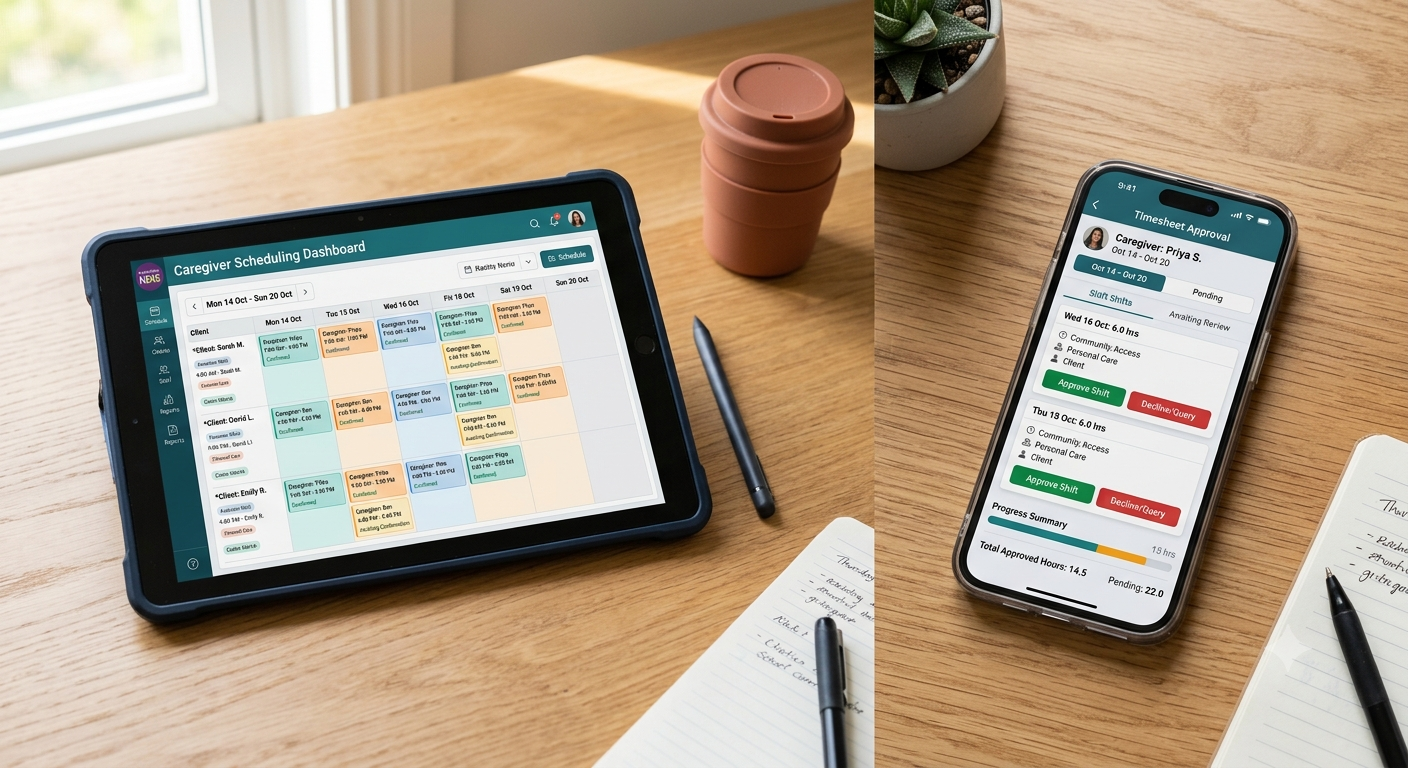
Error-free rostering will help you avoid last-minute changes. Use modern rostering tools like ShiftCare to ensure every participant’s services are scheduled. You can also invite external support coordinators to view clients’ upcoming services on ShiftCare Connect.
- Publish Rosters Early
Full- and part-time workers must receive their rosters two weeks in advance. But the sooner you send out rosters, the easier you’ll find it to resolve any availability issues or organise casual cover.
- Encourage Staff to Bid on Empty Shifts
Allowing NDIS workers to bid on shifts via a job board helps you quickly fill gaps in your roster. And, it means the extra work goes to staff that want additional hours.
What Else Does Your NDIS Business Need to Know About the SCHADS Award?
There’s far more to the SCHADS award than we could ever explain in just one blog post, as it sets minimum pay rates, staff pay levels, potential for progression and allowances for mileage — to name but a few things.
That’s why we’ve published a comprehensive ebook about what the SCHADS award means for NDIS providers. Download it for free here.
Try ShiftCare for free today with a 7-day trial.
1. How many hours can a support worker work in Australia?
In Australia, a support worker can be rostered for either 38 hours per week, 76 hours per fortnight or 152 hours per four weeks. However, support workers can also be required to work overtime.
2. Is a sleepover a broken shift?
Even though it includes a rest period of eight hours, a sleepover is not considered a broken shift under the SCHADS award. The hours worked before and after the sleepover are treated as a continuous shift, with any work during the sleepover compensated at an overtime rate (one hour minimum).
3. How does the SCHADS Award impact shift rostering for NDIS providers?
The SCHADS Award sets strict rules on minimum shift lengths, overtime, penalty rates, and rest breaks, making it challenging for NDIS providers to balance staff flexibility with compliance requirements.
4. What is the maximum span of hours allowed under the SCHADS Award?
Under the SCHADS Award, a standard shift cannot exceed 12 hours, and workers must have at least 10 hours between shifts unless an agreement allows otherwise.
5. How does the SCHADS Award regulate weekend and public holiday shifts?
The SCHADS Award requires higher penalty rates for weekend and public holiday shifts, meaning NDIS providers must carefully manage rostering to ensure compliance while controlling costs.
6. Can a support worker refuse a broken shift under the SCHADS Award?
Yes, under the SCHADS Award, a support worker must agree to work a broken shift. Employers must ensure minimum rest periods and pay appropriate penalties when scheduling these shifts.
7. How can NDIS providers simplify SCHADS Award rostering compliance?
Using NDIS rostering software, like ShiftCare, helps automate compliance with SCHADS Award rules, ensuring penalty rates, shift breaks, and allowances are correctly applied while reducing admin workload.