Every registered NDIS provider is audited: at registration, at the 18-month mid-term mark, and again at renewal. The audit itself isn’t the hard part. It’s proving that your everyday operations meet the NDIS Practice Standards with documentation that’s complete, accurate, and accessible on request.
That’s where most providers feel the pressure. Not because they’re delivering poor care, but because the evidence of good care is scattered across paper files, spreadsheets, and inboxes – or it was never captured in enough detail to satisfy an auditor.
This article breaks down the six key areas auditors examine, what they expect to see in each one, and how ShiftCare automates the documentation so audit readiness becomes part of your daily operations rather than a last-minute compliance project. If you want a step-by-step walkthrough of the full audit process, our NDIS audit checklist also covers each compliance area in detail.
What Happens During an NDIS Audit
NDIS audits are conducted by approved quality auditors, not the NDIS Commission directly. The auditor’s job is to assess whether your organisation meets the relevant modules of the NDIS Practice Standards. Depending on your registration groups, you’ll undergo either a verification audit (remote, document-based) or a certification audit (on-site, with participant and staff interviews).
Regardless of which type, auditors are looking for the same thing: evidence. They want to see that you have systems in place, that those systems are being used consistently, and that you can demonstrate compliance through documentation. The providers who pass audits comfortably aren’t necessarily the ones who prepare hardest in the weeks before, they’re the ones whose daily workflows already produce the records auditors need.
Core NDIS Functional Domains
Here’s a summary of the six areas auditors focus on most closely:
| What Auditors Examine | What They Want to See | What Happens Without It |
| Service delivery records | Proof that services were delivered as documented in service agreements – participant names, worker names, dates, times, service types, progress notes | A non-conformity finding, even if the services were actually delivered |
| Incident reports | Evidence of a functioning incident management system: reports, investigations, corrective actions, and Commission notifications for reportable incidents | One of the most common audit failures; can escalate to major non-conformity |
| Service agreement compliance | Current agreements showing participant goals, authorised supports, funding sources, budgets, and evidence of at least annual reviews | Gaps between what was planned and what was delivered undermine your compliance position |
| Worker qualifications | Current, valid certifications for every worker delivering supports | Expired or missing qualifications create immediate audit findings |
| Participant feedback | Evidence that you collect feedback from participants and act on it | Suggests a lack of participant-centred practice – a core principle of the Practice Standards |
| Risk assessments | Documented risk identification and mitigation strategies with review schedules | Indicates gaps in governance and operational management |
Service Delivery Records: The Foundation of Audit Evidence

This is typically the first thing auditors request. They want to see that every service delivered to a participant was documented with enough detail to verify it matched the service agreement. That means participant names, support worker names, service dates, NDIS support item codes, clock-in and clock-out times, and progress notes describing what support was provided.
The challenge for many providers isn’t that they don’t deliver good care, it’s that the records are incomplete. Paper timesheets go missing. Progress notes get written days after the shift. Manual data entry creates gaps. And what if an auditor asks for three months of service delivery records for a specific participant? That’s where difficulties start, especially if you’re looking across a WhatsApp chat, your own spreadsheets and calendars, to align and provide accurate information.
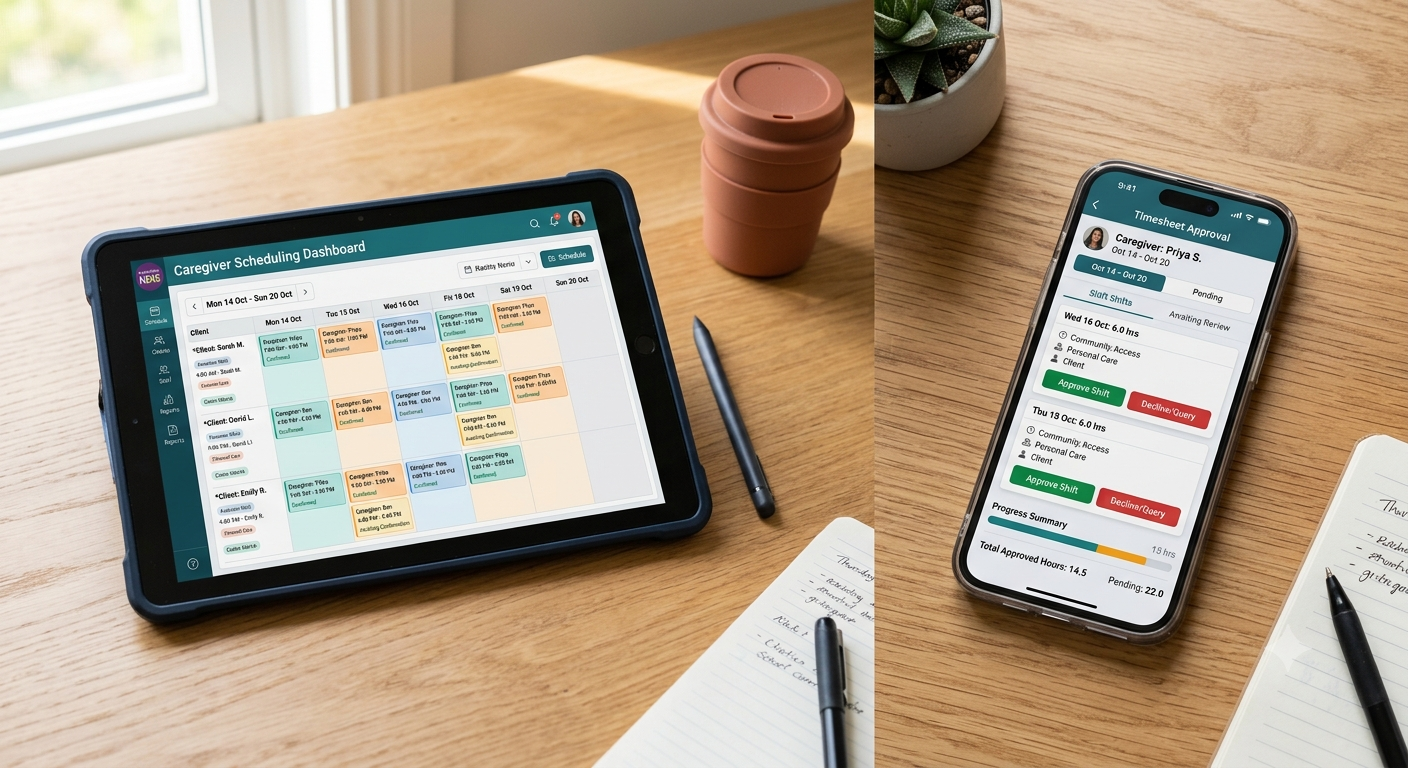
Software like ShiftCare eliminates that scramble by capturing service delivery data automatically through the mobile app. Support workers complete service logs during or immediately after each shift. Each log records the participant’s name and NDIS number, the worker’s name and employee ID, the service date and support item code, shift start and end times with GPS verification, and detailed notes on the support delivered. Everything syncs to your central system in real time, no paper to lose, no manual entry to forget.
When an auditor requests records, you generate a report filtered by participant, date range, support item, or worker. The report shows a complete shift history with timestamps and worker signatures.
What does this look like in practice?
An auditor asks to see all core support services delivered to a participant between January and March 2025. You filter service logs by participant and date range and export the report. Within minutes, the auditor has documentation for 47 shifts showing complete service delivery records: participant details, worker details, times, support codes, and progress notes. No filing cabinets. No spreadsheet cross-referencing.
Incident Management: Where Audits Most Often Go Wrong

Incident management is consistently one of the highest-risk areas in NDIS audits. The Practice Standards require providers to identify, report, investigate, and resolve incidents, and auditors want evidence of every step. They’ll look for incident reports, investigation records, corrective actions, root cause analysis, and (for reportable incidents) evidence of timely notification to the NDIS Commission. For a closer look at common pitfalls, our guide on common findings in NDIS audits breaks down what trips providers up most often.
The most frequent failure isn’t that incidents happen, it’s that they aren’t documented properly. An incident occurs, immediate action is taken, the participant is safe but the written record is incomplete, late, or missing the investigation trail entirely.
ShiftCare’s incident management tools help providers to capture and record incidents at the point they occur. Support workers use the mobile app to report incidents immediately, guided by a structured form that prompts them to record the incident type (injury, property damage, medication error, people involved and witnesses, immediate actions taken, and whether the incident meets NDIS Commission reportable criteria.
Reportable incidents, including death, serious injury, abuse or neglect, sexual misconduct, and unauthorised restrictive practices are flagged automatically based on NDIS Commission guidelines. Your team knows immediately which incidents require Commission notification within 24 hours (or five business days for unauthorised restrictive practices not causing immediate harm).
From there, ShiftCare tracks the full investigation workflow. You assign incidents to managers, record each investigation step: interviews conducted, evidence gathered, root cause identified, document corrective actions and preventive measures, and close incidents with a resolution summary. The entire trail is time-stamped and stored in one place.
For a deeper walkthrough of the notification process and your team’s obligations, our guide on NDIS incident reporting compliance covers each step.
Service Agreements and Authorised Hours: Closing the Plan-to-Delivery Gap

Auditors verify that the services you deliver match the details in each participant’s service agreement. They’ll check for participant goals, delivered supports, funding sources, authorised support budgets, and review schedules. At a basic level, you need to review agreements at least annually, and auditors will ask for documentation.
This is where a common gap appears, service agreements get created during intake, often with care and detail. But participants’ needs change over time: new goals emerge, supports shift, funding gets adjusted. If the agreement stays frozen while the care evolves, auditors see a disconnect between what was planned and what was delivered. Even if the care itself was excellent, an outdated agreement raises questions about your governance processes.
ShiftCare centralises service agreement management so nothing slips through the cracks. You store service agreements alongside participant records, track agreement status (draft, active, under review, or expired), set review dates with automated reminders so renewals don’t get missed, and maintain version history showing exactly when each agreement was created, reviewed, and updated.
Authorised hours tracking adds another layer of protection. Your service agreements define authorised support budgets by NDIS support category, and ShiftCare tracks support delivered against those budgets in real time. A dashboard shows hours delivered versus hours funded. Alerts fire when you’re approaching budget limits. The system prevents rostering shifts that would exceed authorised funding, which means you’re not only compliant on paper, you’re preventing over-servicing before it happens.
Worker Qualifications: Keeping Certifications Current
Auditors will check that every support worker delivering services holds current, valid qualifications for the type of support they provide. Expired certifications, missing first aid training, or lapsed NDIS Worker Screening Checks create immediate audit findings, and they’re among the simplest issues to prevent with the right system.
ShiftCare tracks worker qualifications and certifications centrally, with automatic expiry alerts that notify your team well before a document lapses. You can see at a glance which workers are fully compliant and which have certifications approaching expiry, so you can follow up before it becomes a compliance issue rather than after.
When an auditor requests evidence of worker qualifications, you pull a report showing each worker’s current certifications, issue dates, and expiry dates – no need to rifle through individual personnel files.
Want to learn more about choosing the right NDIS software for your business? Read our comprehensive guide to learn more about the foundations needed for successful operations, and the key benefits it can offer your business (whether you’re 20 staff or 100).
Building Audit Readiness Into Daily Operations with ShiftCare
The difference between providers who stress about audits and providers who handle them with confidence comes down to one thing: compliance. Whether compliance documentation is a by-product of daily work or a separate project that only gets attention when an audit is approaching.
ShiftCare builds audit readiness into your everyday workflow. It enables you to complete service logs, incident reports, and worker qualifications during shifts, not afterward on messy legacy systems. Your team focuses on delivering quality support to participants. The documentation takes care of itself.
Start your free trial today and see how ShiftCare helps NDIS providers stay audit-ready with one integrated care management system.