Understanding the SCHADS Award is essential for managing NDIS support workers fairly and compliantly.
The Social, Community, Home Care and Disability Services Industry (SCHADS) Award, also known as the disability services industry award, is a crucial framework that sets the minimum standards for employment conditions in the SCHADS sectors.
Whether you’re managing home carers, social service providers, or NDIS disability support workers, understanding the SCHADS Award is key to ensuring fair treatment and compliance. The recent 15% minimum wage increase for direct care workers, including nurses and personal care workers, acknowledges the historical undervaluation of care work and is an important aspect of the award’s provisions.
Additionally, the SCHADS Award includes a broken shift allowance for employees working broken shifts, which is particularly relevant in social and community services, including disability services and home care.
Overview of the SCHADS Award
The SCHADS Award is a Modern Award designed specifically for the diverse roles within social and community services, care and disability services, and the broader community services sector. It ensures minimum employment standards for full-time employees, part-time employees, and casual employees.
Employers in not-for-profits, government-funded programs, and private NDIS providers must apply the award when managing disability services work, domestic assistance, and lifestyle support roles.
Key areas regulated include:
- Hours of work and ordinary working hours
- Wage progression through pay point classifications
- Overtime pay, penalty rates, and allowances
- Leave entitlements and notice periods
- Rostering obligations such as reasonably predictable hours
Some roles or sectors, such as those providing family daycare services under a family daycare scheme, may be covered by a different modern award, such as the Support Services Award, rather than the SCHADS Award.
Because many roles involve crisis accommodation, assistance and supported housing, and home maintenance, the award contains additional protections tailored to high-responsibility environments.
What Does the SCHADS Disability Services Industry Award Cover?
The disability services industry award outlines a comprehensive framework that governs employment conditions for community services employees undertaking roles across social and community services and home care and disability settings.
Minimum Pay Rates
The award establishes a structured classification system based on pay point levels that reflect experience, responsibilities, and new or enhanced skills gained through on-the-job training.
Employees under the SCHADS Award typically progress to a higher pay point after 12 months of continuous employment, provided they demonstrate competency and satisfactory performance. However, promotion to a higher pay point is ultimately at the employer’s discretion. Movement to a higher classification level generally requires a formal promotion or reclassification process.
Hours of Work and Overtime
Standard ordinary hours are typically based on 38 hours per week, with overtime applying when employees work ordinary hours beyond agreed limits.
Penalty provisions include:
- Time and a half for overtime
- Paid double time for extended shifts
- Additional payments for night shift allowance and afternoon shift allowance
Allowances and Special Conditions
The award provides specific entitlements for employees performing:
- Domestic and lifestyle support
- Personal care
- Duties in crisis assistance and supported housing
- Work within the supported housing sector
Consultation and Workplace Rights
Employers must consult employees regarding major roster changes and demonstrate reasonable business grounds when modifying agreed working arrangements.
Who Is Covered by the SCHADS Award for Community Services Employees?
The SCHADS Award applies broadly across the community services sector, covering community services employees who deliver support across several specialised fields.
It is important to note that the SCHADS Award can also apply to very senior employees, including roles such as Chief Executive Officer. Correct classification of all employees, including top management, is essential to ensure compliance and avoid legal issues.
- Crisis Assistance and Supported Housing: Employees working in emergency accommodation services, supported living arrangements, and crisis accommodation employees.
- Social and Community Services: Support workers providing essential social services to communities, including counselling, welfare support, and community services employees.
- Home Care: Carers offering in-home support to individuals, including personal care and household assistance.
- Family Day Care Scheme: Coordinators and providers involved in family day care services.
It also includes organisations that provide policy, advocacy, or representation services to these sectors. Additionally, disability services, encompassing personal care, domestic help, and lifestyle support, fall under this award.
Crisis Assistance and Supported Housing
Employees working in crisis assistance, emergency accommodation, and assistance and supported housing programs are covered, including crisis accommodation employees delivering direct support.
Disability Services
Workers undertaking disability services work, including personal care, domestic assistance, and lifestyle support, fall under the award’s provisions.
Roster management and scheduling policies for disability services employees must account for client cancellations and staffing changes, as outlined in the SCHADS Award.
Social and Community Services
This includes employees engaged in:
- Counselling and welfare programs
- Community development work
- Case management roles
- Policy and advocacy support
Home Care and Disability
The award also applies to organisations delivering in-home support, including home maintenance, daily living assistance, and broader home care and disability programs.
Who Is Not Covered by the SCHADS Award?
While the award covers a wide range of community services, there are exclusions.
Workers in the family daycare scheme sector and family day care scheme roles may fall under different industrial instruments, including the Services Industry Award 2010.
Administrative staff performing only basic clerical tasks may also be excluded if another award applies, such as the Nurses Award for registered health professionals.

Breaking Down SCHADS Award Classifications and Pay Points
The SCHADS Award classifies workers into different levels and pay points, reflecting their responsibilities and experience. The SCHADS award rates are set to increase by 3.75% from 1 July 2024, as determined by the Fair Work Commission‘s Annual Wage Review. Here’s a simple breakdown:
- Level 1: Basic tasks with significant supervision.
- Level 2: Tasks with moderate supervision and some decision-making.
- Level 3: Higher responsibilities, including independent decision-making.
- Level 4: Advanced tasks, often involving supervisory roles.
- Level 5: Senior roles, typically involving management and leadership.
Each level has multiple pay points, allowing for progression based on experience, skills, and performance. Typically, an employee moves up a pay point annually, provided they meet the required conditions, such as professional development or additional skills training. Acquiring new or enhanced skills is crucial for employees to progress through pay points and classification levels.
Understanding Pay Points
Pay points are specific wage rates within each award level. They vary based on the type of shift worked. For example, an employee’s ordinary hourly rate might be different from the rate paid for:
- Weekend and Public Holiday Work: Higher rates to compensate for working on these days. Any changes to shift arrangements must be based on reasonable business grounds.
- Afternoon and Night Shifts: Additional pay for working outside typical business hours.
- Overtime: Enhanced rates for hours worked beyond standard shifts.
- Back-to-Back Shifts: Extra pay if there’s less than a 10-hour break between shifts.
These pay variations ensure that workers are fairly compensated for the different types of work they perform.
SCHADS Award Levels and Pay Points: An Example
Let’s look at a practical example to clarify how this works:
- Level 4 — Pay Point 1: $39.26 per hour
- Level 4 — Pay Point 2: $40.29 per hour
- Level 5 — Pay Point 1: $44.92 per hour
- Level 5 — Pay Point 2: $45.88 per hour
If an employee starts at Level 4, Pay Point 1, they would earn $39.26 per hour. After a year of satisfactory performance and skill enhancement, they could move to Pay Point 2, increasing their hourly rate to $40.29. Over time, they could progress through the levels, potentially reaching a management role at Level 5.
Casual vs Part-Time vs Full-Time Employees
- Casual Employees: A casual employee under the SCHADS Award is someone with no guaranteed hours of work and irregular working patterns. These support workers do not have guaranteed hours, so their hourly pay is higher to compensate for this uncertainty. Casual employees also have rights regarding conversion to full-time or part-time employment and are subject to additional pay rates and conditions that reflect their unique employment status.
- Part-Time Employees: Part-time support workers have the same base pay rate as full-time employees, but some allowances (like the first aid allowance) are prorated.
- Full-Time Employees: Full-time support workers receive standard pay rates and full entitlements, including annual leave and superannuation.
Ordinary Hours of Work
The SCHADS Award sets a standard work week of 38 hours. Employees generally work within a specified span of hours for day workers. Work performed outside these spans or in excess of weekly limits attracts overtime rates, with higher rates often paid for weekends and public holidays.
Standard Hours and Rostered Days Off
Full-time and part-time employees (excluding casuals) must receive at least two full days off each week, four full days every fortnight, or eight full days within a 28-day cycle. Employees are entitled to a minimum 10-hour break between shifts or work periods. This ensures that workers have adequate rest and can maintain a healthy work-life balance, which is particularly important in the demanding field of community services.
Employers must carefully manage rosters to comply with these requirements, ensuring that employees are not overworked and that they receive the necessary breaks. This not only helps in maintaining compliance with the SCHADS Award but also contributes to the overall well-being and productivity of the workforce.

Unique Allowances Under the SCHADS Award
Additionally, the SCHADS Award covers a range of home care services, including domestic assistance, which involves personal care and support for individuals with disabilities or the elderly. The SCHADS Award also includes specific allowances that can catch employers off guard if not managed correctly. These include:
SCHADS Broken Shift Allowances
A broken shift splits an employee’s workday into two or more periods, excluding regular meal breaks. This arrangement is common in home care and disability services. The key rules are:
- Maximum Shift Span: A broken shift can last up to 12 hours, including breaks. If it exceeds this, workers must be paid double time.
- Rest Between Shifts: There must be at least 10 hours between broken shifts, or 8 hours if the previous shift was a sleepover.
- Allowance Rate: Employees are entitled to an additional allowance depending on the number of unpaid breaks within the shift. For one break, the allowance is $19.39; for two breaks, it’s $25.67.
Broken shifts apply primarily to employees engaged in disability services work and home care.
SCHADS Sleepover Shifts
Sleepover shifts require a support worker to stay overnight at a client’s home, being on call to assist if necessary. Key aspects include:
- Shift Duration: A sleepover shift can span up to 8 continuous hours. Any work beyond this should be paid as overtime.
- Facilities: Workers must have access to proper facilities, including a separate room, bed, bathroom, and kitchen/kitchenette.
- Overtime Pay: If any duties are performed during the night, workers must receive at least one hour of overtime pay.
- Minimum Pay: If a worker is scheduled before or after the sleepover, they must be paid for at least four hours, even if they work less.
For instance, if Lucy works from 8 p.m. to 8 a.m. (including a sleepover), she would be paid:
- A sleepover allowance of $55.89 for the 10 p.m. to 6 a.m. period.
- At least one hour of overtime if she’s required to work during the sleepover.
- A minimum of four hours’ pay if she works before or after the sleepover shift.
Why Employers Struggle with These Allowances
Many employers find these allowances challenging due to their complexity. For example, it’s easy to overlook the need to pay a sleepover allowance even when the worker sleeps uninterrupted. Managing these manually can lead to errors, resulting in underpayments and potential penalties from Fair Work.
Using automated tools like ShiftCare can simplify compliance by ensuring accurate scheduling and payroll processing. Properly configured software reduces the risk of mistakes and helps maintain compliance with the SCHADS Award.
SCHADS Sleepover Shifts
Sleepover shifts require a support worker to stay overnight at a client’s home, being on call to assist if necessary. Key aspects include:
- Shift Duration: A sleepover shift can span up to 8 continuous hours. Any work beyond this should be paid as overtime.
- Facilities: Workers must have access to proper facilities, including a separate room, bed, bathroom, and kitchen/kitchenette.
- Overtime Pay: If any duties are performed during the night, workers must receive at least one hour of overtime pay.
- Minimum Pay: If a worker is scheduled before or after the sleepover, they must be paid for at least four hours, even if they work less.
Personal care workers often perform sleepover shifts to provide overnight assistance to clients.
For instance, if Lucy works from 8 p.m. to 8 a.m. (including a sleepover), she would be paid:
- A sleepover allowance of $55.89 for the 10 p.m. to 6 a.m. period.
- At least one hour of overtime if she’s required to work during the sleepover.
- A minimum of four hours’ pay if she works before or after the sleepover shift.
The Fair Work Ombudsman offers a free online Pay Calculator tool that is very useful as a guide to help you understand the pay rates.
Why Employers Struggle with These Allowances
Many employers find these allowances challenging due to their complexity. For example, it’s easy to overlook the need to pay a sleepover allowance even when the worker sleeps uninterrupted. Managing these manually can lead to errors, resulting in underpayments and potential penalties from Fair Work.
Using automated tools like ShiftCare can simplify compliance by ensuring accurate scheduling and payroll processing. Properly configured software reduces the risk of mistakes and helps maintain compliance with the SCHADS Award.
Leave Entitlements
The SCHADS Award outlines various leave entitlements for employees, including annual leave, public holidays, and sick leave.
Annual Leave, Public Holidays, and Sick Leave
Employees are entitled to annual leave, public holidays, and sick leave. Annual leave loading is paid at 17.5% of the ordinary pay rate for employees who do not work shifts. Shiftworkers taking annual leave are paid their base rate plus the higher of these two options: 17.5% annual leave loading or the higher of the shift penalty rate or the casual loading rate.
Public holidays are paid at double time and a half of the ordinary pay rate for full-time and part-time employees, and 275% of the ordinary rate (including casual loading) for casual employees. Sick leave is paid at the ordinary rate of pay for the number of hours taken.
These leave entitlements are designed to ensure that employees in the community services sector have the necessary time off to rest and recover, which is crucial given the often demanding nature of their work. Employers must accurately track and manage these entitlements to ensure compliance with the SCHADS Award and to support the health and well-being of their staff.
Overtime and Shiftwork
Overtime Rates and Shiftwork Penalty Rates
The SCHADS Award regulates overtime and shiftwork to ensure fair compensation for employees who work beyond their ordinary hours or in non-standard shifts. These provisions recognise the additional demands and sacrifices made by employees who work outside regular hours, ensuring they are adequately compensated for their time and effort.
Overtime rates apply to employees who exceed their ordinary hours of work, including full-time, part-time, and casual employees. For full-time employees, the overtime rate is 150% of their base rate for the first two hours and 200% thereafter. Part-time and casual employees receive overtime rates when they exceed 38 hours per week, 152 hours per 4-week cycle, or 76 hours per 2-week cycle.
Shiftwork penalty rates are designed to compensate employees who work outside the standard span of hours, such as night shifts, weekends, and public holidays. For full-time and part-time employees, the shiftwork penalty rate is 150% of their base rate for Saturday work and 200% for Sunday work. Casual employees receive a higher penalty rate of 175% for Saturday work and 225% for Sunday work.
These rates ensure that all employees, including casual employees, are fairly compensated for the additional demands of working overtime or non-standard shifts, reflecting the SCHADS Award’s commitment to fair and equitable treatment in the community services sector.
Termination of Employment
Notice Periods and Redundancy
The SCHADS Award outlines specific requirements for terminating employment, including notice periods and redundancy provisions. These requirements ensure fair treatment of employees and help avoid potential disputes.
The notice period for terminating employment varies depending on the employee’s length of service. For employees with less than one year of service, the notice period is one week. For those with one to three years of service, it is two weeks. Employees with three to five years of service require three weeks’ notice, and those with more than five years of service require four weeks’ notice. Employers must provide written notice of termination, clearly stating the reason for termination and the effective date.
Redundancy provisions apply to employees who are terminated due to operational requirements or restructuring. Employers must provide redundancy pay, which is calculated based on the employee’s length of service and weekly wage. For example, an employee with one to two years of service is entitled to four weeks of redundancy pay, while an employee with more than ten years of service is entitled to twelve weeks of redundancy pay.
By adhering to these notice periods and redundancy provisions, employers can ensure a fair and transparent termination process, aligning with the SCHADS Award’s standards for the community services sector.
Equal Remuneration Order (ERO)
Ensuring Equal Pay for Equal Work
The Equal Remuneration Order (ERO) is a significant provision under the SCHADS Award, aimed at addressing pay equity within the social and community services sector. The ERO ensures that employees receive equal pay for equal work, regardless of their gender or classification, promoting a fairer and more equitable workplace.
The ERO applies to social and community services employees, including those working in crisis assistance, supported housing, and home care. Employers are required to review and update their pay structures to reflect the ERO requirements, ensuring that all employees are compensated fairly for their work.
As part of the ERO, employees are entitled to a 15% minimum wage increase, effective from 30 June 2023. This increase acknowledges the historical undervaluation of work in the community services sector and aims to bring wages in line with the value of the work performed. Employers must provide employees with written notice of their rights and obligations under the ERO, ensuring transparency and compliance.
By implementing the ERO, the SCHADS Award contributes to a more equitable workplace, aligning with its broader goals of fair treatment and compliance in the community services sector. This provision not only benefits employees but also helps employers attract and retain a skilled and motivated workforce, essential for delivering high-quality services in the community.
Understanding the “Predictable Hours” SCHADS Award Requirement
The SCHADS award establishes NDIS workers’ rights, including the right to reasonably predictable hours. But, there are several major exceptions to this, including reasonable changes, overtime and casual workers.
Defining a Worker’s Hours
You must provide full- and part-time employees with a written agreement outlining their spread of ordinary hours. This means the days and times during which they would normally be assigned shifts. You don’t need to specify their exact shift times.
For part-time employees, this document should also include the number of hours they’ll typically work.
What Counts as Reasonably Predictable Hours?
Neither the SCHADS award nor Fair Work Australia define reasonably predictable hours. But tests of reasonableness generally ask questions like:
- How much does it inconvenience the worker?
- How much would alternative options inconvenience the NDIS business?
- Is there a health and safety risk for the worker or any NDIS participants?
- How much notice has the worker received?
- What is the worker’s level of responsibility?
Workers should also receive seven days’ notice of changes to their roster. But, the SCHADS award lists several exceptions to this rule, including employee-requested shift swaps, cover for staff illness, emergencies and, in the case of part-time staff, mutually agreed-on extra hours.
Overtime & Predictable Hours in the SCHADS Award
Any hours that fall outside of a worker’s ordinary hours are considered overtime. Under the SCHADS award, there are also several situations in which work done within an employee’s spread of ordinary hours is considered overtime. This includes:
- After eight hours or, with the worker’s consent, after ten hours of an unbroken shift
- Broken shifts with a span exceeding 12 hours
- Any shifts without a full 10-hour break beforehand
- Any work done during sleepovers
Even though overtime isn’t predictable, full- and part-time NDIS workers can only turn it down if it “unreasonably exceeds” their maximum working hours. This provides you with extra rostering flexibility, but be careful: too much overtime can demotivate staff.
Casual Workers’ Rights Under the SCHADS Award
Unlike full- and part-time employees, casual workers don’t have a right to reasonably predictable hours. You can offer them shifts as and when you need extra staff. But don’t forget that they can also turn downshift requests.

SCHADS-Compliant Tips for Increasing Flexibility in Your Team Rostering
1. Employ Casual and Permanent Staff
Employing both casual and permanent staff can help you ensure NDIS participants receive regular support while also filling empty shifts where needed. You can also offer existing staff casual conversions and vice versa.
2. Avoid Rostering Mistakes
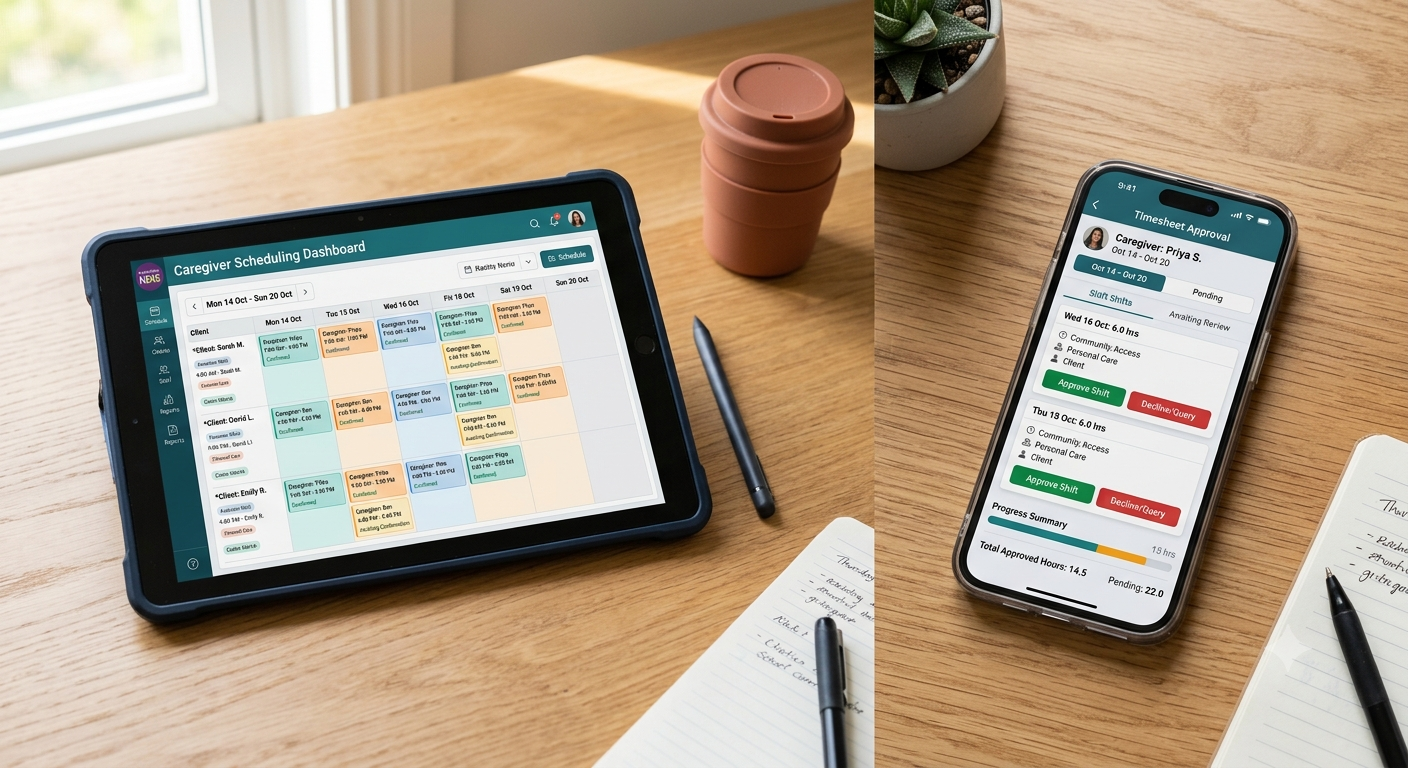
Error-free rostering will help you avoid last-minute changes. Use modern rostering tools like ShiftCare to ensure every participant’s services are scheduled. You can also invite external support coordinators to view clients’ upcoming services on ShiftCare Connect.
3. Publish Rosters Early
Full- and part-time workers must receive their rosters two weeks in advance. But the sooner you send out rosters, the easier you’ll find it to resolve any availability issues or organise casual cover.
4. Encourage Staff to Bid on Empty Shifts
Allowing NDIS workers to bid on shifts via a job board helps you quickly fill gaps in your roster. And, it means the extra work goes to staff that want additional hours.
SCHADS Award Compliance: Navigating Common Challenges
As an NDIS employer or manager, staying compliant with the SCHADS Award can feel overwhelming. The award’s numerous classifications, SCHADS award pay rates, and rules can easily lead to mistakes, even with the best intentions. The Fair Work Ombudsman provides current rates and compliance information to help ensure adherence to wage standards in the sector. Here are some common compliance issues and how technology can help:
1. Timesheets and Billing Requirements
Manual timesheets can be inaccurate and hard to verify, leading to errors in pay. Switching to digital scheduling and time-tracking tools ensures precise records and compliance with the award. It is also important to check timesheets for the latest ‘union won pay rise’ to ensure all entitlements are accurately reflected.
2. Incorrect Pay Classifications
With nine pay levels, assigning the correct classification is tricky. Misclassifications or outdated pay rates can result in underpayments. Automated payroll systems can help manage these classifications and keep everything up-to-date.
3. Managing Sleepover Shifts and Allowances
Sleepover shifts have specific rules around shift spans and allowances. Manual management often leads to mistakes. Automation ensures these shifts are managed correctly, avoiding non-compliance.
4. Handling Broken Shifts and Minimum Engagements
Employees are entitled to allowances for broken shifts, but manual management can result in errors. Digital tools ensure each part of a broken shift is paid correctly, and minimum engagement periods are met. Properly managing shifts is especially crucial in the supported independent living (SIL) sector, where providing essential services and assistance during crises is vital. Broken shifts are common when undertaking disability services work and home care.
5. Ensuring Adequate Time Between Shifts
The SCHADS Award mandates a minimum of 10 hours off between shifts. Manual rostering can accidentally breach this rule, leading to underpayments. Automated scheduling helps ensure workers get the rest they need and are paid fairly.
6. Calculating Annual Leave for Shift Workers
Shift support workers often accrue additional leave, which can be complex to calculate. Missing out on these entitlements can lead to underpayments. Automated tracking and payroll systems can manage these calculations accurately.
7. Keeping Accurate Records
Accurate record-keeping is essential for compliance, but paper records are prone to errors. Digital records ensure transparency and reduce the risk of non-compliance.
Remote Work and Superannuation
Remote Work Considerations
The SCHADS Award has introduced provisions for remote work, reflecting the evolving nature of the community services sector. Remote work refers to tasks performed by an employee from a location other than the employer’s premises, such as from home. This flexibility is crucial for many employees, especially in roles that can be effectively managed outside traditional settings.
Under the SCHADS Award, employers are required to compensate employees for the time spent performing remote work. The minimum payments are structured as follows:
- 1 hour for each day worked remotely.
- 2 hours for each day worked if the employee is required to perform remote work for more than 4 hours.
The compensation for remote work is generally paid at the employee’s minimum hourly rate. However, there are specific conditions where higher rates apply:
- Outside Standard Hours: Remote work performed outside the span of 6am to 8pm is paid at 150% of the minimum hourly rate for the first two hours and 200% thereafter.
- Overtime: Remote work exceeding 38 hours per week or 76 hours per fortnight is paid at the applicable overtime rate.
- Extended Days: Remote work exceeding 10 hours in a single day is paid at 150% of the minimum hourly rate for the first two hours and 200% thereafter.
- Weekends and Public Holidays: Remote work on Saturdays is paid at 150%, on Sundays at 200%, and on public holidays at 250% of the minimum hourly rate.
These provisions ensure that employees are fairly compensated for their time and effort, regardless of where the work is performed.
Superannuation Obligations
Superannuation is a critical component of employee benefits, ensuring financial security in retirement. Under the SCHADS Award, employers are mandated to make superannuation contributions on behalf of their employees. The current requirement is to contribute 10.5% of an employee’s ordinary time earnings to a superannuation fund.
This contribution is in addition to the employee’s salary and is a non-negotiable aspect of the award. Ensuring timely and accurate superannuation contributions is not only a legal obligation but also a vital part of supporting employees’ long-term financial well-being.
Higher Duties
Understanding Higher Duties and Responsibilities
Higher duties occur when an employee is required to perform tasks at a higher classification level than their usual role. This situation often arises when an employee is asked to relieve in a higher-classified position or take on responsibilities beyond their standard duties.
For home care employees, the SCHADS Award specifies that if they are engaged in higher duties for a period of two hours or less, they are paid the higher rate only for the time worked. However, if the period extends beyond two hours, they are entitled to the higher rate of pay for the entire day or shift.
For all other employees, if they are required to relieve the duties of a higher classified employee for a period of five consecutive working days or more, they must be paid at the higher rate for the entire period. This ensures that employees are fairly compensated for the additional responsibilities and skills required to perform higher-level tasks.
Understanding and correctly applying the provisions for higher duties is essential for employers. It ensures that employees are recognized and rewarded for their contributions, maintaining fairness and compliance within the workplace.
Best Practices for Employers
- Review pay rates and allowances to align with the latest SCHADS Award updates.
- Conduct routine compliance audits to ensure proper application of allowances and entitlements.
- Use third-party auditors or legal advisors to identify potential risks and errors.
Train HR and Payroll Teams
- Provide ongoing training on award interpretation and compliance.
- Educate managers on rostering requirements, minimum rest breaks, and overtime entitlements.
- Implement structured onboarding for new HR/payroll personnel to ensure consistent compliance.
Use Digital Timesheets
- Implement automated time-tracking to reduce manual errors and prevent time theft.
- Ensure digital timesheets integrate with payroll software to streamline processing.
- Keep records for at least 7 years to comply with Fair Work regulations.
Engage Employees in Compliance
- Encourage staff to review their payslips regularly and report discrepancies promptly.
- Maintain open communication about award changes and entitlements through staff meetings and training sessions.
- Develop an employee handbook outlining key SCHADS Award provisions, ensuring all workers understand their rights.
- Establish an anonymous reporting system for employees to raise payroll or compliance concerns without fear of retaliation.
ShiftCare’s SCHADS Award Interpretation
By integrating these features, ShiftCare streamlines employee rostering and upholds SCHADS Award compliance, protecting your business from potential breaches.The Role of Technology in Simplifying SCHADS Award Compliance
Automation is key to simplifying SCHADS Award compliance. Tools like ShiftCare integrate payroll and workforce management, ensuring accurate scheduling, pay rates, and allowance calculations. By reducing the risk of errors, automation helps NDIS providers avoid underpayments and costly penalties.
With the right technology in place, NDIS providers can focus on what matters most—delivering quality care—while ensuring their staff are treated fairly and paid correctly.
By understanding these aspects of the SCHADS Award, employers can better navigate its complexities and ensure they provide fair, compliant, and supportive working conditions for their carers.
ShiftCare’s automated simplifies SCHADS Award compliance, helping you manage pay points, shift allowances, and support workers without the hassle.
Stay compliant and keep your focus on delivering quality care—explore how ShiftCare can streamline your operations today.
Sign up for a free 7-day trial with ShiftCare today
Want to more information about the SCHADS Award? Explore the resources we’ve gathered for you on our website.
1. Unlocking SCHADS Award Success: Mastering Compliance with Xero
2. Achieve Complete SCHADS Compliance with Pay Cat and ShiftCare
3. Staying Up to Date: SCHADS Award and HR Compliance
1. Comprehensive SCHADS Award Guide for ShiftCare Users
Top SCHADS Award FAQs for Employers in the Community Services Sector
Here are some frequently asked questions about the SCHADS Award:
What is the SCHADS Award?
The SCHADS Award sets minimum employment standards for workers in social, community, home care, and disability services.
Who does the SCHADS Award apply to?
It applies to workers in crisis assistance, supported housing, social services, home care, and disability support roles.
How are workers classified under the SCHADS Award?
Workers are classified into levels based on their duties and experience, with pay points reflecting their progression.
How can employers ensure SCHADS Award compliance?
Employers and support workers can use tools like ShiftCare to manage payroll, scheduling, and compliance, ensuring accurate adherence to the award.
How does ShiftCare simplify SCHADS Award payroll calculations?
ShiftCare automates SCHADS Award payroll by factoring in overtime, penalty rates, and shift allowances. This reduces manual errors, ensures compliance, and helps providers manage wages efficiently.
What are the key challenges of managing SCHADS Award compliance?
The SCHADS Award has complex rules around overtime, penalty rates, shift breaks, and allowances, making compliance difficult for providers. Ensuring accurate payroll calculations and correct rostering is essential to avoid breaches.
Can ShiftCare assist with SCHADS Award reporting and audits?
Yes, ShiftCare’s reporting tools help track SCHADS Award compliance by logging shift details, allowances, and pay calculations, making audits and reporting easier for providers.
How does ShiftCare handle SCHADS Award shift variations like broken shifts and sleepovers?
ShiftCare allows providers to manage broken shifts, sleepovers, and split shifts while ensuring compliance with SCHADS Award rules, preventing payroll errors and incorrect allowances.
Why is SCHADS Award compliance important for NDIS and aged care providers?
Non-compliance with the SCHADS Award can result in penalties, wage disputes, and legal issues. Accurate payroll and shift management ensure staff are paid correctly, reducing risks for NDIS and aged care businesses.
Housing Sector Provisions
The SCHADS Award contains dedicated provisions for the housing sector, recognizing the unique demands placed on employees supporting individuals with housing needs. Employers operating within the housing sector must adhere to the Award’s specific requirements regarding classification levels, pay points, and hours of work.
Given the nature of housing services, employees may be rostered for flexible hours, including evenings and weekends, to ensure clients receive the support they need when they need it most. The SCHADS Award provides clear guidance on managing these flexible hours, ensuring that all employees are compensated fairly for any work performed outside standard hours. This includes overtime rates, penalty rates for weekend and public holiday work, and minimum engagement periods.
By following the SCHADS Award’s minimum employment standards, employers in the housing sector can ensure their workforce is treated fairly, remains motivated, and is protected from burnout. Staying compliant not only supports staff well-being but also helps maintain high-quality service delivery for clients in need of housing support.
Supported Housing Sector Provisions
The supported housing sector is a distinct stream within the SCHADS Award, designed to address the specific needs of employees working in supported housing services, such as crisis accommodation and assistance programs. These roles often require staff to be available for a variety of shifts, including overnight sleepovers and on-call duties, to provide continuous support to vulnerable clients.
The SCHADS Award sets out minimum employment standards for the supported housing sector, covering pay rates, hours of work, and leave entitlements. For example, employees working in crisis accommodation or supported housing services are entitled to allowances for sleepover shifts and must receive appropriate compensation for any work performed during these periods. The Award also ensures that employees receive adequate rest breaks and are not rostered for excessive hours, safeguarding both staff welfare and service quality.
Employers in the supported housing sector must be diligent in applying these provisions, as non-compliance can lead to significant penalties and undermine the well-being of both employees and clients. By understanding and implementing the SCHADS Award’s requirements for the supported housing sector, organisations can foster a fair, safe, and supportive working environment.
Resources and Support
Navigating the SCHADS Award can be complex, but a range of resources and support is available to help employers and employees in the community services sector stay informed and compliant. The Fair Work Ombudsman is a key resource, offering up-to-date information on the SCHADS Award, including pay rates, hours of work, and leave entitlements. Their website features tools such as pay calculators and guides tailored to the community services industry.
In addition to the Fair Work Ombudsman, industry associations and unions provide valuable advice and advocacy for both employers and employees. These organisations can assist with interpreting the SCHADS Award, resolving workplace issues, and ensuring that minimum employment standards are met. Employees are encouraged to reach out to their unions or employee associations for support in understanding their rights and entitlements.
By leveraging these resources, both employers and employees in the community services sector can work together to maintain fair treatment, uphold compliance with the SCHADS Award, and create a positive, supportive workplace culture.